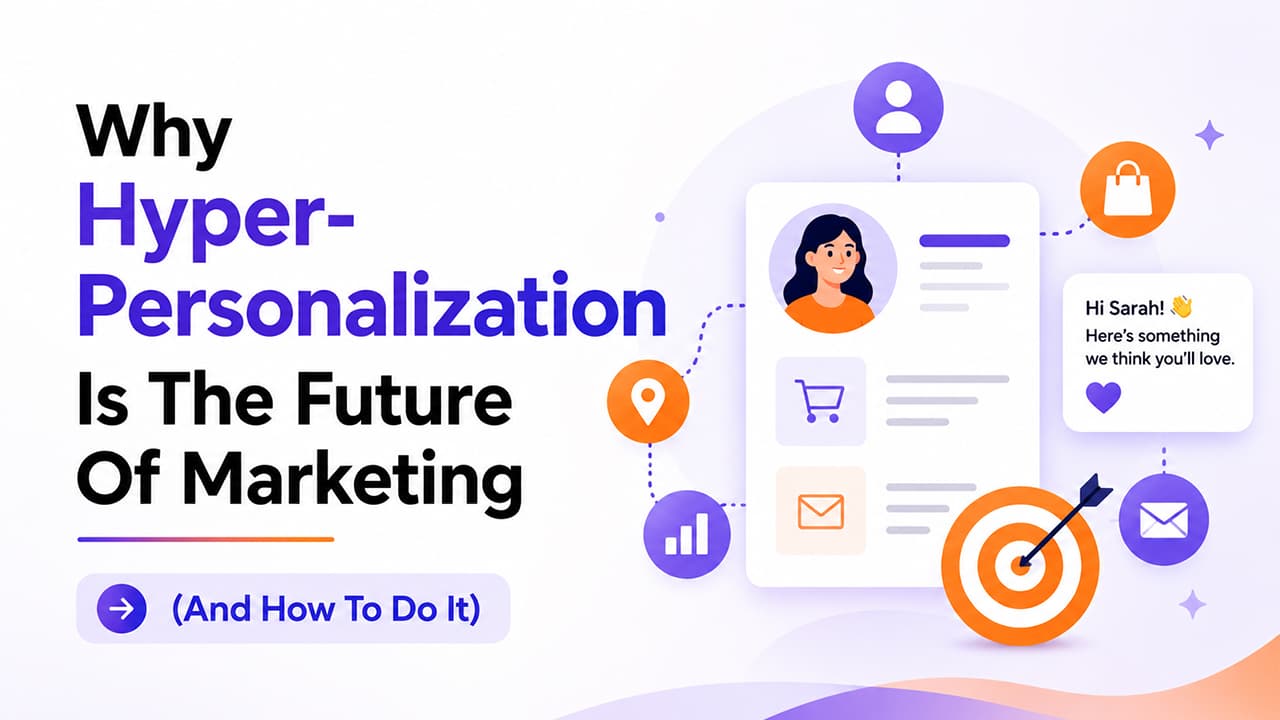
Customers today don't just appreciate personalized experiences — they expect them. Generic email blasts and one-size-fits-all ads are increasingly ignored, while brands that speak directly to individual needs are winning loyalty and revenue. Enter hyper-personalization: the next evolution of marketing that's changing how businesses connect with their audiences.
What is Hyper-Personalization and Why is it Important for Businesses?
Hyper-personalization is the use of real-time data, artificial intelligence, and behavioral analytics to deliver highly individualized content, product recommendations, and experiences to each customer. Unlike traditional personalization — which might use a customer's first name in an email — hyper-personalization digs into browsing history, purchase patterns, location, device usage, and even time of day to craft messages that feel tailor-made.
For businesses, this matters enormously. Customers are more likely to buy from brands that demonstrate they understand their needs. It builds trust, drives conversions, and fosters long-term loyalty.
Regular Personalization vs Hyper-Personalization
Traditional personalization works with static data — a name, a past purchase, a demographic segment. It's broad and reactive.
Hyper-personalization, on the other hand, is dynamic and predictive. It uses real-time behavioral signals to anticipate what a customer wants before they even search for it. Think of the difference between a store that remembers your name versus one that already has your favorite items waiting at the counter.
The Need for Hyper-Personalization
Consumer attention spans are shorter than ever, and competition for that attention is fierce. People are bombarded with hundreds of marketing messages daily — and most get tuned out. Hyper-personalization cuts through that noise by making every touchpoint relevant and timely. Additionally, with third-party cookies being phased out, brands must rely more on first-party data and intelligent personalization to maintain meaningful customer relationships.
How Hyper-Personalization Can Help Reduce Marketing Costs in the Long Run
At first glance, hyper-personalization seems resource-intensive — and it does require upfront investment in tools and data infrastructure. But the long-term returns are compelling. When messaging is highly relevant, click-through rates improve, cart abandonment drops, and customer lifetime value increases. Brands stop wasting budget on irrelevant audiences and instead focus spend where it genuinely converts. Over time, this precision translates into a significantly lower cost per acquisition.
How Brands are Using Hyper-Personalization
Amazon's Recommendation Engine
Amazon's "Customers who bought this also bought" engine is perhaps the most well-known personalization system in the world. By analyzing purchase history, search behavior, and browsing patterns across millions of users, it generates recommendations that account for roughly 35% of the company's total revenue.
Netflix's Personalized Viewing Experience
Netflix doesn't just recommend shows — it personalizes the artwork shown for each title based on your viewing habits. A user who watches a lot of romantic comedies will see different thumbnail art for the same film than someone who prefers thrillers. Every element of the interface is tuned to keep you engaged.
Spotify's AI-Powered Music Discovery
Spotify's Discover Weekly and Daily Mix playlists use machine learning to analyze listening habits, skips, saves, and even the time of day you listen. The result is a playlist that feels like it was curated by someone who knows you personally — because algorithmically, it was.
Sephora's Personalized Shopping Experience
Sephora combines in-store data, app usage, and purchase history to create a unified customer profile. Their app offers personalized product recommendations, restock reminders, and even virtual try-on features tailored to each user's skin tone and past purchases.
How to Start with Hyper-Personalization
Collect and Unify Customer Data
Start by bringing together data from all touchpoints — website behavior, email engagement, purchase history, social media interactions, and customer service records — into a single customer data platform (CDP). A fragmented data picture leads to fragmented personalization.
Segment Audiences Based on Behavior
Move beyond demographic segments. Group customers by what they do: what they browse, what they abandon, how often they buy, and what content they engage with. Behavioral segmentation forms the foundation of truly relevant messaging.
Use AI and Automation Tools
AI-powered platforms like dynamic email tools, recommendation engines, and predictive analytics software do the heavy lifting. Tools such as HubSpot, Salesforce Marketing Cloud, Braze, or Klaviyo can help automate personalized experiences at scale without requiring manual effort for every interaction.
Personalize Across Multiple Channels
Consistency matters. A customer who sees a personalized product recommendation in an email should encounter the same product highlighted on your website and retargeted across social media. Omnichannel personalization creates a seamless experience that reinforces relevance at every step.
Track, Test, and Optimize Campaigns
Hyper-personalization is never truly "done." Continuously A/B test subject lines, content blocks, offers, and timing. Use the data you collect to refine your models and improve relevance over time.
Challenges of Hyper-Personalization
Data Privacy and Compliance
Collecting and using personal data comes with serious responsibilities. GDPR, CCPA, and other regional regulations require brands to be transparent about data usage and to give customers control over their information. Non-compliance can result in heavy fines and reputational damage.
Managing Large Volumes of Customer Data
The more data you collect, the more complex it becomes to manage, clean, and activate. Businesses without robust data infrastructure may find themselves overwhelmed by the volume and velocity of behavioral data.
Maintaining Accuracy in Personalization
Poor data quality leads to poor personalization. Recommending a product someone already bought, or targeting a message to the wrong segment, can feel intrusive and damage trust rather than build it.
Best Practices for Effective Hyper-Personalization
Focus on Customer Intent
Look beyond who someone is and focus on what they're trying to accomplish right now. Intent signals — like what someone is actively searching for or comparing — are far more actionable than demographic data alone.
Balance Personalization with Privacy
Be transparent. Tell customers what data you collect and why, and make it easy for them to manage their preferences. Personalization built on trust is far more durable than personalization that feels invasive.
Deliver Real-Time Experiences
The window of relevance is narrow. A personalized offer delivered the moment a customer is browsing a product category is exponentially more effective than the same offer sent 48 hours later.
Avoid Over-Personalization
When personalization goes too far — referencing too many specific behaviors or appearing to "know too much" — it can feel creepy rather than helpful. Strike a balance that feels intuitive, not surveillance-like.
The Future of Hyper-Personalization in Marketing
The future is predictive and increasingly invisible. As AI models become more sophisticated, personalization will move from reactive (responding to what customers do) to anticipatory (predicting what they'll want next). Emerging technologies like generative AI will allow brands to create entirely unique content for individual users at scale — personalized landing pages, custom video ads, and dynamic product bundles that shift in real time. Voice, AR, and IoT devices will add entirely new data streams, making personalization more contextual and immersive than ever before.
Summing It Up
Hyper-personalization isn't a trend — it's a fundamental shift in how marketing works. Customers have moved past tolerating generic communication; they now reward the brands that truly understand them. By investing in the right data infrastructure, AI tools, and customer-first strategies, businesses of all sizes can deliver experiences that feel personal, timely, and genuinely valuable. The brands that embrace this shift now won't just stay competitive — they'll define what great marketing looks like in the years ahead.