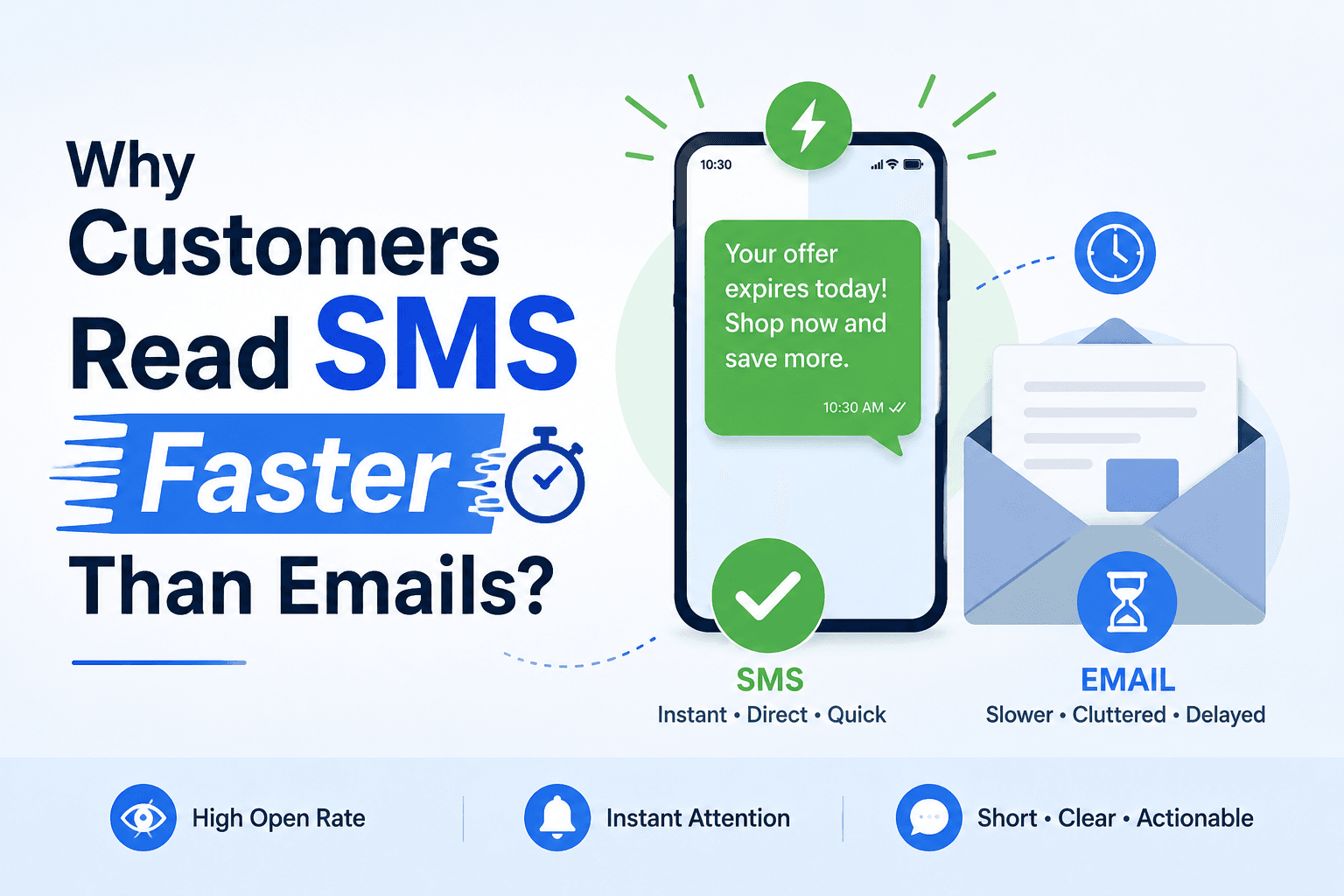
Every business wants its message to be seen the moment it's sent. Yet not every channel delivers on that promise. Email, for decades the backbone of business communication, often sits unread for hours or even days. SMS, on the other hand, tends to get noticed almost instantly. This gap in engagement isn't accidental — it's rooted in how people use their phones, how inboxes have become cluttered, and how human attention naturally gravitates toward short, direct messages. Understanding why SMS outperforms email in speed and attention can help businesses rethink how they reach their customers.
How Do SMS and Email Engagement Rates Compare?
When you place SMS and email side by side, the numbers tell a clear story. SMS consistently wins on speed and visibility, while email struggles to compete for attention in a crowded inbox.
SMS Open Rates vs Email Open Rates
SMS messages are typically opened within minutes of being received, and open rates for text messages are dramatically higher than those for email. Most people check a text message almost as soon as their phone buzzes, simply because notifications feel personal and urgent. Email, by contrast, often gets left unopened, buried under promotional clutter, newsletters, and workplace messages that compete for the same limited attention span.
Why Do Customers Ignore Emails?
Inboxes have become noisy places. The average person receives dozens, sometimes hundreds, of emails a day, and most of them are not urgent. Over time, customers develop a kind of filter in their minds, scanning subject lines quickly and archiving or deleting anything that doesn't immediately seem important. This habit means even well-crafted marketing emails can go unnoticed.
Common Reasons Emails Are Ignored
A few patterns show up again and again. Emails land in spam or promotions folders where they're never seen. Subject lines fail to stand out among dozens of similar messages. Customers associate email with less time-sensitive information, so they postpone reading it. And many people simply check email less frequently than they check their phone for texts, especially outside of work hours.
Why Is Mobile-First Communication Changing Customer Behaviour?
As smartphones have become central to daily life, customer expectations around communication have shifted. People no longer want to wait for information — they want it now, and they want it where they already are: on their phone screen.
Are Customers Spending More Time on Mobile Devices?
Mobile usage has grown steadily, with people checking their phones dozens of times a day for everything from social media to banking to messaging. This constant engagement with mobile devices means that any message delivered directly to the phone, especially as a text, has a far greater chance of being seen quickly compared to something sitting in an email inbox that requires opening an app or logging into a browser.
Why Do SMS Messages Feel More Immediate?
Text messages carry a sense of urgency that email simply doesn't replicate. Notifications for SMS typically appear directly on the lock screen, are short enough to read at a glance, and don't require sorting through other content. This immediacy trains customers to treat texts as important, time-sensitive communication, which is exactly why businesses see faster responses through SMS than through email.
How Can Businesses Use SMS Marketing More Effectively?
Given these behavioural patterns, businesses have a real opportunity to improve how they connect with customers by weaving SMS into their broader communication strategy.
What Types of Businesses Benefit Most from SMS?
Businesses that rely on time-sensitive updates tend to benefit the most from SMS. This includes retailers running flash sales, healthcare providers sending appointment reminders, delivery and logistics companies providing real-time updates, and service-based businesses confirming bookings or offering support. Any business where timing matters can see a noticeable improvement in customer engagement through text-based communication.
How Can SMS Improve Customer Response Rates?
Because SMS messages are read quickly, they naturally lead to faster customer responses. A short, clear text with a simple call to action, such as confirming an appointment or claiming a limited-time discount, tends to prompt an immediate reaction. This speed can translate directly into higher conversion rates, fewer missed appointments, and stronger customer satisfaction overall.
Is Email Still Important for Business Communication?
Despite SMS having the edge in speed, this doesn't mean email has become irrelevant. Email still plays a critical role, particularly for communication that requires more detail, context, or documentation.
Should Businesses Stop Using Email Marketing?
Not at all. Email remains ideal for newsletters, detailed product information, invoices, and long-form content that wouldn't fit into a text message. It's also more cost-effective for reaching large audiences with visually rich content. The smarter approach isn't choosing one channel over the other, but understanding when each one serves the customer best.
What Is Email to SMS and Why Is It Useful?
One way businesses are bridging these two channels is through a feature known as email to SMS, which allows an email to be automatically converted and delivered as a text message.
How Does Email to SMS Work?
Typically, email to SMS works by sending an email to a special address tied to a recipient's phone number and mobile carrier, which then converts the message into a text. Businesses use this to make sure critical information, like appointment reminders or urgent alerts, reaches customers through their phone even if the original communication started as an email. It's a practical way to combine the reach of email systems with the immediacy of SMS.
How Can Businesses Build a Strong SMS Strategy?
To make the most of SMS, businesses should start by identifying which messages are truly time-sensitive and reserving text messaging for those. Keeping messages short, clear, and action-oriented helps maintain the immediacy customers expect from SMS. It's also important to gain proper consent before texting customers and to avoid overusing the channel, since too many messages can lead to opt-outs. Segmenting audiences and personalising messages, even briefly, can further improve response rates. Finally, businesses should track metrics like response time and conversion rate to continually refine their approach.
Conclusion
SMS and email each serve a distinct purpose in modern customer communication, but when it comes to speed and attention, SMS clearly has the advantage. Customers read text messages almost immediately, while emails often sit unopened amid inbox clutter. This doesn't mean email should be abandoned — it still holds value for detailed, less urgent communication. The real opportunity lies in using both channels strategically: relying on SMS for time-sensitive, action-driven messages and email for richer, more detailed content. Businesses that understand this balance, and make use of tools like email to SMS to connect the two, will be better positioned to capture customer attention and drive faster, more meaningful engagement.