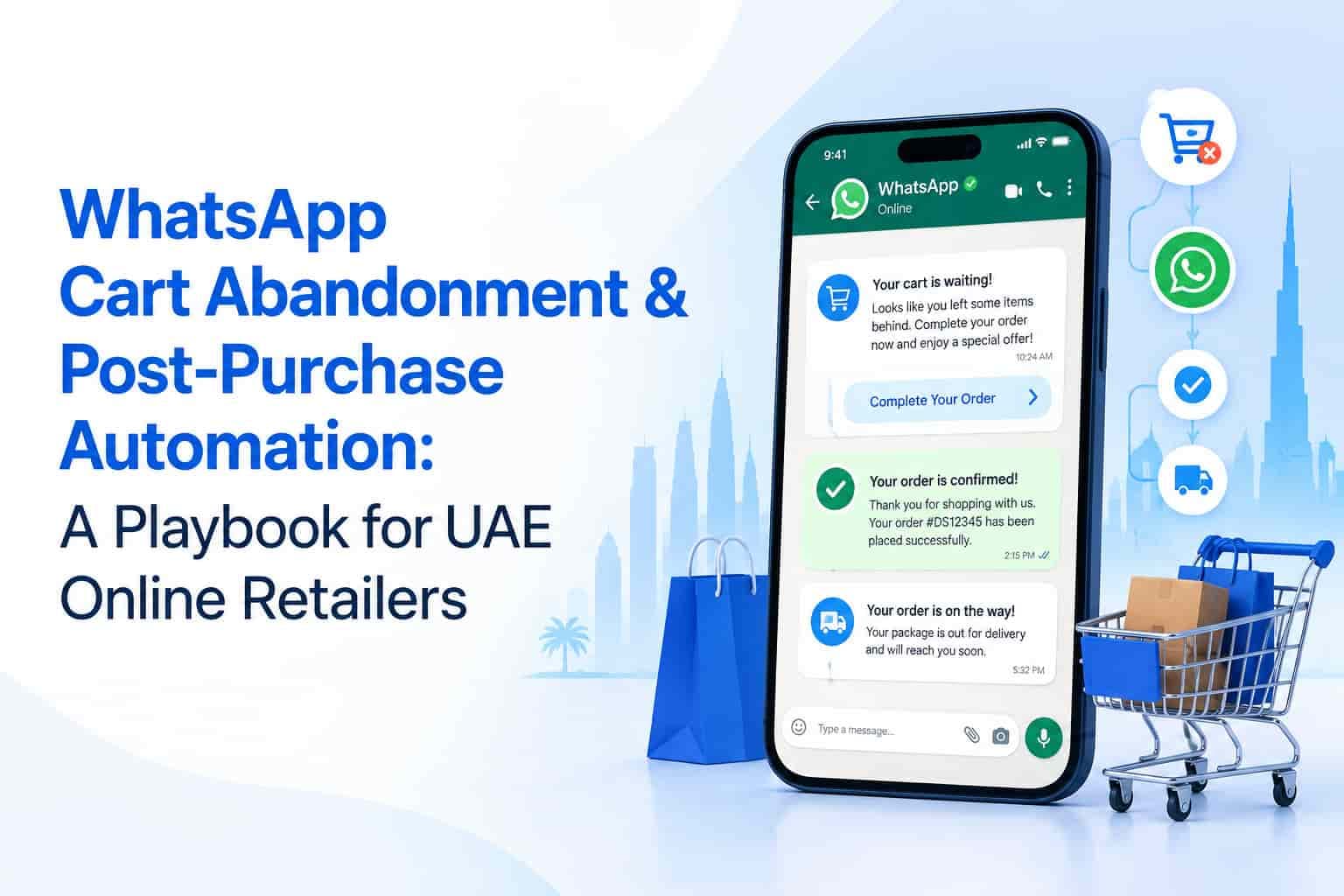
WhatsApp isn't just a channel for order updates — for UAE shoppers who already browse and ask questions there, it's often a more natural place to recover an abandoned cart than email or even SMS. The rich media, buttons, and conversational format make it possible to remind a customer of exactly what they left behind and let them complete the purchase without leaving the chat.
Why WhatsApp Outperforms Email for This Use Case in the UAE
Read speed: WhatsApp messages are typically opened far faster than email, especially among UAE's heavily mobile-first shopper base.
Visual context: A product image and price directly in the message jog memory better than a text-only link.
Two-way capability: A customer can ask a quick question ("is this still in stock?") right in the same thread instead of abandoning the recovery flow entirely to search elsewhere.
Building the Cart Recovery Flow on WhatsApp
1. Trigger and Template Requirements
A cart abandonment reminder sent proactively (not in response to a customer message) requires a pre-approved WhatsApp utility template, since it's tied to an existing transaction interest rather than being unsolicited marketing. Templates need Meta approval before use, so build and approve your cart-recovery templates in advance rather than during a campaign launch.
2. Timing the Sequence
First message: 1-2 hours after abandonment, showing the exact item(s) left in the cart.
Second message: 24 hours later, potentially with a small incentive, using a distinct approved template.
Final message: 48-72 hours later, framed around urgency (limited stock or an expiring offer).
3. Design for the Reply, Not Just the Click
Unlike SMS, WhatsApp lets the customer respond directly — "still interested but have a question," "wrong size," "just browsing." Route these replies to either an automated FAQ flow or a live agent rather than letting a genuine question go unanswered in an automated sequence.
Post-Purchase Automation: Beyond the Sale
Delivery and Fulfillment Updates
Utility templates confirming dispatch, delivery windows, and delivered status keep the customer informed in the same thread where they placed the order — no app-switching required.
Review Requests
Sent a few days after delivery (giving time for the product to actually be used), a simple "how was your order?" message with a direct review link or in-chat star rating captures feedback while it's still fresh.
Replenishment and Repeat-Purchase Prompts
For consumable or subscription-style products (skincare, groceries, supplements), a well-timed "running low?" message based on typical usage cycles can recover repeat purchases without the customer needing to remember to reorder.
Loyalty and Milestone Messages
Marking a customer's first anniversary with the brand, a purchase milestone, or a birthday (where data is available and consented to) builds relationship value beyond pure transaction recovery.
Cost Awareness Under the 2026 Pricing Model
Since October 2026, Meta bills WhatsApp messages per category and destination, with service (free-form) messages now billable beyond each number's 1,000 free monthly allowance. Utility templates used for cart recovery and post-purchase flows are billed at utility rates — factor this into your recovery campaign's ROI calculation alongside the recovered revenue it generates, rather than assuming the channel is free once template approval is done.
Sample WhatsApp Recovery & Post-Purchase Templates
Cart reminder (utility template): Hi [Name], you left [Product] in your cart 🛒 Still want it? Tap below to complete your order.
Delivered + review request: Your order arrived! 📦 We'd love to know what you think — tap below to leave a quick review.
Replenishment prompt: Hi [Name], based on your last order, you might be running low on [Product]. Reorder in one tap: [link]
Frequently Asked Questions
Can I send a cart reminder as a free-form WhatsApp message?
Only if the customer messaged you within the last 24 hours (the active customer service window). Otherwise, a proactive reminder must use an approved template, typically categorized as utility.
How is a WhatsApp cart reminder different from an SMS one, compliance-wise?
WhatsApp messaging runs under Meta's Business Platform policies and template approval process rather than TDRA's SMS sender ID and AD- prefix rules, though general consent and opt-out expectations still apply.
Should post-purchase messages always include an offer?
No — a delivery confirmation or review request works best kept purely functional. Save any discount or cross-sell offer for a separate, clearly optional follow-up message.
What's a realistic timeline to get cart-recovery templates approved?
Template approval through Meta is usually processed within a short window (often under 24 hours for straightforward, policy-compliant templates), but building this in ahead of a campaign launch avoids delays affecting a live promotion.
Conclusion
WhatsApp's combination of high open rates, rich media, and two-way conversation makes it one of the most effective channels UAE retailers have for recovering abandoned carts and deepening post-purchase relationships — provided the templates are approved in advance, the sequence is timed thoughtfully, and the 2026 per-message costs are factored into what counts as a genuinely profitable recovery flow.