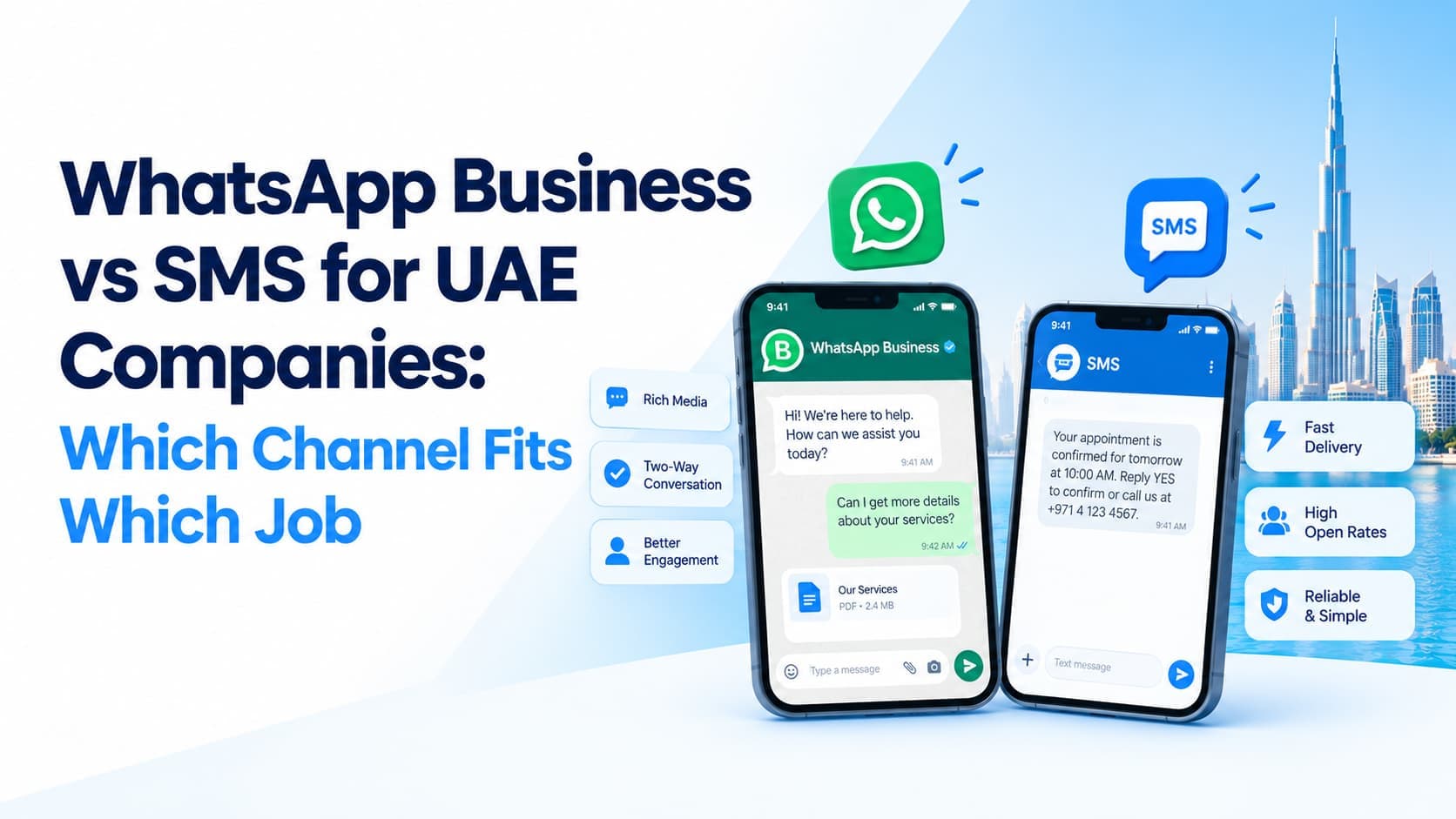
In the UAE, WhatsApp is part of daily life for personal and business communication. SMS, meanwhile, reaches every mobile phone without needing an app or an internet connection. Rather than picking a winner, smart businesses understand what each channel does best and use them together. This guide compares the two on reach, rules, format, interaction and cost, and explains how to combine them so that customers get the right message in the right place.
Reach and Accessibility
SMS works on any phone with a mobile connection, from the newest smartphone to a basic handset, and it does not depend on a data plan or Wi-Fi. That makes it uniquely dependable for reaching everyone, including visitors with limited roaming data and customers who rarely use messaging apps. WhatsApp requires the recipient to have the app installed and to be online, and the business must hold the contact's number and have appropriate permission to message them. Within its user base, however, WhatsApp commands very high daily engagement.
Rules and Permissions
Both channels are governed by rules that protect users from unwanted messages. In the UAE, SMS requires registered sender IDs and approved templates under telecom regulatory requirements, and promotional content is subject to consent and timing expectations. The WhatsApp Business Platform requires businesses to use pre-approved message templates when starting conversations outside the customer service window, and it classifies messages into categories that affect how they are charged.
In both cases, marketing messages need clear consent from the customer, and you should keep records of when and how it was given. Rules and platform policies evolve, so confirm the current requirements with your provider before designing a campaign.
Content and Format
Standard SMS is plain text, usually with a link, and its length limits mean messages need to be concise. WhatsApp supports images, documents, buttons, product catalogs, location sharing and longer messages, which makes it far better suited to product discovery, detailed instructions and visual content. If you want customers to see a product photo, download an invoice or tap a button to confirm a booking, WhatsApp provides a richer experience in a single thread.
Interaction and Conversation
WhatsApp is naturally conversational. Customers expect to reply, ask follow-up questions and receive answers in the same thread, and many are comfortable sending voice notes and photos. SMS can support two-way conversations too, but most people still treat it as a notification channel, and two-way flows are typically limited to keywords and short replies. If your business depends on back-and-forth discussion, such as sales enquiries or customer support, WhatsApp usually fits better.
Cost Considerations
Pricing models differ. SMS is generally charged per message segment, with costs influenced by volume, message category and route quality. WhatsApp Business Platform pricing depends on the type of message or conversation, and the structure has changed several times as the platform evolved. Because of this, compare current rate cards from your provider rather than relying on general comparisons. Also consider the full picture: a more expensive message that produces much higher conversion can cost less per sale than a cheaper one that is ignored.
When SMS Is the Better Choice
SMS shines wherever universal reach and speed matter most. One-time passwords and critical alerts must arrive quickly for every customer, regardless of app usage or data availability. Simple reminders and confirmations are easily handled in a short text, and broad announcements to your entire opted-in list benefit from SMS's near-universal coverage. It is also a dependable fallback when other channels fail.
When WhatsApp Is the Better Choice
WhatsApp excels when the interaction is richer or more conversational. Customer support, sales conversations, product catalogs, invoices, booking details and order tracking with interactive buttons all work well on the platform. It is also effective for re-engaging customers who have already messaged your business, because the conversation history stays visible and the relationship feels personal.
Using Both Together
The strongest strategies combine the channels instead of treating them as rivals. One practical approach is to send a message on the preferred channel and fall back to the other if it is not delivered. For example, you might send an order update through WhatsApp and switch to SMS if the customer cannot be reached there. Another approach uses SMS to invite customers to continue the conversation on WhatsApp for support or product discussions. Whichever method you choose, keep the content consistent across channels so that customers never feel confused.
Consent Is Channel-Specific
Permission to send SMS does not automatically cover WhatsApp, and the reverse is also true. Collect and record consent separately for each channel, explain clearly what customers will receive, and make opting out simple on both. Respecting channel preferences also improves results, since customers who choose their favorite channel tend to engage more.
Test With Your Own Audience
General comparisons only go so far. Run a small experiment by splitting a segment between channels with the same offer, then compare delivery, response and conversion. Residents, tourists and business customers may behave quite differently from industry averages, and your own data is the best guide to the right balance.
Conclusion
WhatsApp and SMS complement each other. Use SMS for universal reach and critical notifications, WhatsApp for rich, conversational engagement, and combine them with sensible fallbacks. Keep consent clear, test with your own audience and refine over time. Businesses that treat the two channels as parts of a single communication strategy give customers convenience and reliability, and that combination is hard for competitors to match.