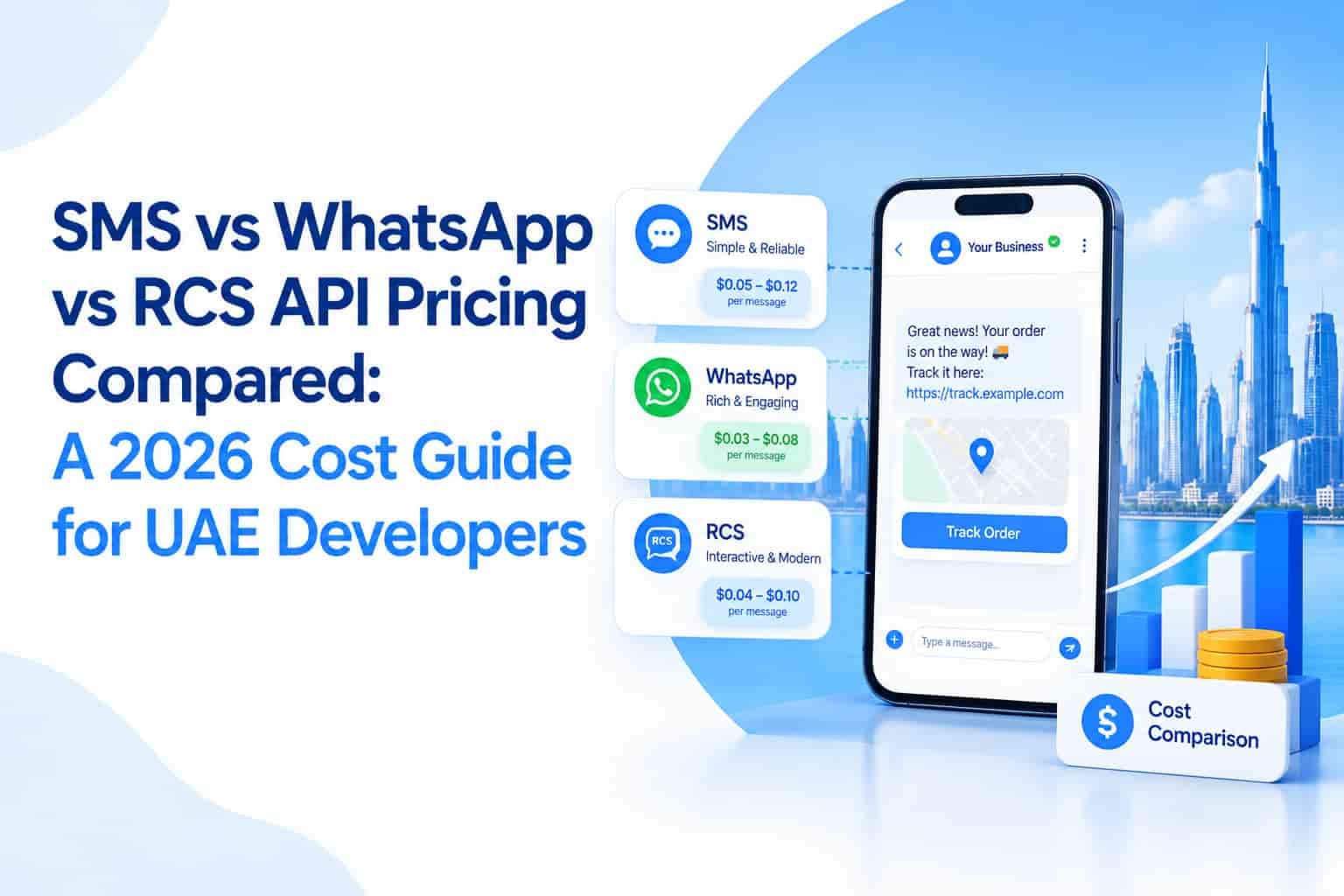
When a Dubai business scopes a new messaging integration, the technical decision (which API, which provider) usually comes second to the financial one: what will this actually cost at scale? SMS, WhatsApp, and RCS each price messaging differently in 2026, and the "cheapest" channel depends heavily on message type, volume, and destination — not just a flat per-message rate.
SMS API Pricing: Predictable, Per-Segment
SMS remains the most straightforward to budget: pricing is typically per message segment (a standard 160-character segment, with longer messages split into multiple billed segments), varying mainly by destination country and route quality. For UAE-registered sender IDs sending to local numbers, this is generally the lowest and most predictable cost per message of the three channels — though international routes and roaming numbers can raise costs and affect delivery speed.
What Affects SMS Cost
Destination (domestic UAE vs. international)
Message length (each 160-character segment is billed separately for standard SMS)
Sender ID type (registered alphanumeric IDs vs. shared/shortcode numbers)
Route quality/tier chosen from your SMS API provider
WhatsApp Business API Pricing: Category-Based, Per Message (2026 Model)
Meta's pricing changed materially as of 1 October 2026. The platform now bills per business message sent, based on message category and the recipient's destination country, across six categories:
Marketing templates — promotional campaigns, generally the highest-cost category.
Utility templates — transactional updates tied to a specific customer action (order status, appointment reminders).
Authentication templates — OTPs and identity verification.
Authentication-International — verification messages to certain countries, billed at premium rates.
Service messages — free-form replies from a human agent or bot, now billable at utility rates beyond a free allowance.
Meta Business Agent — AI-generated responses sent on a business's behalf.
Each WhatsApp Business phone number receives 1,000 free service messages per month before billing begins on that category — a meaningful change from the previous model, where any reply within the 24-hour customer service window was free regardless of volume. The 72-hour Click-to-WhatsApp ad entry point remains free, as do all incoming customer-initiated messages.
RCS API Pricing: Positioned Between SMS and WhatsApp
RCS Business Messaging pricing varies by aggregator and market, but generally sits between standard SMS and WhatsApp's template rates — reflecting its richer feature set (cards, carousels, verified sender) while still riding on carrier and Google RBM infrastructure rather than a fully separate app ecosystem. A key cost consideration: RCS messages that fall back to SMS (for unsupported devices) are typically billed at standard SMS rates for that portion of the send, so total campaign cost is a blend rather than a single flat rate.
A Practical Cost Comparison Framework
1. Map Message Type to Category First
Before comparing providers, classify what you're actually sending: OTP (authentication), order status (utility/transactional), or campaign (marketing/promotional). Cross-channel cost comparisons only make sense within the same message type.
2. Model Volume Against Free Allowances
WhatsApp's 1,000 free service messages per number per month can meaningfully offset costs for lower-volume support use cases, but scales quickly past that threshold for high-traffic accounts — model your expected monthly volume against it explicitly rather than assuming the free tier covers your use case.
3. Factor In Delivery Reliability, Not Just Sticker Price
The cheapest per-message rate isn't the cheapest overall if it comes with lower delivery rates or slower speeds that force resends or lost conversions — particularly for OTP and time-sensitive transactional messages.
4. Blend Channels Deliberately
Many UAE businesses run a layered approach — SMS for guaranteed-reach OTP and critical alerts, WhatsApp for rich, conversational engagement with opted-in customers, and RCS to modernize promotional SMS without a full channel switch — rather than picking one channel exclusively.
Sample Monthly Cost Modeling Approach
Example structure (illustrative, not fixed pricing): 10,000 OTP messages via SMS + 5,000 order-status utility messages via WhatsApp (within free allowance where applicable) + 2,000 promotional messages via RCS with automatic SMS fallback for unsupported devices. Total cost = (SMS OTP rate × 10,000) + (WhatsApp utility rate × messages beyond free allowance) + (blended RCS/SMS-fallback rate × 2,000).
Frequently Asked Questions
Which channel is cheapest for OTP specifically?
SMS is generally the lowest and most predictable cost for OTP delivery in the UAE, though WhatsApp's authentication template category is a competitive alternative, particularly for customers already highly engaged on WhatsApp.
Does RCS always cost more than SMS?
Not necessarily for every message — but the richer format typically carries a premium over plain SMS, offset partly by the fact that unsupported devices automatically fall back to standard SMS billing rather than failing to deliver.
How do I estimate WhatsApp costs under the new 2026 model?
Break down expected monthly messages by category (marketing, utility, authentication, service), subtract the 1,000 free service messages per number, and apply your provider's per-category, per-country rates to the remainder.
Should pricing alone decide which channel I use?
No — message type, audience reach, and the customer experience each channel delivers should weigh at least as heavily as raw cost, since a slightly more expensive channel that converts meaningfully better often produces a better overall return.
Conclusion
SMS, WhatsApp, and RCS each price messaging on a different logic — per-segment, per-category, and blended-with-fallback, respectively — which means there's no single "cheapest channel" answer that holds across every use case. UAE developers and marketers get the best results by matching message type to the channel built for it, modeling volume against WhatsApp's 2026 free allowance, and treating channel selection as a blend rather than a single decision.