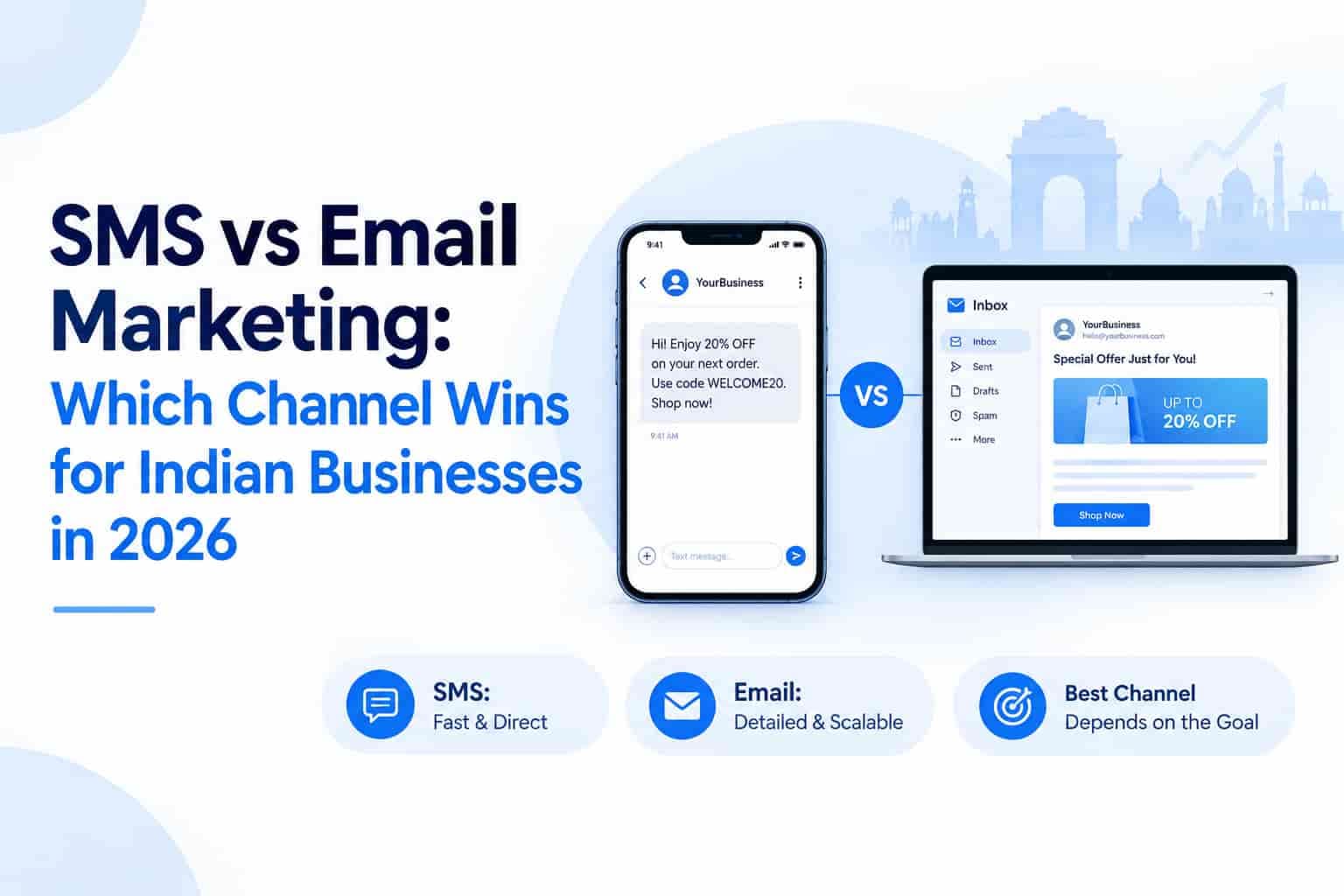
Two Channels, Two Very Different Strengths
Marketers often frame SMS and email as competitors, but they're better understood as tools built for different jobs. Bulk SMS wins on speed and visibility; email wins on depth and content richness. Choosing correctly for each campaign — rather than defaulting to one channel out of habit — is what actually improves ROI across a marketing budget.
Open Rates and Speed: SMS Takes the Lead
Bulk SMS consistently achieves open rates around 98%, with most messages read within three minutes of delivery. Email, by comparison, averages open rates closer to 20%, and messages can sit unread for days or land in spam folders entirely, especially from senders without strong domain reputation. For anything time-sensitive — flash sales, OTPs, appointment reminders, delivery alerts — SMS is simply faster and more reliable, because it doesn't compete with an overflowing inbox for attention.
Where Email Still Has the Advantage
Email supports rich formatting, images, long-form content, and detailed product catalogs — none of which fit into a 160-character text. For newsletters, detailed offers, or storytelling-driven campaigns, email remains the better format, giving marketers room to explain a product, show multiple images, and include several calls to action within one message.
It's also generally cheaper per message at high volumes, since SMS carries a per-message carrier cost that email doesn't. For large lists where the content itself is complex or informational rather than urgent, email often delivers better cost efficiency, even with its lower open rate.
Cost Per Conversion: A More Useful Comparison
Open rate alone can be misleading. A more useful metric is cost per conversion, which accounts for both the sending cost and how effectively each channel drives the desired action. SMS often wins this comparison for urgent, high-intent moments — a flash sale ending in two hours, for instance — because its speed advantage directly translates into faster action, even though the per-message cost is higher.
Email tends to win cost-per-conversion for lower-urgency, higher-consideration purchases, where customers benefit from browsing detailed product information before deciding, something a short text simply can't provide.
Building a Combined Strategy
The strongest-performing Indian businesses don't choose one channel — they layer both:
SMS for time-critical alerts, OTPs, and short high-urgency offers
Email for detailed newsletters, catalogs, and nurture sequences
SMS as a follow-up to a low-engagement email campaign, reaching contacts who never opened the original message
Email as a receipt/summary after an SMS-driven transaction, providing a detailed record the customer can reference later
This combined approach captures the best of both: the immediacy of SMS and the depth of email, without over-relying on either channel for tasks it isn't well suited to.
Avoiding Channel Fatigue
Using both channels effectively also means avoiding redundant messaging — sending the identical offer via SMS and email on the same day often feels repetitive rather than reinforcing. Sequencing the two, such as an email announcement followed by an SMS reminder closer to a deadline, tends to perform better than simultaneous identical blasts across both channels.
Conclusion
There's no universal winner between SMS and email — the right choice depends entirely on the message's urgency and complexity. For time-sensitive, action-driving communication, bulk SMS's near-instant open rates make it the clear choice. For detailed, visually rich content, email still leads. Indian businesses that combine both channels strategically, sequencing rather than duplicating messages, consistently see stronger overall engagement and conversion than those relying on a single channel alone.