The Question Behind the Question
When businesses ask whether they should use RCS or SMS, they are usually really asking something more specific: will the richer experience of RCS pay for itself, or will plain SMS do the job? The honest answer depends on what a given message is meant to achieve, who is receiving it, and what happens if it does not arrive in its richest form. This guide gives you a practical way to decide, message by message, rather than choosing one channel for everything.
How the Two Channels Actually Differ
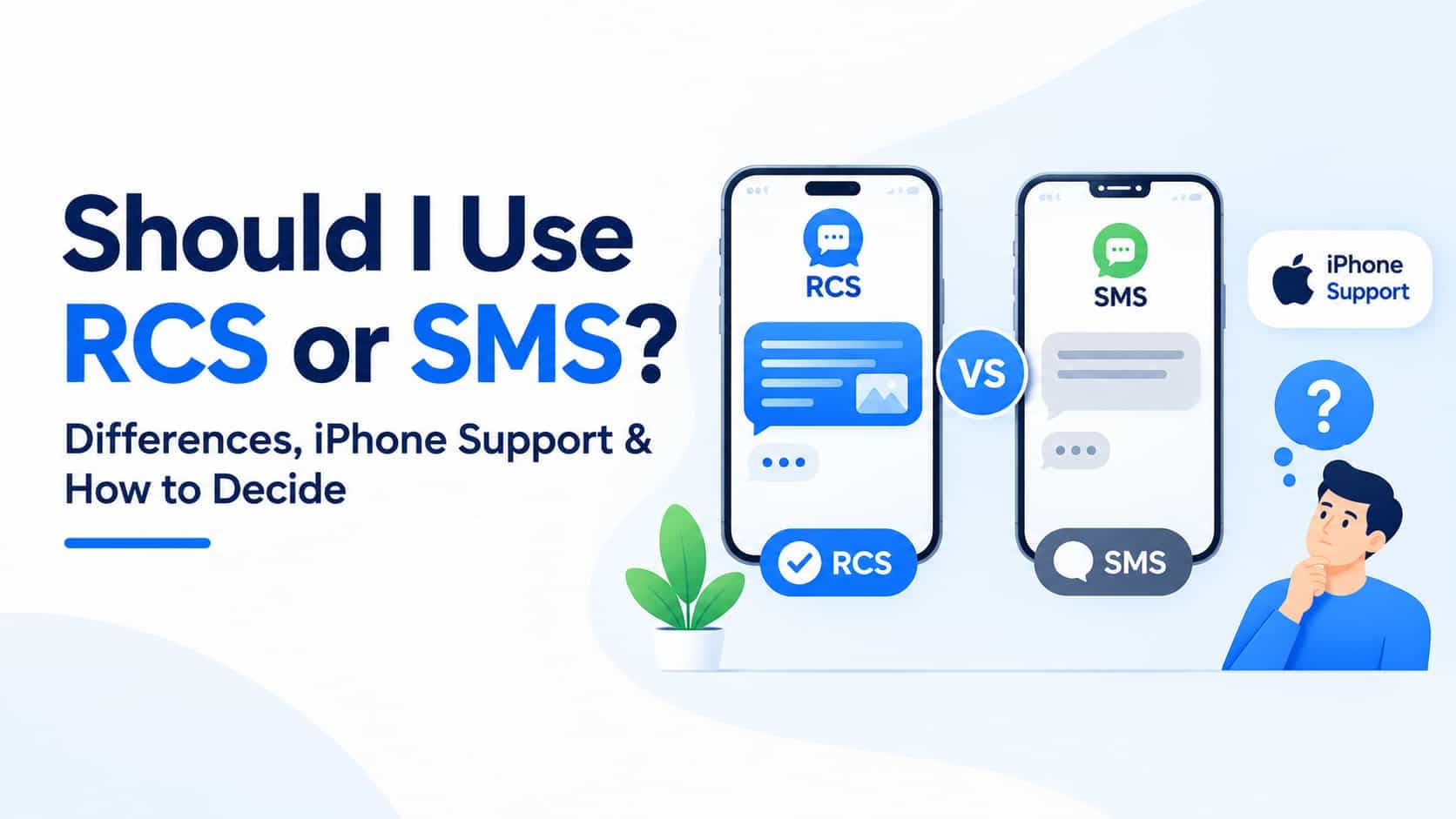
SMS is plain text, with 160 characters per segment in standard encoding. It needs no internet connection, works on virtually every handset, and is delivered through the mobile network itself. RCS, or Rich Communication Services, upgrades the phone's default messaging app. It supports images, video, carousels, tappable buttons, verified brand profiles, read receipts, and typing indicators, but it needs a data connection and a compatible phone, operating system, and carrier.
The practical consequence is that SMS wins on reach and certainty, while RCS wins on presentation and interactivity. Neither is better in the abstract. They are better at different jobs.
What About iPhone?
RCS support on iPhone has historically been a major limitation, since a large share of customers in many markets use iPhones. Apple has added RCS support to its messaging app, which narrows the gap, but availability still depends on iOS version, region, and carrier arrangements, and business messaging rollout is not identical everywhere. For planning purposes, assume that some portion of your audience, including some iPhone users, may still receive the SMS fallback rather than the RCS version, and confirm current support for your target markets with your provider before building a campaign around rich features.
A Practical Decision Checklist
Ask four questions about each message. First, is it time-critical and must it arrive regardless of device or connection? If yes, SMS is the safer primary channel. One-time passwords, payment confirmations, and urgent delivery alerts belong here. Second, does the message benefit from images or an interactive action? A fashion launch, a restaurant booking, or a boarding pass are strong candidates for RCS. Third, is your audience mixed or unknown? If you cannot tell which devices they use, plan for fallback. Fourth, does the cost difference matter at your volume? Rich messages are typically priced differently from plain SMS, so compare actual rates with your provider.
Three Scenarios Compared
Consider a bank sending a transaction alert. The content is a few words, the stakes are high, and delivery certainty matters most, so SMS is the right choice and RCS adds little. Consider a clothing retailer launching a new collection. A swipeable carousel with product images and a "Shop now" button gives customers a faster path to purchase than a text with a link, so RCS with SMS fallback is a reasonable choice. Consider a clinic reminding patients of appointments. A short SMS reminder with a reply keyword to confirm works well, and an RCS version with a "Reschedule" button is a pleasant upgrade for those whose phones support it. In each case the decision followed from the message, not from loyalty to a channel.
Designing the Fallback Properly
If you send RCS with SMS fallback, write the SMS version deliberately. It must carry the essential offer and a link or reply instruction in plain text, because some recipients will see only that. A common mistake is to design a beautiful rich card and then let the fallback be an afterthought. Test both versions on real devices before sending to your list.
Common Mistakes
Businesses often assume rich automatically means better, then use RCS for simple alerts where it adds nothing. They also forget that brand verification and sender approval may be required for RCS, which takes time, so launching on short notice fails. Another frequent mistake is measuring RCS and SMS performance on different audiences and then drawing conclusions from the mismatch. To compare fairly, send both to comparable, randomly split groups.
Frequently Asked Questions
Will RCS replace SMS?
Not in the near term. SMS remains the universal fallback and the default for authentication and critical alerts, and RCS coverage is still uneven.
Is RCS more expensive?
Pricing varies by provider, country, and message type, so ask for a current rate card rather than assuming.
Do customers need to install anything?
No. RCS works inside the phone's default messaging app, provided the device, software, and carrier support it.
Conclusion
The most useful way to choose between RCS and SMS is to stop treating it as a one-time decision. Use SMS where reach and certainty matter most, use RCS where visuals and one-tap actions improve results, and combine them with a carefully written fallback so no customer is left out. Test on a small, comparable audience, measure the difference, and expand RCS to the campaigns where it genuinely earns its place.