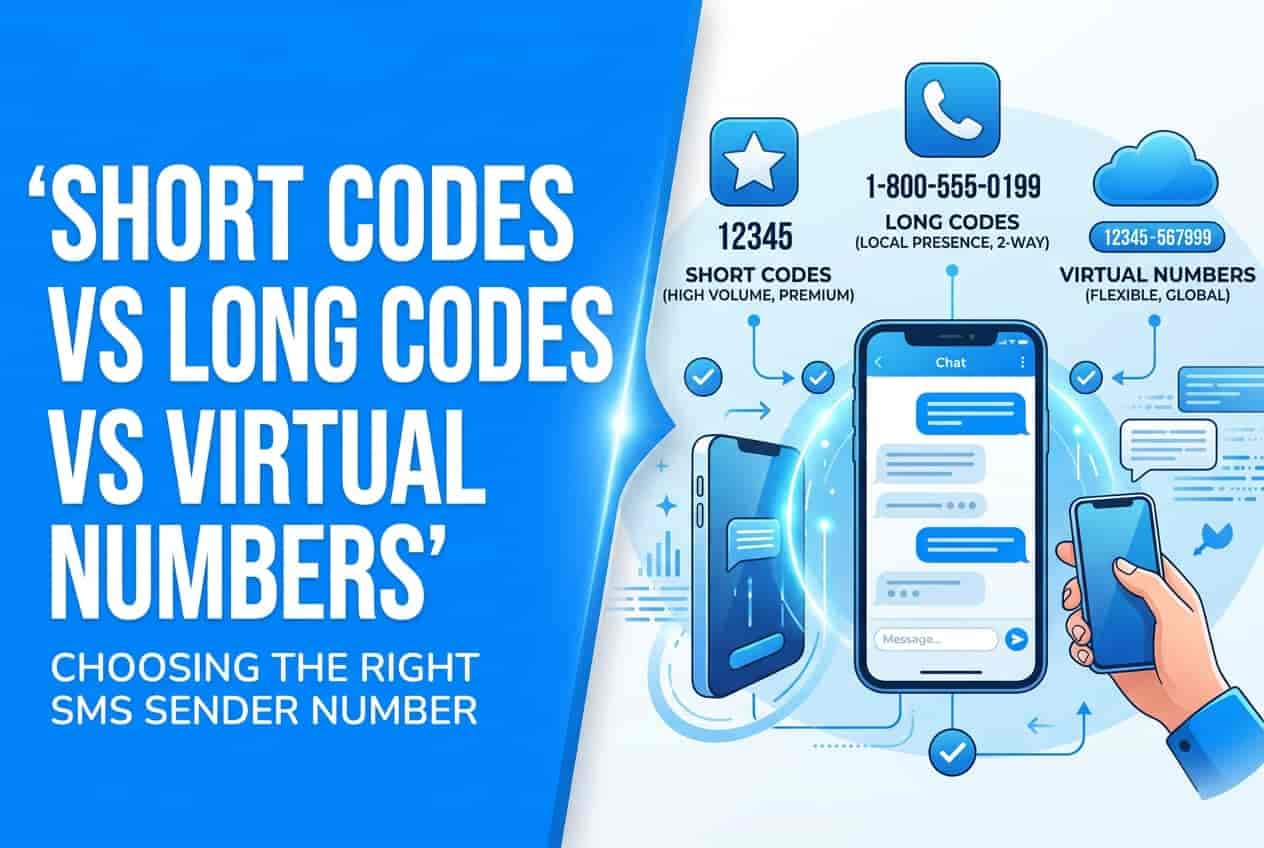
Three Types of Sender Numbers, Three Different Purposes
Choosing how your business sends bulk SMS isn't just a technical detail — it affects deliverability, cost, throughput, and whether recipients trust the message enough to act on it. Short codes, long codes, and virtual numbers each serve different purposes, and picking the wrong one for your use case can quietly undermine an otherwise well-planned campaign.
Short Codes: Built for High-Volume Broadcast
A short code is a 5–6 digit number leased specifically for bulk messaging, typically shared across many businesses using the same sender infrastructure with unique keyword routing. Short codes support very high throughput, making them well suited to large promotional blasts and alphanumeric sender IDs that display a recognizable brand name instead of a number. In India, this is the standard setup for DLT-registered promotional and transactional bulk SMS sent through a registered sender ID.
Long Codes: Built for Two-Way, Lower-Volume Conversations
A long code is a standard 10-digit number, similar to a regular mobile number, that supports both sending and receiving at a lower throughput than a short code. Long codes work well for two-way SMS use cases like customer support or appointment confirmations, where the conversational, personal feel of a regular-looking number is actually an advantage rather than a limitation — recipients are more likely to reply to what looks like a normal phone number than a clearly commercial short code.
Virtual Numbers: Flexibility Across Channels
Virtual numbers are cloud-based numbers not tied to a specific physical SIM or location, often used to route messages across multiple channels or geographies from a single number. They're particularly useful for businesses operating across several regions that want consistent branding without maintaining separate local numbers for each market, or for routing both SMS and voice through a unified virtual presence.
Matching the Number Type to Your Use Case
The right choice depends on what the campaign needs to accomplish:
Large promotional broadcasts: short code with alphanumeric sender ID
Two-way customer support or appointment management: long code
Multi-region operations needing unified routing: virtual number
High-volume transactional alerts (OTPs, delivery updates): short code with registered template
Many businesses end up using a combination — a short code for promotional blasts and transactional alerts, paired with a long code specifically for two-way support conversations — rather than forcing every use case through a single number type.
Cost and Setup Considerations
Short codes generally involve higher setup costs and longer approval timelines, particularly given India's DLT registration requirements, but offer the throughput needed for serious marketing volume. Long codes are typically faster and cheaper to set up but cap out at lower sending volumes, making them impractical for large-scale broadcast campaigns even though they excel at conversational use cases.
Conclusion
There's no single "best" sender number type — the right choice depends entirely on whether your priority is broadcast volume, two-way conversation, or multi-region flexibility. Short codes handle high-volume promotional and transactional sending efficiently, long codes support genuine two-way conversations at a more personal scale, and virtual numbers add flexibility for businesses operating across regions. Understanding these distinctions upfront helps avoid choosing infrastructure that technically works but quietly limits what your SMS program can actually achieve.