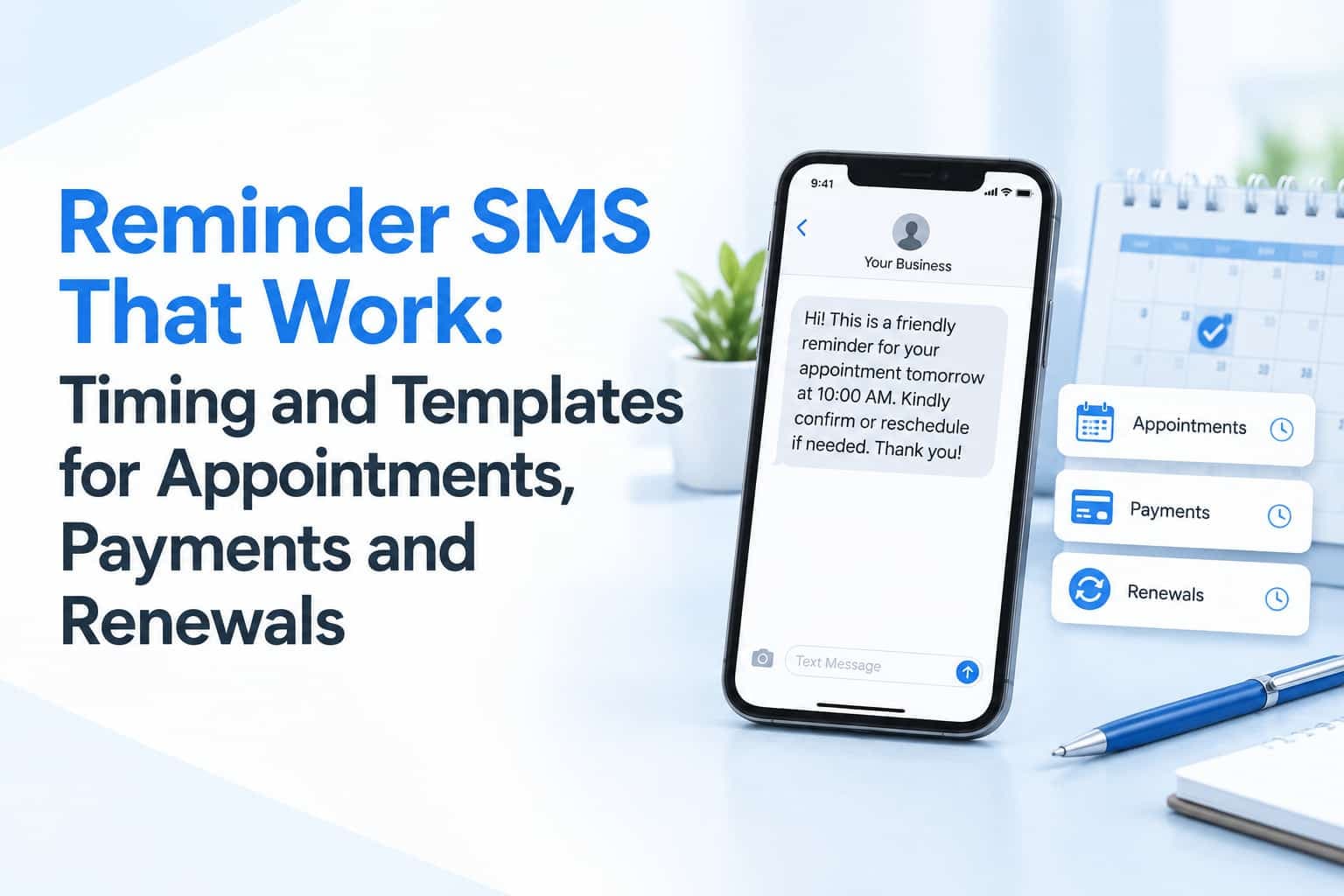
Missed appointments, late payments and lapsed renewals cost businesses money every single day. A well-timed reminder is one of the simplest and most cost-effective ways to fix all three. SMS works especially well for this purpose because it reaches people on the device they carry everywhere, without requiring an app, a login or even a stable internet connection. This guide explains when to send reminders, what to put in them and how to make them genuinely helpful rather than annoying.
The Main Types of Reminder Messages
Appointment reminders are the most familiar, used by clinics, salons, consultants and service providers to cut no-shows and give customers a chance to reschedule in time. Payment reminders help businesses collect invoices, instalments, utility bills and fees without awkward phone calls. Renewal reminders protect recurring revenue by alerting customers before memberships, subscriptions, contracts or licences expire. Event reminders round out the group, covering webinars, classes, deliveries and pickups where the customer needs to be ready at a specific time.
Timing Your Appointment Reminders
A common and effective pattern uses three touchpoints. A confirmation goes out immediately after the booking so the customer has the details in writing. A reminder follows one or two days before the appointment, giving enough notice to reschedule, and a short final reminder is sent a few hours before the start time. Services that need preparation, such as medical procedures with fasting instructions, may need an earlier message that includes those instructions.
The right timing depends on your customer's behavior. If people frequently cancel at the last minute, a reminder that arrives early enough to allow rebooking helps you refill the slot. If they tend to forget entirely, the message on the day does most of the work. Review your no-show data and adjust the schedule accordingly.
Timing Payment and Renewal Reminders
For payments, a courteous notice before the due date gives customers time to arrange funds, a message on the due date acts as a prompt, and a follow-up after the date has passed deals with overdue accounts. Each message should be a little firmer than the last, but it should never become threatening or accusatory. Most late payments are simple oversights, and a polite tone preserves goodwill while still getting results.
Renewal reminders should start earlier, perhaps thirty days before expiry for annual products, with additional messages as the date approaches. Customers often need time to compare alternatives, get approval or arrange payment, so a last-minute alert is often too late to be useful. Where renewal is automatic, an advance notice of the upcoming charge also builds trust and reduces disputes.
What Every Reminder Should Contain
A good reminder identifies your business by name so the customer immediately knows who is writing. It states the essential fact, whether that is the date and time of an appointment, the amount owed or the deadline for renewal. It gives a clear next step, such as confirming, rescheduling or paying, and makes that step easy by including a short link or a reply keyword. Finally, it provides contact details for questions. Anything beyond this is usually clutter.
Sample Message Structures
An appointment reminder might read: "Hello Sara, this is a reminder of your appointment at City Dental on 25 October at 4:30 PM. Reply 1 to confirm or 2 to reschedule." A payment reminder might say: "Dear Ahmed, your invoice 1047 for AED 1,250 is due on 30 October. Pay securely here: [link]. Questions? Call 04 000 0000." A renewal notice could read: "Your membership expires on 15 November. Renew before that date to keep your benefits: [link]." Each is short, specific and actionable, with the customer's name and a relevant reference to make it feel personal.
Make Reminders Interactive
Two-way replies make it simple for customers to confirm or change their plans, which frees up slots for others and reduces no-shows far more effectively than one-way notices. Automate the responses to common replies such as confirm, cancel and reschedule, but route unclear messages to a real person. Customers appreciate being able to respond with one word instead of calling a busy phone line, and your staff save time on routine administration.
Language, Tone and Consent
Use each customer's preferred language where you have it on record, including Arabic, and keep the wording polite and neutral. A reminder is a service, not a reprimand. Although service reminders are generally treated as transactional, you should still follow local messaging rules, use approved templates and sender IDs, and offer a way to opt out where appropriate. Avoid slipping promotions into payment or appointment messages unless your provider and the applicable rules clearly allow it, since mixing the two can cause delivery issues and annoy customers.
Measure the Impact
To prove the value of reminders, compare no-show rates before and after introducing them, and track the proportion of invoices paid on time and the average number of days to payment. For renewals, watch the renewal rate and the share of customers who act within a few days of each message. Also monitor reply and confirmation rates, which show whether your messages are clear and easy to act on. These measures help you refine timing and wording over time.
Conclusion
Reminder SMS is practical, measurable and valued by customers when done respectfully. Time your messages around the customer's needs, keep them clear and actionable, and use two-way options wherever possible. The result is fewer missed appointments, faster payments and steadier renewals, all achieved with a channel that costs little and that customers already trust. For most businesses, it is one of the easiest improvements available.