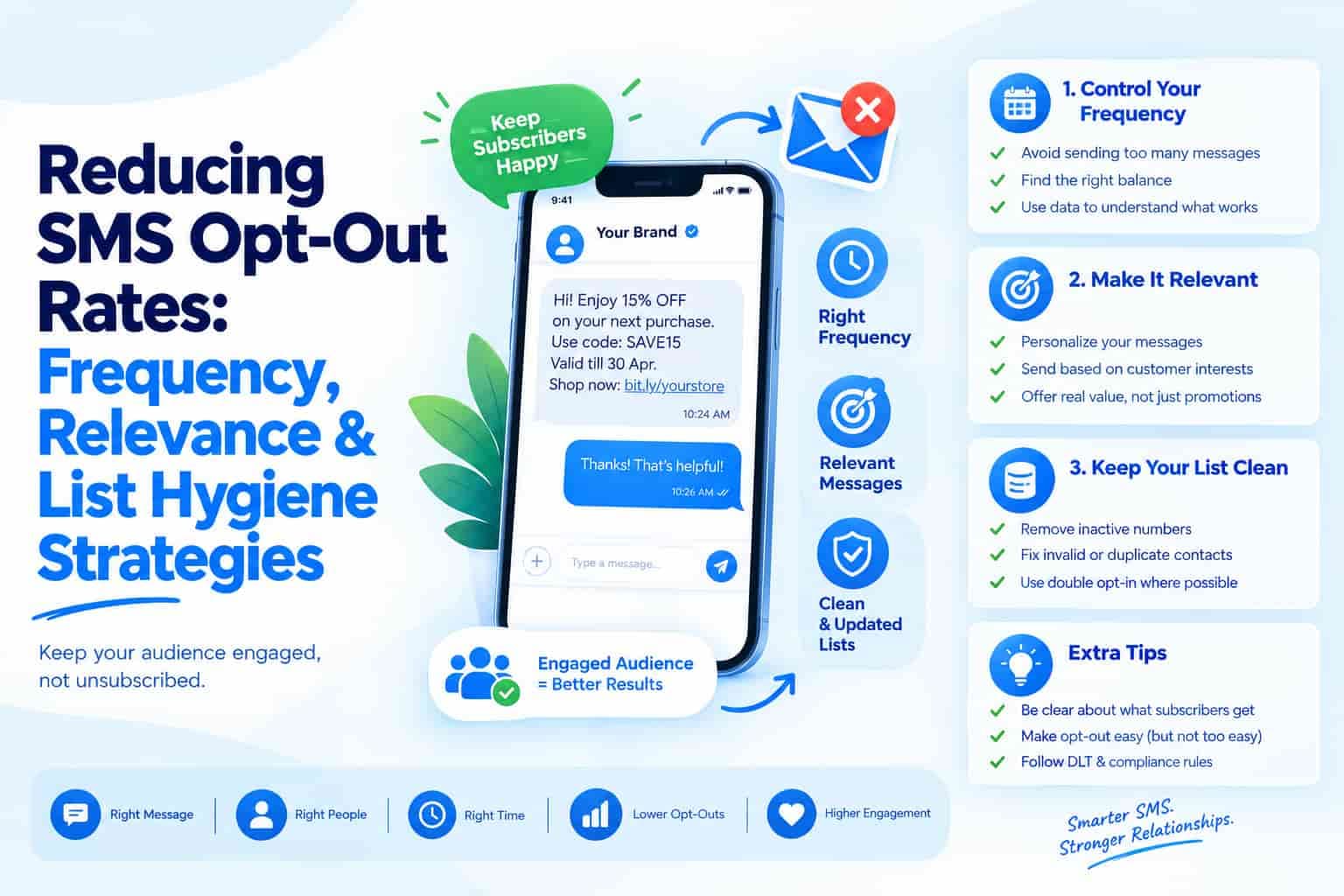
Why Opt-Out Rate Deserves as Much Attention as Click-Through Rate
Marketers often obsess over click-through and conversion rates while treating opt-out rate as a minor footnote. That's a mistake. A rising opt-out rate is an early warning signal that your bulk SMS program is eroding its own future reach — every unsubscribed contact is permanently gone, unlike a low-engagement email subscriber who might still see a future campaign land in their inbox.
The Three Main Drivers of Opt-Outs
Most opt-outs trace back to one of three root causes:
Excessive frequency — messaging contacts more often than they expected when they opted in
Irrelevance — sending offers or content that doesn't match the recipient's interests or purchase history
Poor initial consent — recipients who never clearly agreed to promotional messaging in the first place
Addressing frequency and relevance is largely within a marketer's control, while poor consent points back to opt-in practices that need fixing at the source rather than something that can be corrected after the fact through better messaging alone.
Finding the Right Frequency for Your Audience
There's no universal "correct" number of messages per week — the right frequency depends on your industry, offer cadence, and what customers expect based on how they signed up. A flash-sale-driven fashion retailer can sustain higher frequency than a B2B service business, provided every message brings genuine value rather than repetitive noise.
Tracking opt-out rate alongside send frequency over several campaigns usually reveals a clear inflection point — a frequency level beyond which opt-outs spike noticeably. Staying just below that threshold, rather than pushing volume as high as possible, protects the long-term health of the list.
Using Segmentation to Reduce Irrelevant Messaging
A significant share of opt-outs come from customers receiving offers that simply don't apply to them — a vegetarian customer receiving a meat-focused restaurant promotion, or a customer in one city receiving an offer only valid at a store hundreds of kilometers away. Proper segmentation by location, purchase history, and stated preferences directly reduces this category of opt-out, since the underlying issue isn't frequency at all but relevance.
Practicing Regular List Hygiene
Beyond preventing opt-outs, actively maintaining list quality matters just as much. Removing invalid numbers, honoring STOP requests immediately rather than with delay, and periodically re-confirming consent from long-inactive contacts all keep your list healthier and your engagement metrics more meaningful. A smaller, genuinely engaged list consistently outperforms a larger one padded with disengaged or invalid contacts, both in campaign performance and in carrier-perceived sender reputation.
Reading Opt-Out Patterns as Diagnostic Data
Spikes in opt-out rate immediately following a specific campaign are valuable diagnostic signals, not just a number to minimize. A sudden jump after a particular message often points to that specific campaign's tone, offer, or frequency as the trigger, giving you a concrete lesson to apply to future sends rather than treating the metric as background noise to monitor passively.
Conclusion
Reducing opt-out rates isn't about sending fewer messages for its own sake — it's about ensuring every message sent earns its place in a customer's inbox through relevance and respectful frequency. By segmenting thoughtfully, finding the right cadence for your specific audience, and treating opt-out spikes as diagnostic signals rather than background noise, businesses can protect the long-term value of their SMS list rather than slowly eroding it campaign by campaign.