If you've sent a text message in the last year, you've probably noticed something: some conversations look like sleek chat-app threads with read receipts and high-res photos, while others still feel stuck in 2005 — grainy images, no typing indicators, a hard 160-character limit. That split comes down to two different protocols working behind the scenes: SMS and RCS. Understanding the difference isn't just trivia anymore. It affects how your messages look, how secure they are, and — if you run a business — how effectively you reach customers.
The Basics: What Each Protocol Actually Is
SMS (Short Message Service) has been the backbone of mobile texting since the 1990s. It's simple, universal, and works on virtually every phone ever made, even the oldest flip phone on the most remote network. But that simplicity comes with real limitations: messages are capped at 160 characters, there's no encryption, and anything beyond plain text (photos, videos) has to be handled by a separate, lower-quality protocol called MMS.
RCS (Rich Communication Services) is essentially SMS's modern replacement. It's a carrier-and-device-level standard, built into your phone's native messaging app — Google Messages on Android, or the standard Messages app on iPhone — rather than a separate app you have to download. RCS brings texting up to the standard people expect from apps like WhatsApp or iMessage: high-resolution media, read receipts, typing indicators, larger group chats, and no character limit.
The Big Shift: Apple Joins In
For years, RCS was mostly an Android story, championed heavily by Google while Apple stuck to its own iMessage system for iPhone-to-iPhone chats and fell back to plain SMS/MMS for everything else. That's what created the infamous "green bubble" experience — pixelated photos, broken group chats, and no read receipts whenever an iPhone and an Android phone tried to talk to each other.
That changed when Apple added RCS support starting with iOS 18. iPhone and Android users texting each other can now get rich media sharing, read receipts, and typing indicators for the first time — no more automatic downgrade to SMS quality just because the conversation crosses ecosystems. It's worth noting this doesn't touch iMessage itself: iPhone-to-iPhone chats still use iMessage and stay blue-bubble. RCS is specifically the upgrade for cross-platform conversations that would otherwise fall back to SMS.
Encryption has been catching up too. In 2026, Apple began rolling out end-to-end encryption for RCS messages between iPhones and Android devices running the latest Google Messages, though it currently depends on both the carrier and OS version supporting it. That's a meaningful gap that's closing but not fully closed yet.
Where SMS Still Wins
Despite RCS's advantages, SMS isn't going away, and for good reason.
Universal reach. SMS works on every phone, every carrier, everywhere in the world, with no dependency on data connectivity, app updates, or carrier partnerships. RCS support still varies by carrier and country, and if either person in a conversation doesn't have it enabled or available, the conversation automatically falls back to plain SMS.
Reliability under pressure. Because SMS travels over the cellular network's signaling channel rather than data, it tends to get through even when data networks are congested or unavailable — which is part of why it remains the standard for two-factor authentication codes and emergency alerts.
Simplicity. There's nothing to configure, no app to enable, and no dependency on both parties having compatible, updated software. It just works.
Where RCS Wins
Rich media, done right. Photos and videos sent over RCS keep their resolution. Over MMS (SMS's media companion), they get heavily compressed.
Real conversational features. Typing indicators, read receipts, reactions, and better group chat handling make RCS feel like a modern messaging app rather than a 1990s holdover.
No character limit. Long messages don't get chopped into multiple fragments the way SMS messages do past 160 characters.
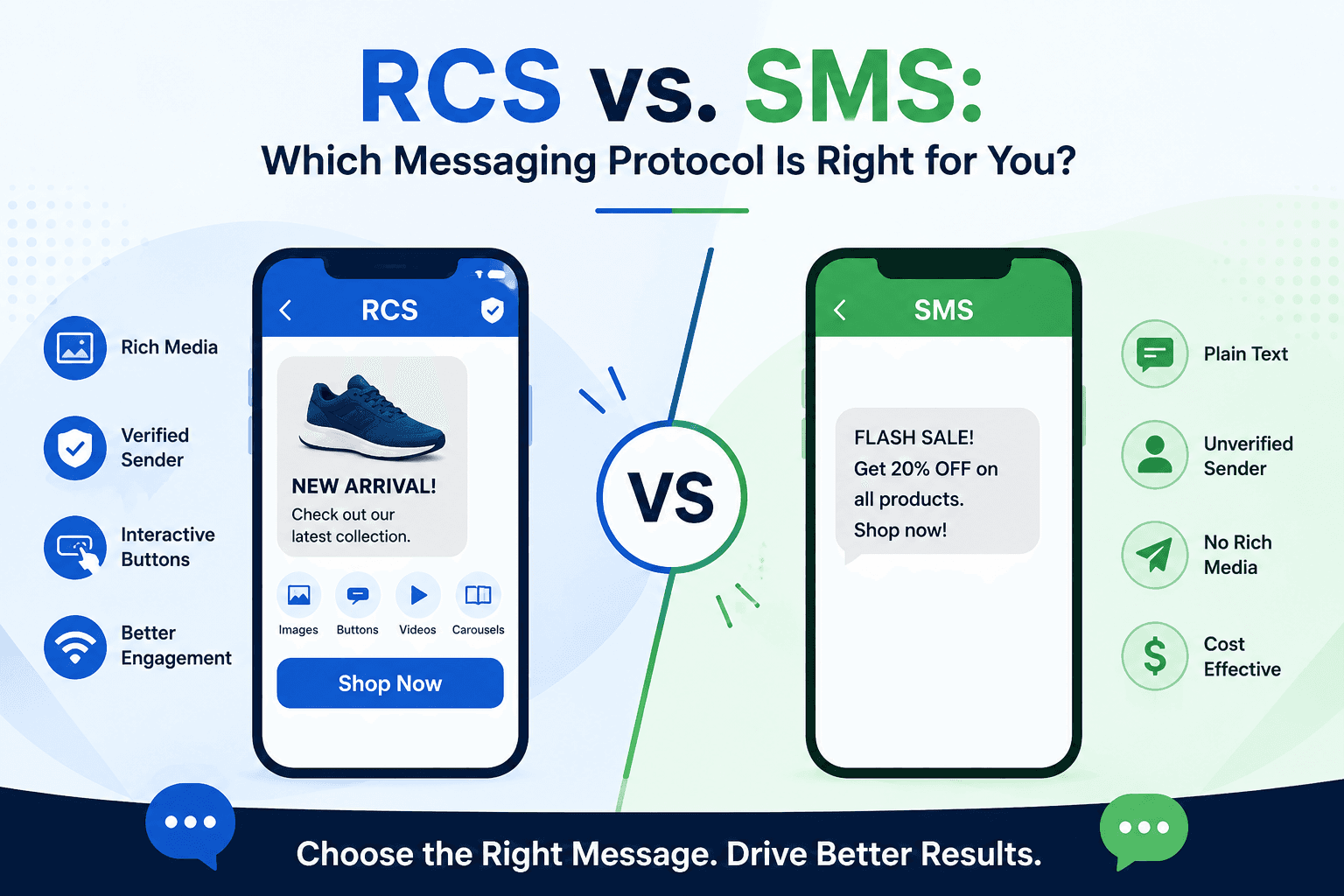
Better business tools. For companies that text customers, RCS supports verified sender branding — a business name, logo, and confirmed identity attached to the message — plus interactive buttons, carousels, and rich visual content like order confirmations or product demos. That verified identity also helps combat the impersonation and spam that plague plain SMS.
Which One Is Right for You?
For most people, this isn't really an either/or decision — it's already happening automatically in the background. If you and the person you're texting both have RCS enabled and supported by your carriers, your phone uses it without you doing anything. If not, it quietly falls back to SMS. There's rarely a reason to actively choose one over the other as an individual user, beyond making sure RCS is turned on in your messaging app's settings if you want the richer experience.
The decision matters more if you're evaluating messaging strategy for a business. A few questions can help clarify which to prioritize:
Who's your audience? If your customers skew toward younger, Android-heavy, or iOS 18+ demographics, RCS's rich features are likely to land well and drive stronger engagement. If you need to reach the broadest possible audience — including older devices, prepaid plans, or regions with limited RCS carrier support — SMS remains the safer universal baseline.
What are you sending? Visual marketing, product showcases, and interactive campaigns benefit enormously from RCS. Time-sensitive alerts, verification codes, and anything that absolutely must arrive regardless of network conditions still lean toward SMS.
How much does branding and trust matter? If impersonation risk or brand trust is a concern — think financial services or healthcare — RCS's verified sender identity offers a real advantage SMS can't replicate.
In practice, most businesses getting the most out of text messaging in 2026 aren't picking a side. They're running both protocols in parallel, using RCS as the rich-media, high-engagement channel where it's supported, with SMS as the dependable fallback that ensures nobody gets left out.
The Bottom Line
RCS is, functionally, where texting was always headed — an open standard that finally brings SMS into the modern messaging era without forcing anyone onto a specific app. But it's not a full replacement yet. Carrier support, cross-platform encryption, and consistent availability are all still maturing. SMS, for all its limitations, remains the one messaging format that's guaranteed to work everywhere, on everything, every time.
The most realistic answer to "RCS or SMS?" isn't a choice between the two — it's understanding that RCS is the better experience when it's available, and SMS is the safety net that makes sure your message gets through when it isn't.