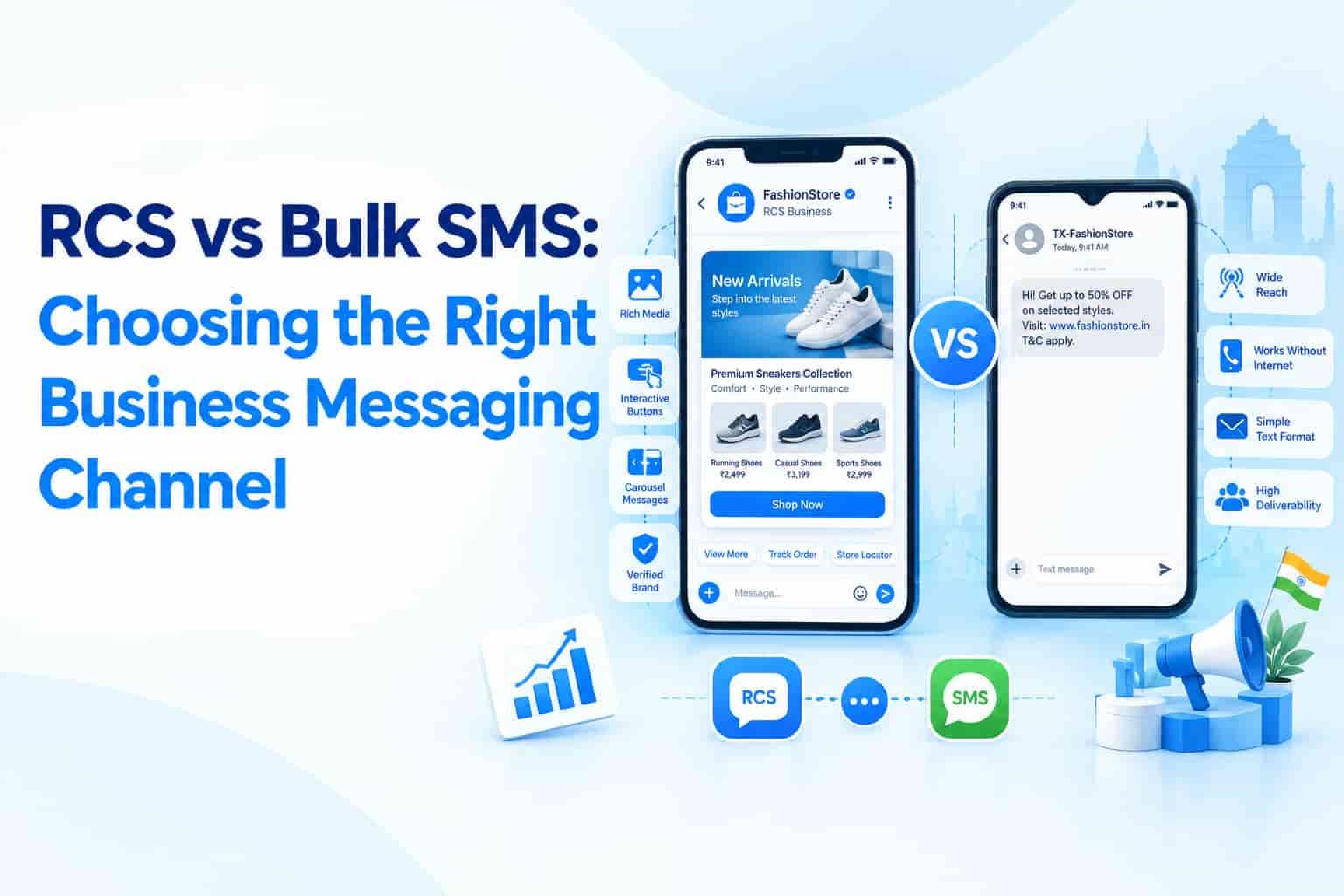
Businesses evaluating their messaging stack often reach a fork in the road: stick with the reliability of Bulk SMS, or move toward the richer, app-like experience of RCS Business Messaging. The truth is that neither channel replaces the other outright — each has a role depending on device support, campaign goals, and how critical guaranteed delivery is to the message.
What Is RCS Business Messaging?
Rich Communication Services (RCS) is the evolution of the standard SMS protocol, enabling businesses to send messages with high-resolution images, carousels, suggested reply buttons, read receipts, and typing indicators — all inside the recipient's native messaging app, without needing to install a separate app.
What Is Bulk SMS?
Bulk SMS is the plain-text messaging standard supported by every mobile phone in the world, regardless of whether it is a smartphone or a basic feature phone, and regardless of internet connectivity. It has no rich media support but offers the widest possible reach of any messaging channel.
Head-to-Head Comparison
Reach
Bulk SMS wins decisively on reach. Every mobile number on every network can receive an SMS. RCS requires the recipient's device and carrier to support the RCS protocol, and while adoption has grown significantly, coverage is still not universal across all carriers and regions.
Rich media and interactivity
RCS is the clear winner here, supporting carousels, high-res images, suggested actions, and branded sender cards that make campaigns feel more like a native app experience than a text message.
Cost
Bulk SMS pricing is simple and predictable per message. RCS pricing can vary depending on message type (basic vs. rich card vs. session-based conversational messages) and generally costs more per message where rich features are used.
Reliability for time-sensitive alerts
Bulk SMS remains the gold standard for anything that absolutely must arrive — OTPs, urgent account alerts, emergency notifications — because it does not depend on data connectivity or app-level rendering support.
Branding and trust signals
RCS supports verified sender branding (business name, logo, and verification badge) directly in the chat thread, which can improve trust and reduce the perception of spam compared to a generic SMS sender ID.
When to Choose Bulk SMS
OTPs, security alerts, and any message where guaranteed delivery matters more than presentation
Reaching customers on older devices or in areas with inconsistent data coverage
Simple, high-volume notifications like appointment reminders or delivery updates
When to Choose RCS
Product launch campaigns that benefit from carousels and visual storytelling
Interactive flows where suggested-reply buttons can reduce customer effort
Brand-forward campaigns where verified sender identity builds trust
The Smart Approach: Use Both With a Fallback Strategy
The most resilient setup treats RCS as an enhancement layer and Bulk SMS as the guaranteed foundation: attempt delivery via RCS first for supported devices, and automatically fall back to standard SMS whenever the recipient's device or carrier does not support the rich protocol. This way, no customer is left without the message, while capable devices still get the richer experience.
Sample Fallback Logic in Practice
RCS attempt: Rich card showing product image, price, and "Buy Now" / "View Details" buttons.
SMS fallback: New arrival! Check out our latest collection: [link]
FAQs
Does RCS replace SMS entirely?
No. RCS is designed to run alongside SMS as a fallback network, meaning any RCS-capable platform should always have an SMS delivery path available for unsupported devices.
Is RCS more expensive than Bulk SMS?
Generally yes, particularly for messages using rich cards or multi-message conversational sessions, though basic RCS messages can sometimes be comparable to SMS pricing.
Which channel is better for OTPs?
Bulk SMS remains the recommended channel for OTPs because of its universal device support and independence from data connectivity, which matters most during login or payment moments.
Conclusion
Choosing between RCS and Bulk SMS is not really an either-or decision — it's a question of matching the right channel to the right message. Bulk SMS remains unmatched for guaranteed reach and time-critical alerts, while RCS opens the door to richer, more engaging campaigns on supported devices. Businesses that build a layered strategy, using RCS where it shines and Bulk SMS as the dependable fallback, get the benefits of both without the risk of either.