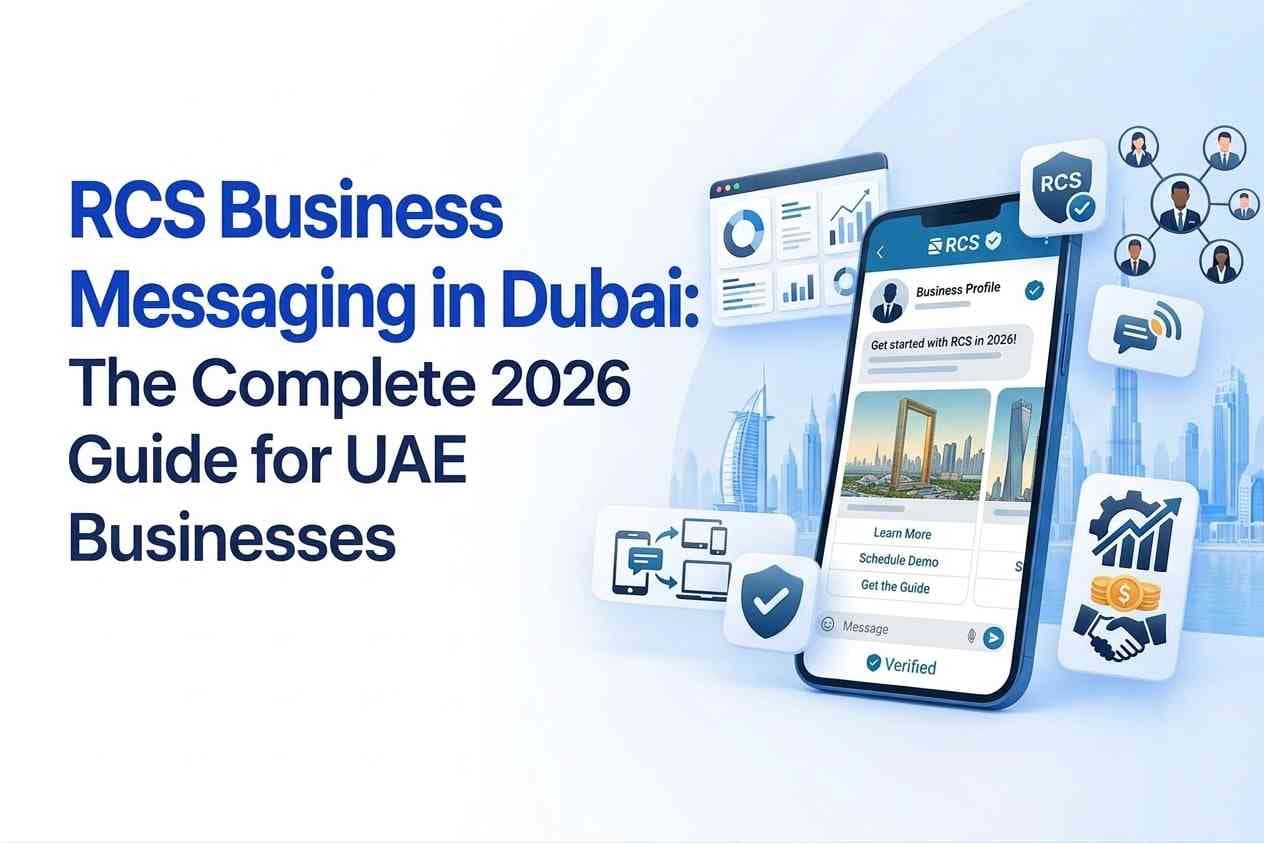
Google's Rich Communication Services (RCS) has moved from "interesting standard" to "board-level conversation" for Dubai and UAE businesses in 2026. With RCS now built into Android by default and supported through Apple's Messages app, the branded, media-rich messaging experience once reserved for WhatsApp is now available directly inside a customer's native messaging app — no app download required.
This guide breaks down what RCS Business Messaging actually is, whether it works reliably in the UAE today, how it compares to SMS and WhatsApp Business API, what it costs, and how to roll it out without wasting budget on a channel your customers can't yet receive.
What Is RCS Business Messaging?
RCS Business Messaging (sometimes called RBM) is the commercial version of the RCS protocol — the technology carriers and Google use to replace basic SMS with a richer messaging experience. For businesses, it means you can send messages that include:
High-resolution images, GIFs, and short videos inside the message thread
Interactive suggested reply and suggested action buttons (Book Now, Track Order, Call Us, View Map)
Carousels of products or offers a customer can swipe through
Read receipts and typing indicators
A verified sender profile — your business name, logo, and a verification badge — instead of an unknown ten-digit number
Unlike WhatsApp Business or a chatbot app, RCS messages arrive in the phone's default Messages app, the same place a customer already reads their personal texts. There's nothing to install and nothing to opt into beyond the initial consent your business collects.
RCS vs SMS vs WhatsApp Business API: Where It Actually Fits
RCS vs SMS
Plain SMS is text-only, capped at 160 characters per segment, and gives customers no way to verify who actually sent it — a major reason SMS phishing ("smishing") has eroded trust in unknown-number texts across the UAE. RCS keeps SMS's universal delivery (no app, no internet connection required for the base protocol on most networks) while adding rich media, buttons, and sender verification. Where a promotional SMS in Dubai might get a glance and a delete, a verified RCS message with a product carousel and a "Buy Now" button gives the customer somewhere to act immediately.
RCS vs WhatsApp Business API
WhatsApp remains the dominant chat app across the UAE's expatriate and resident population, and for many businesses it should stay the primary two-way engagement channel. RCS isn't a replacement for WhatsApp — it's a stronger replacement for SMS. The practical difference: WhatsApp requires the customer to already have the app and, for template messages, to have opted in within specific windows; RCS reaches anyone with a compatible device the moment they're in your contact list, without requiring them to have joined a separate platform. Many OMTEL clients now run RCS and WhatsApp Business API side by side — RCS for broad, verified outbound campaigns and order updates, WhatsApp for ongoing two-way conversations and support.
Does RCS Actually Work in the UAE? Carrier and Device Reality
This is the question most UAE businesses ask first, and it's a fair one — plenty of "2026 guides" gloss over it. Both of the UAE's mobile carriers, e& (Etisalat) and du, operate on networks that support RCS through Google's Jibe platform, and RCS is enabled by default in the Google Messages app on Android devices in the region. The bigger shift is on the Apple side: since Apple added RCS support to Messages, iPhone users — who make up a very large share of the UAE's high-spending expatriate and tourist segments — can now receive RCS messages as well, closing the gap that made RCS a partial solution in past years.
The realistic takeaway: RCS reach in the UAE is no longer "Android only," but it also isn't universal overnight. A responsible rollout treats RCS as the default rich channel and automatically falls back to plain SMS for the small number of devices that don't yet support it — most reputable RCS providers, including OMTEL, handle this fallback automatically so no message is ever lost.
Why UAE Businesses Are Paying Attention to RCS in 2026
Independent industry research (Infobip's 2026 RCS market data) points to why marketers are moving budget toward RCS: verified RCS messages report meaningfully higher open and click-through rates than plain SMS, largely because the verified sender badge and rich content build immediate trust — something a plain ten-digit SMS sender ID simply cannot do. For sectors where trust is the entire sale — banking, real estate, healthcare, government-adjacent services — that verification badge alone can be the difference between a message being read or deleted as suspected spam.
For Dubai businesses specifically, this matters more than most markets: OTP and delivery-notification fraud impersonating banks and logistics companies has made residents understandably cautious about unknown SMS senders. A verified RCS sender profile is a direct answer to that fatigue.
Real-World Use Cases for Dubai and UAE Businesses
Banking & finance: verified transaction alerts, card offers with an "Activate Now" button, appointment booking for branch visits
Real estate: new listing carousels with photos, "Schedule Viewing" action buttons, mortgage pre-approval reminders
Retail & e-commerce: order confirmation with live tracking, abandoned-cart carousels, Ramadan and Eid campaign offers with rich imagery
Hospitality & travel: booking confirmations, check-in reminders with a map link, upsell offers for spa or dining
Healthcare: appointment reminders with a reschedule button, lab result notifications, clinic location cards
Logistics & delivery: live courier tracking, delivery-window confirmation, "Reschedule Delivery" buttons that cut failed-delivery costs
TDRA Compliance and Building Consumer Trust
As with SMS and WhatsApp marketing, RCS Business Messaging in the UAE still falls under the Telecommunications and Digital Government Regulatory Authority's (TDRA) commercial messaging rules. That means explicit customer consent before sending marketing messages, a clear opt-out mechanism, and accurate sender identification — RCS's built-in verified business profile actually makes the last requirement easier to satisfy than anonymous SMS sender IDs. Businesses should still register their sender profile through an approved RCS partner and keep consent records for every contact list used in campaigns, exactly as they would for bulk SMS or WhatsApp broadcasts.
How to Implement RCS Business Messaging: Step-by-Step
1. Audit your current messaging stack. Map out where SMS, WhatsApp, and email currently sit in your customer journey and identify where a richer, verified channel would lift performance.
2. Choose an approved RCS Business Messaging partner. You'll need a provider with an agency or brand relationship to Google's Jibe platform (or an equivalent carrier hub) to register your verified sender profile.
3. Build your verified brand profile. Logo, business name, colour, and category — this is what customers see before they even open the message.
4. Design fallback-safe message templates. Every RCS template should have an SMS-equivalent fallback so delivery never fails on unsupported devices.
5. Start with a single high-value use case. Order confirmations or appointment reminders are low-risk, high-visibility places to prove the channel before expanding to full marketing campaigns.
6. Track engagement separately from SMS. Read rates, button taps, and carousel swipes are new metrics most UAE teams haven't measured before — build reporting for them from day one.
7. Scale into promotional and lifecycle campaigns once the transactional use case is stable and your team is comfortable with the reporting.
RCS Business Messaging Pricing in Dubai: What Affects the Cost
RCS pricing in the UAE typically follows a per-message model similar to SMS, but with a few extra variables:
Message type — basic (text + one image) versus rich cards and carousels usually carry different rates
Verification tier — a fully verified brand sender typically costs more to set up than a standard business sender, but delivers the trust benefit that drives engagement
Fallback volume — how many messages fall back to plain SMS on unsupported devices, which is billed at SMS rates
Volume commitments — as with bulk SMS, higher monthly volumes typically unlock lower per-message pricing
Because pricing varies by provider and campaign type, most UAE businesses get an accurate figure by requesting a quote based on their actual monthly message volume rather than relying on a generic published rate card.
Common Challenges and How to Solve Them
"Will my messages actually reach iPhone users?" Yes, on current iOS versions with RCS support enabled — and your provider should automatically fall back to SMS for anyone who isn't.
"Do we need a separate team to manage this?" No — RCS should sit in the same dashboard and workflow as your existing SMS and WhatsApp campaigns, not as a separate silo.
"Is the verified badge automatic?" No — it requires a formal brand verification process through your RCS provider, which is why choosing an experienced partner matters.
Frequently Asked Questions
Is RCS Business Messaging available on both Etisalat and du networks?
Yes. Both UAE carriers operate on networks compatible with RCS, and Android devices in the region have RCS enabled by default through Google Messages. iPhone support has also expanded significantly following Apple's adoption of the protocol.
Is RCS more expensive than SMS?
Rich RCS messages typically cost more per message than plain SMS, but businesses often see the higher engagement and conversion rates offset the cost difference, particularly for transactional and high-value promotional messages.
Do customers need to install an app to receive RCS messages?
No. RCS messages appear directly in the phone's default messaging app — Google Messages on Android or Messages on supported iPhones — with no download required.
Can we run RCS alongside our existing WhatsApp Business account?
Yes, and most UAE businesses do exactly this — using RCS for verified, broad-reach notifications and WhatsApp for ongoing customer conversations.
Conclusion
RCS Business Messaging has reached a genuine tipping point in the UAE: carrier support is in place, Android adoption is default, and iPhone compatibility has closed the last major gap. For Dubai businesses fighting SMS fatigue and rising customer skepticism toward unknown senders, a verified, rich messaging channel that lives inside a customer's default inbox is one of the more practical upgrades available in 2026 — provided it's rolled out with proper fallback handling, TDRA-compliant consent, and clear performance tracking. Businesses that treat RCS as an upgrade to their existing SMS strategy, rather than a separate experiment, tend to see the fastest, lowest-risk results. OMTEL helps Dubai and UAE businesses set up verified RCS Business Messaging alongside their existing Bulk SMS and WhatsApp Business API channels — get in touch to see whether your customer base is ready for it.