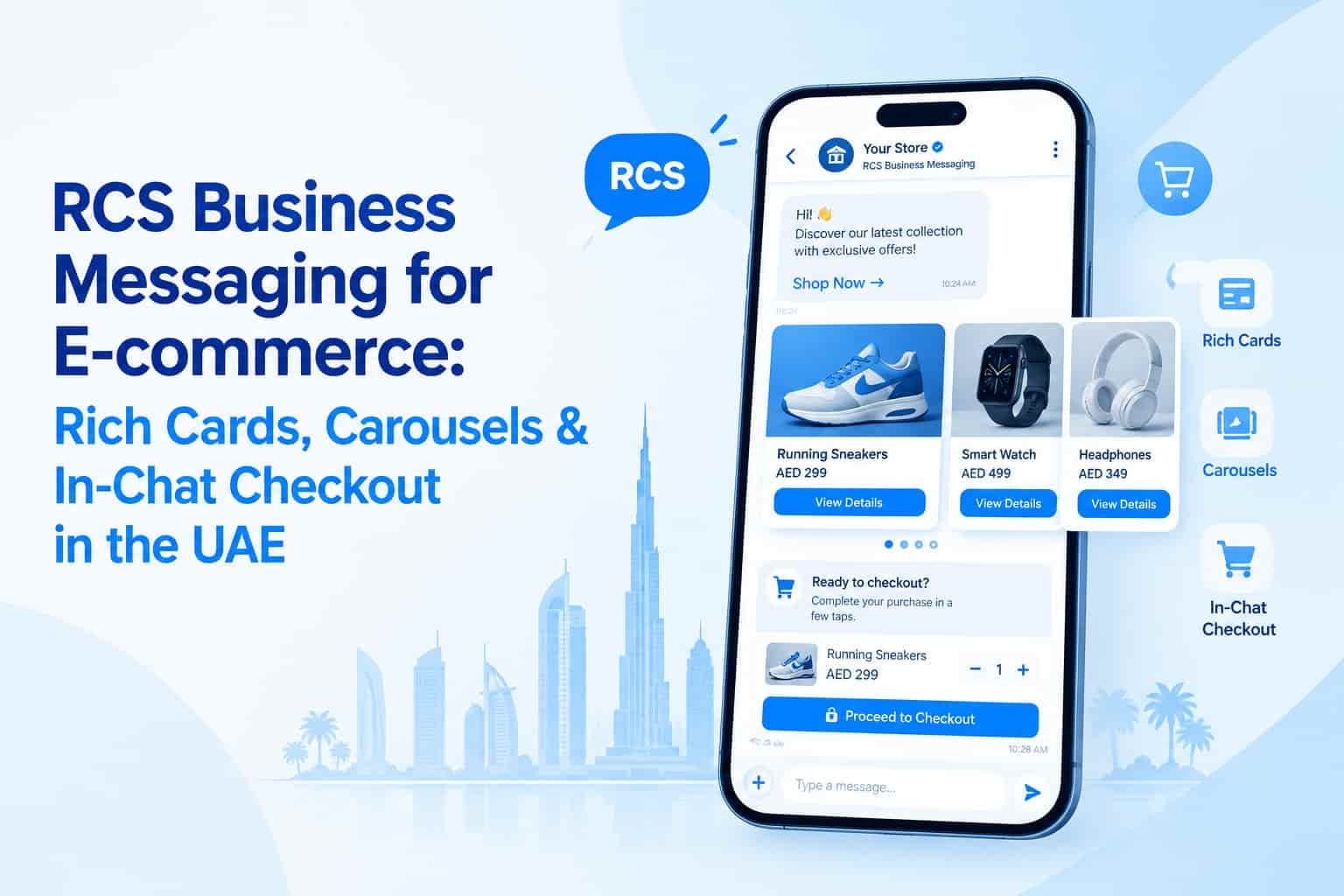
For e-commerce brands, the gap between "a text message" and "a mini storefront" has narrowed considerably with RCS Business Messaging. Where SMS gives you plain text and a link, RCS gives you rich cards, image carousels, and interactive buttons — delivered through the customer's native messaging app, with no separate download required. For UAE online retailers looking to modernize promotional and transactional messaging without asking customers to install another app, RCS sits in a compelling middle ground between SMS and WhatsApp.
What RCS Adds to an E-commerce Message
Rich cards: A single message can display a product image, title, price, and a call-to-action button — closer to a mini product page than a text line.
Carousels: Multiple products can be swiped through in one message, ideal for "new arrivals" or "you might also like" style promotions.
Suggested reply chips: Pre-set quick replies ("Track order," "View more," "Not interested") reduce friction compared to typing a response.
Verified sender badge: RCS displays a verified business name and logo, which helps combat the brand-spoofing risk that plain SMS is more exposed to.
Automatic SMS fallback: If a recipient's device or network doesn't support RCS, the message is delivered as standard SMS instead — so campaigns don't need a separate "RCS list" and "SMS list."
High-Impact E-commerce Use Cases
1. Rich Product Promotions
Instead of a plain-text "20% off storewide" SMS, an RCS carousel can show the actual discounted products with images and prices, letting the customer browse without leaving the message thread.
2. Order and Delivery Updates With Visual Tracking
An order confirmation or "out for delivery" update can include a rich card with a map-style delivery status graphic and a "Track Package" button, rather than a plain link the customer has to tap and wait to load.
3. Abandoned Cart Recovery With Product Visuals
Showing the actual item left in the cart — image, price, and a direct "Complete Purchase" button — tends to prompt faster recognition and action than a text-only reminder.
4. Post-Purchase Cross-Sell
A carousel of complementary products ("customers who bought this also liked...") sent shortly after delivery confirmation can drive repeat purchases within the same conversation thread.
Building an RCS E-commerce Flow
Step 1: Work With an RCS-Enabled Aggregator
RCS Business Messaging is delivered through platforms connected to carrier and Google RCS infrastructure — your messaging provider needs to support rich card and carousel formats, not just plain RCS text.
Step 2: Design for the Fallback Case Too
Since RCS automatically falls back to SMS for unsupported devices, write a plain-text fallback version of every rich card message so customers on non-RCS devices still get a usable, complete message rather than a broken or empty one.
Step 3: Keep Cards Focused
A card with too many elements competing for attention performs worse than one clear image, one clear price, and one clear action button. Resist the urge to cram an entire catalog into a single card.
Step 4: Track RCS-Specific Engagement
Where your platform supports it, measure card-level engagement (which product in a carousel got tapped) separately from overall click-through — this data is far more granular than plain SMS link clicks and can directly inform which products to feature next.
Sample RCS E-commerce Message Concepts
Order update rich card: "Your order is on its way! 📦" — delivery status graphic, estimated arrival window, [Track Order] button, [Change Delivery Address] quick reply.
Product carousel caption: "New in this week 👀" — swipeable cards for 4 featured products, each with image, price, and [Add to Cart] button.
Fallback SMS version (for non-RCS devices): [Brand]: New arrivals just dropped! Shop now: [link]
Frequently Asked Questions
Do I need a separate contact list for RCS versus SMS?
No — RCS Business Messaging platforms typically handle this automatically, sending the rich version where supported and falling back to SMS where it isn't, from a single send.
Is RCS more expensive than SMS for e-commerce campaigns?
Pricing varies by provider, but RCS is generally positioned between standard SMS and WhatsApp, reflecting its richer feature set. For high-value promotional or transactional messages, the engagement lift can offset the incremental cost.
Can customers check out entirely inside an RCS message?
RCS itself is primarily a rich messaging format rather than a full checkout environment — most flows use RCS to showcase products and drive the customer to a fast, pre-filled checkout page via the card's action button, similar to how WhatsApp cart flows work.
Does RCS require TDRA sender ID registration like promotional SMS does?
RCS sender verification runs through the RCS/Google Business Messaging ecosystem itself, though any traffic that falls back to SMS is still subject to standard UAE SMS sender ID and consent rules.
Conclusion
RCS gives UAE e-commerce brands a way to make promotional and transactional messaging genuinely richer — product carousels, visual order tracking, verified branding — without asking customers to install a new app or abandoning the reach that SMS fallback still guarantees. For online retailers already running SMS at scale, layering RCS on top is less a channel switch and more an upgrade to the experience customers already receive.