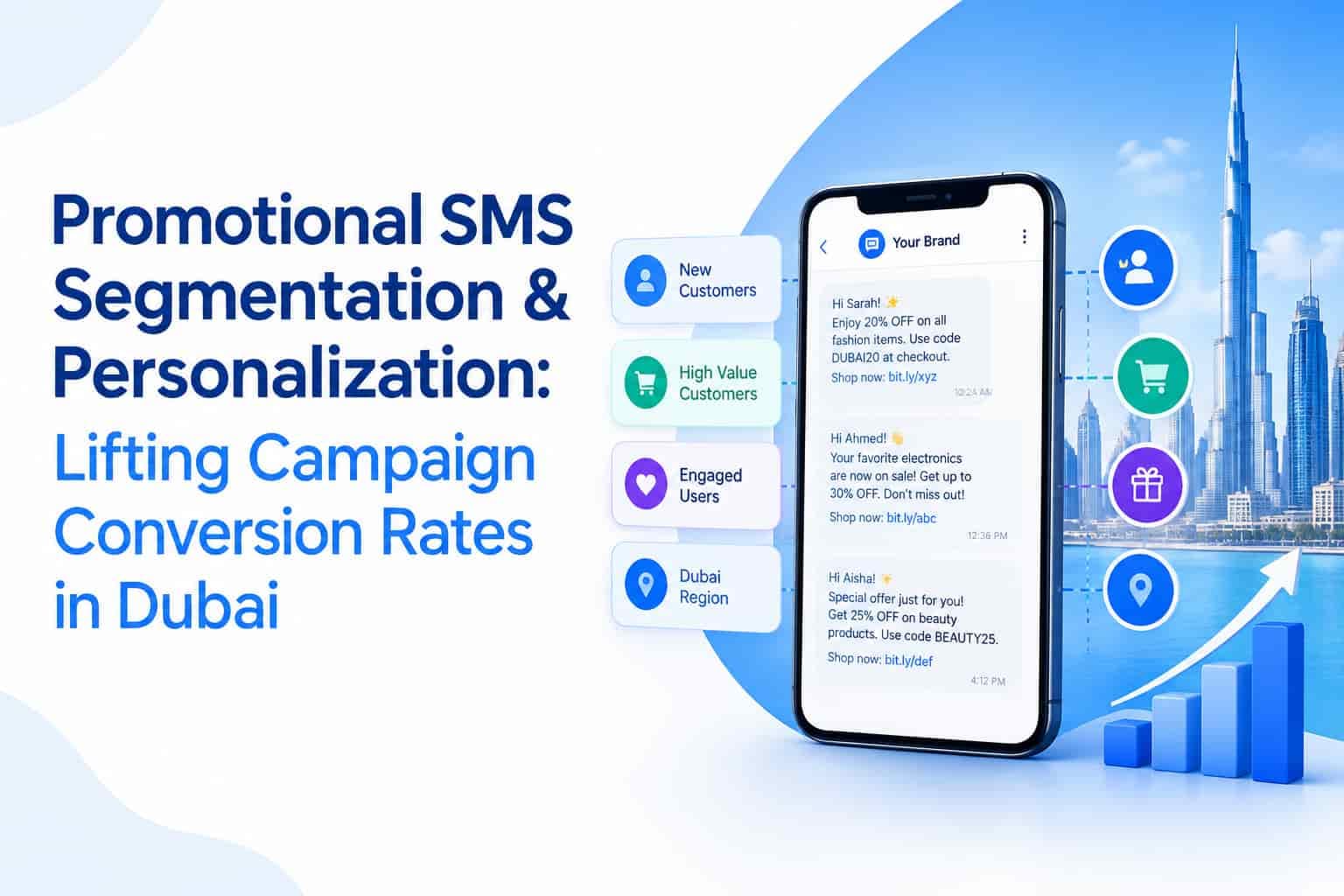
Sending the same promotional SMS to your entire list is the fastest way to trade short-term reach for long-term list fatigue — recipients who receive offers irrelevant to them are more likely to opt out via 7726 or simply stop opening messages altogether. For Dubai businesses running compliant, AD- registered promotional campaigns, segmentation and personalization are what turn a broadcast channel into something closer to a targeted one.
Why Segmentation Matters More for SMS Than Email
SMS has a much smaller "canvas" than email — a single message, no subject line to preview, no unsubscribe-and-ignore middle ground the way a promotions folder allows. That makes relevance disproportionately important: an irrelevant SMS is more likely to generate an opt-out or a spam report than an irrelevant email sitting unread in an inbox.
Core Segmentation Approaches
1. Purchase History
Category affinity: Customers who buy electronics shouldn't receive the same promotion as customers who only buy home goods.
Recency: A customer who purchased last week needs a different message than one who hasn't ordered in six months (win-back vs. cross-sell).
Average order value: High-value customers often respond better to early access or exclusivity than to blanket percentage-off discounts.
2. Engagement Behavior
Click history: Segment by which past campaign links a customer actually tapped, not just what they purchased.
Response to previous offers: Customers who consistently ignore discount-led messages might respond better to new-arrival or restock alerts instead.
3. Lifecycle Stage
New customers: A welcome offer or onboarding sequence rather than a generic sale blast.
At-risk/lapsing customers: A distinct win-back message, often with a stronger incentive than an active customer would need.
Loyal repeat customers: Recognition-based messaging (early access, loyalty milestones) rather than discount-first offers that can erode margin unnecessarily on customers who'd have bought anyway.
Personalization Beyond "Hi [Name]"
Name insertion is table stakes. Meaningful personalization in a promotional SMS usually means referencing something specific and true about the recipient — a category they've bought from before, a product they viewed, or a loyalty status — without overstepping into content that feels surveillance-heavy rather than helpful.
Testing and Optimizing Segments
A/B Test Within Segments, Not Just Across the Whole List
Testing message variants within a defined segment (rather than across your entire undifferentiated list) produces more actionable results, since you're isolating message performance from the noise of segment-mix differences.
Watch Opt-Out Rate by Segment, Not Just Overall
A campaign with a healthy overall opt-out rate can still be quietly losing your highest-value segment if that group finds the frequency or offer type mismatched. Segment-level opt-out tracking catches this before it becomes a bigger churn problem.
Staying Compliant While Segmenting
Segmentation doesn't change the underlying TDRA requirements — every segment still needs a registered AD- prefixed sender ID, documented opt-in consent, and sends restricted to the 7 AM-9 PM UAE window. What changes is only the content and targeting logic, not the compliance framework around it.
Sample Segmented SMS Templates
New customer welcome (AD- sender): AD-[BRAND]: Welcome to [Brand], [Name]! Here's 15% off your first order: [link]. Reply STOP to opt out.
High-value/loyalty segment: AD-[BRAND]: [Name], as one of our top customers, you get 24-hour early access to our new collection: [link]. Reply STOP to opt out.
Win-back / lapsed segment: AD-[BRAND]: We miss you, [Name]! Here's 20% off to welcome you back: [link]. Reply STOP to opt out.
Frequently Asked Questions
How granular should SMS segmentation be?
Start with 3-5 broad, meaningfully different segments (new, active, high-value, lapsing) rather than dozens of micro-segments — over-segmentation adds operational complexity without proportionate performance gains for most businesses.
Does more personalization always mean higher conversion?
Generally yes, up to a point — personalization that clearly reflects real purchase or browsing behavior performs better, but personalization that feels intrusive or overly specific can backfire and increase opt-outs.
Can I segment by location within the UAE?
Yes, where you have reliable delivery-address or account-location data — useful for emirate-specific promotions, delivery-zone-specific offers, or event-based campaigns tied to a particular city.
How often should segments be refreshed?
Purchase-history and engagement-based segments should update automatically as new transaction and click data comes in — a segment built once and never refreshed quickly becomes inaccurate.
Conclusion
The businesses getting the best return from promotional SMS in Dubai aren't necessarily the ones sending the most messages — they're the ones sending the right message to the right segment, with the compliance fundamentals (AD- registration, consent, sending hours) handled consistently underneath. Segmentation turns SMS from a blunt broadcast tool into a channel that customers actually look forward to opening.