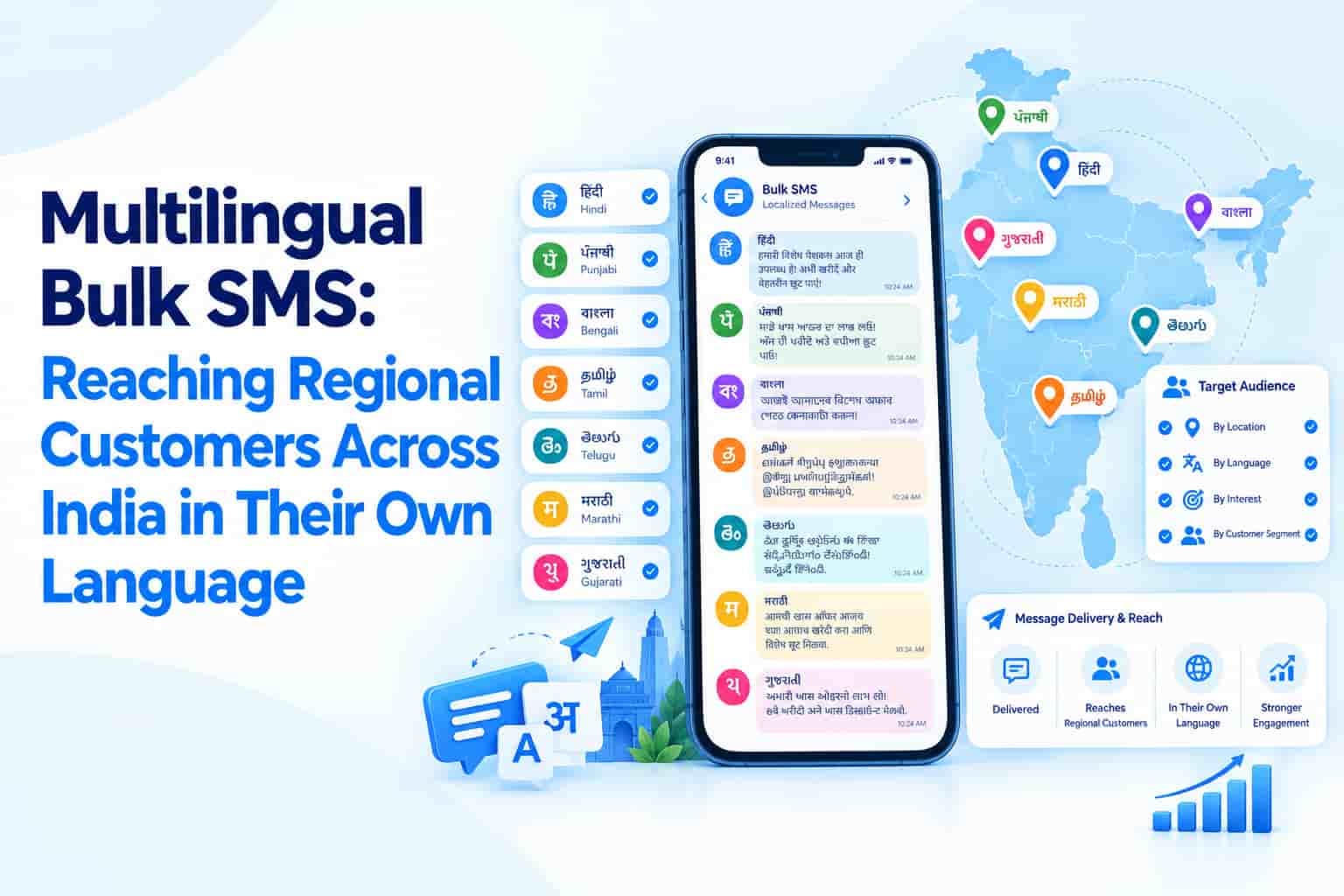
India's Language Diversity Is a Marketing Opportunity
India has more than 20 officially recognized languages and hundreds of regional dialects, yet a large share of bulk SMS campaigns are still sent only in English or Hindi. For businesses with customers in Tamil Nadu, West Bengal, Punjab, or Maharashtra, this leaves significant engagement on the table — messages in a customer's own language consistently perform better than translated or generic English text, particularly outside major metro areas.
Why Regional-Language SMS Drives Higher Engagement
A message written in a customer's native language feels more personal and trustworthy, particularly for older demographics or Tier 2 and Tier 3 city audiences who may be less comfortable reading English. This is especially important for time-sensitive or transactional messages like payment confirmations, appointment reminders, or delivery alerts, where clarity directly affects whether the customer acts correctly on the information — a misunderstood delivery time or payment instruction can cause real friction, not just lower engagement.
Beyond comprehension, there's a trust dimension too. Messages in a regional language often read as more authentic and locally rooted, which can meaningfully improve how a brand is perceived in markets outside major metro cities where English-first branding is less common.
Technical Considerations for Multilingual Campaigns
Sending regional-language SMS requires Unicode (UCS-2) encoding rather than standard GSM-7, since scripts like Devanagari, Tamil, Bengali, or Gurmukhi fall outside the basic character set. This reduces the single-segment character limit to 70 characters, so multilingual messages need to be written more concisely than their English equivalents, without losing the clarity or warmth that made the local-language approach worthwhile in the first place.
Segment your list by preferred or regional language using location or stated preference data
Keep Unicode messages short to avoid unnecessary multi-segment costs
Test translations with native speakers rather than relying purely on machine translation
Maintain separate templates per language rather than translating on the fly for each send
Collecting Language Preference Without Extra Friction
The simplest way to build a multilingual sending list is to ask for language preference at the same point you collect a phone number — during checkout, sign-up, or in-store registration. A single additional dropdown or question adds minimal friction while giving you the data needed to route future messages correctly from day one, rather than guessing based on geography alone, which can be inaccurate in linguistically mixed regions.
Avoiding Common Translation Pitfalls
Literal, word-for-word translation often produces awkward or unclear messaging, especially for idiomatic phrases common in marketing copy like "don't miss out" or "limited time only." Working with native speakers to adapt — rather than directly translate — key phrases ensures the message retains its persuasive tone in each language, not just its literal meaning. This is particularly important for calls to action, where the wrong phrasing can significantly reduce click-through rates even if the core message is technically correct.
Conclusion
Multilingual bulk SMS isn't just a nice-to-have for businesses serving India's diverse population — it's a direct lever for higher open rates, better comprehension, and stronger trust. By segmenting audiences by language, accounting for the Unicode character limits that come with regional scripts, and investing in proper localization rather than literal translation, businesses can meaningfully expand their reach beyond English- and Hindi-speaking customers. As competition for attention increases, speaking to customers in their own language is a simple but often-overlooked advantage that compounds across every campaign you send.