The Cost of Separate Integrations
Many businesses reach customers through several channels, such as SMS, WhatsApp, RCS, email, and voice. Often each was added at a different time through a different vendor, with its own integration, dashboard, and invoice. Developers must build and maintain each connection, marketers manage each channel in isolation, and nobody has a single view of what a customer actually received. Customers, meanwhile, experience one brand and expect consistent communication regardless of channel. A multi-channel messaging API addresses this by providing one integration point for sending and receiving across channels.
How a Multi-Channel API Works
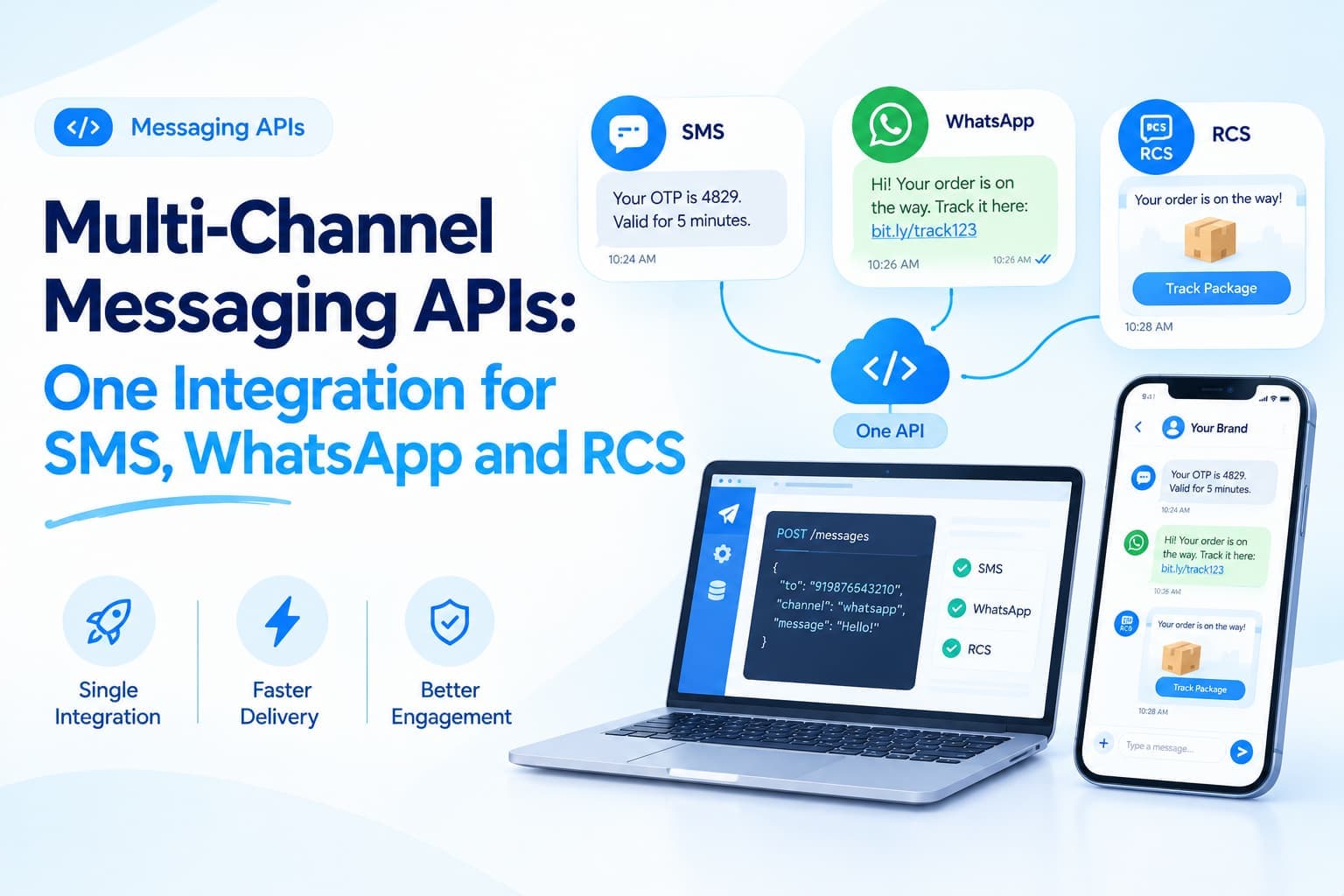
Instead of integrating separately with an SMS gateway, a WhatsApp provider, and an RCS platform, a developer connects once and specifies, for each message, the channel or an ordered list of channels. The platform translates between channel-specific formats, handles template requirements, and returns delivery events in a consistent structure. Adding a new channel later becomes a configuration change rather than a new integration project.
Fallback Logic in Practice
The most valuable feature is fallback routing, and a concrete example shows why. Imagine an online retailer sending a delivery update. The preferred channel is WhatsApp because it supports rich tracking details. The rule might be: try WhatsApp first, and if the message is not delivered within a short window, send an SMS with the tracking link. A customer without the app, or with no data connection, still gets the update by SMS. For a one-time password, the rule might be reversed: SMS first, voice call if the code is not entered within a minute. The logic is yours to define, based on urgency, cost, and what each channel does well.
A Simple Flow Diagram in Words
An order-shipped event occurs in your system. Your application calls the messaging API once with the customer's contact details, the template, and the channel order. The platform attempts the first channel, receives a delivery status, and if it fails or times out, moves to the next channel automatically. It then reports the final outcome back to your system by webhook, including which channel succeeded. Your system updates the order record with that result. Your developers wrote this once rather than three times.
Unified Data and Reporting
When channels are managed separately, customer data lives in disconnected systems with different formats. A single API centralizes delivery events, replies, and engagement into one structure, making it much easier to compare channel performance, calculate real costs, and identify where messages are failing. It also makes opt-out handling more reliable, since a preference recorded on one channel can be respected across the others.
Where It Helps Most
Authentication benefits from SMS with voice fallback. Order and delivery notifications benefit from rich channels with SMS as a safety net. Appointment reminders can adapt to each patient's preferred channel. Marketing sequences can combine channels, such as an email announcement, an SMS reminder, and a WhatsApp message to those who have not responded. In each case the common benefit is reach: no single channel covers every customer.
Evaluating a Provider
Look at channel coverage, documentation quality, and sandbox availability. Check the reliability of delivery reports and webhooks, since your fallback logic depends on timely status data. Ask how templates and sender registrations are handled per channel, because requirements differ widely. Compare pricing across channels with realistic volumes. Examine how consent and opt-outs are managed consistently, and what support is available when something breaks. A good test is to build a small proof of concept on the sandbox before committing.
Common Mistakes
Teams often send the same message to all channels at once, which annoys customers with duplicates. Others forget to design the SMS fallback, so it is an afterthought. Some ignore per-channel template approval timelines and discover them at launch. Many fail to monitor fallback rates, which reveal when a primary channel is underperforming.
Frequently Asked Questions
Do I need a developer?
For API integration, yes, though many providers also offer no-code tools or plugins for common platforms.
Will fallback double my costs?
Not if configured correctly, because the next channel is used only when the previous one fails or times out.
Can I migrate gradually?
Yes. Many businesses move one use case at a time, starting with a low-risk flow such as order updates.
Conclusion
A multi-channel messaging API replaces a patchwork of separate integrations with one consistent connection to your customers. It simplifies development, enables intelligent fallback that protects reach, and unifies reporting. Evaluate providers on coverage, reliability of delivery events, template handling, and compliance support, start with one flow on a sandbox, and expand once the fallback behaves as intended.