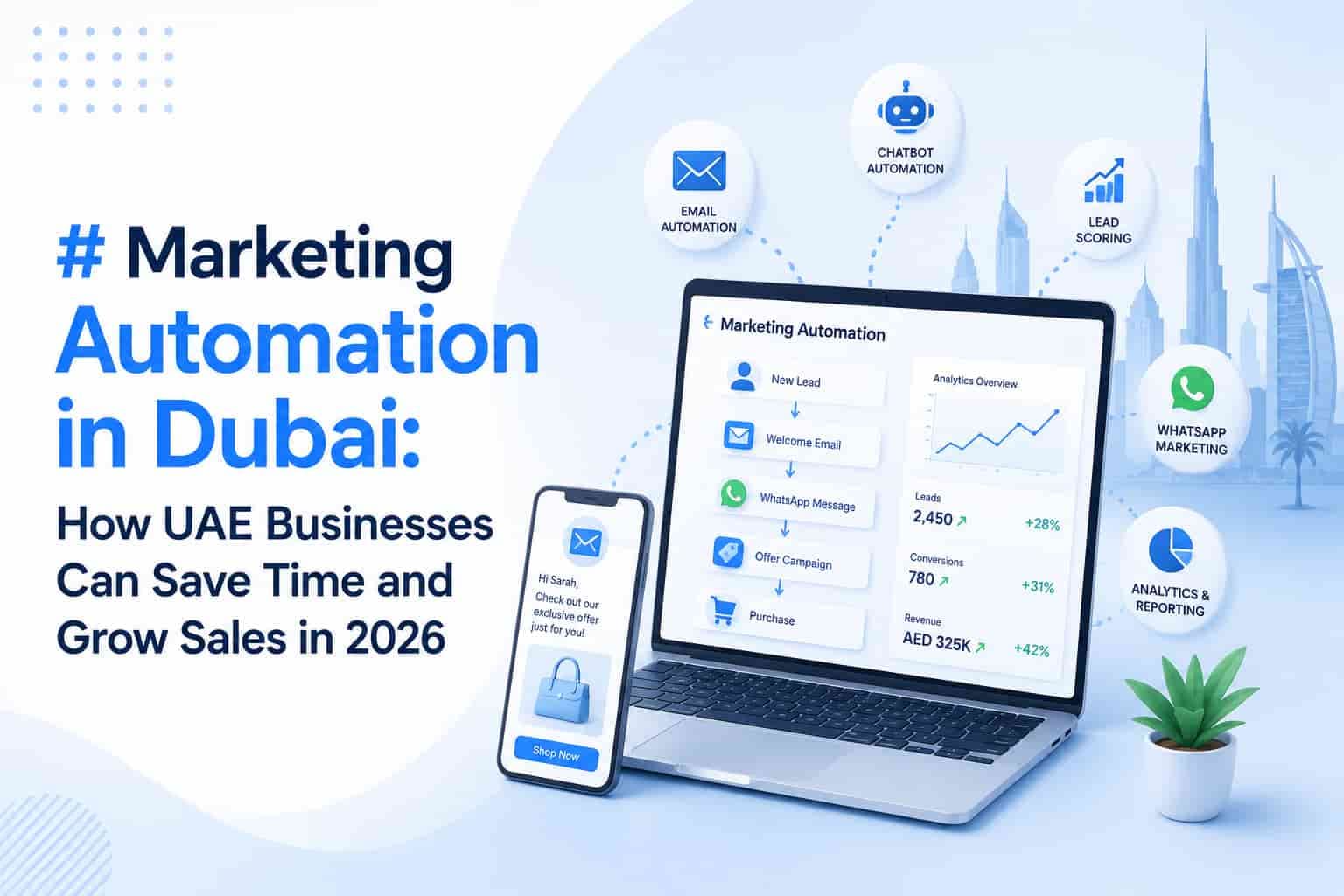
Running a business in Dubai in 2026 means competing in one of the most digitally connected markets on earth. With internet penetration at 99% and smartphones driving over 80% of web traffic across the UAE, customers expect brands to respond instantly, follow up consistently, and communicate on the channel of their choice — WhatsApp, email, SMS, or social media. Doing all of this manually simply doesn't scale, which is why more Dubai and UAE businesses are turning to marketing automation to keep up.
Marketing automation is no longer a "nice to have" reserved for large enterprises. Today, small businesses, e-commerce brands, real estate agencies, clinics, and service providers across the UAE are using automated workflows to capture leads, nurture them, and convert them into paying customers — often while the team is asleep.
What Is Marketing Automation?
Marketing automation refers to software and workflows that handle repetitive marketing tasks automatically, based on triggers such as a website visit, a form submission, an abandoned cart, or a customer's purchase history. Instead of a marketing team manually sending every email, WhatsApp message, or SMS, automation platforms send the right message to the right person at the right time — without constant manual effort.
Common examples businesses in the UAE are already using include:
Automated WhatsApp replies and follow-ups for new inquiries
Welcome email sequences for new subscribers or customers
Abandoned cart reminders for e-commerce stores
Appointment and booking reminders via SMS
Lead scoring and CRM follow-up tasks for sales teams
Re-engagement campaigns for inactive customers
Why Marketing Automation Matters for Dubai and UAE Businesses in 2026
The numbers make a strong case for why UAE businesses can no longer ignore automation. Globally, 76% of businesses now use some form of marketing automation technology, and companies that adopt it report a 451% increase in qualified leads on average. Automated email sequences alone generate 320% more revenue than one-off, non-automated sends.
For the UAE specifically, the opportunity is even bigger. With 11.3 million active social media identities, a 95% smartphone penetration rate heading into 2026, and 85% of email subscribers also active on WhatsApp, Dubai businesses have an unusually mobile-first, multi-channel audience. A customer might discover a brand on Instagram, ask a question on WhatsApp, and expect an email confirmation minutes later — automation is what keeps that experience seamless instead of chaotic.
The UAE's digital ad spend is projected to reach $2.64 billion by 2026, which means competition for attention is only going to intensify. Businesses that can respond faster and follow up more consistently than their competitors — without hiring a larger team — will have a clear edge.
How Marketing Automation Works
At its core, marketing automation follows a simple logic: trigger, condition, action. A potential customer takes an action (like filling out a contact form on your website), the system checks a condition (for example, whether they've shown interest in a specific service), and then it automatically performs an action — sending a WhatsApp message, adding them to an email sequence, or notifying your sales team.
Over time, these workflows can become more sophisticated, using customer behavior and purchase history to personalize messaging, score leads based on their likelihood to buy, and route hot leads directly to your sales team while nurturing colder ones automatically.
Key Marketing Automation Channels for UAE Businesses
WhatsApp Marketing Automation
WhatsApp remains the single most-used communication channel in the UAE, which makes it one of the most valuable channels to automate. Businesses use the WhatsApp Business API to send automated order confirmations, appointment reminders, delivery updates, and personalized offers — all while maintaining the instant, conversational feel customers expect. When paired with a CRM, WhatsApp automation can also route conversations to the right team member automatically.
Email Marketing Automation
Despite the rise of messaging apps, email automation continues to deliver strong returns, with studies showing an average return of roughly $36 for every $1 spent. Welcome series, abandoned cart flows, re-engagement campaigns, and post-purchase follow-ups are among the highest-performing automated email sequences for UAE e-commerce and service businesses.
SMS and Bulk Messaging Automation
SMS remains one of the fastest ways to reach customers in the UAE, with open rates far higher than email. Automated SMS is particularly effective for time-sensitive updates — appointment reminders, delivery notifications, flash sale alerts, and payment confirmations — where speed and reliability matter most.
CRM and Lead Nurturing Automation
A connected CRM ties every channel together. When a lead comes in from Google Ads, your website, or social media, automation can instantly assign it to a sales rep, trigger a personalized follow-up sequence, and track every interaction — so no lead ever falls through the cracks, even during busy periods like Dubai Shopping Festival or Ramadan promotions.
Benefits of Marketing Automation for Dubai Businesses
Faster response times: Automated replies ensure customers get an instant acknowledgment, which matters in a market where speed heavily influences conversion.
Consistent follow-up: No lead is forgotten because a team member got busy — automation follows up every time.
Lower marketing overhead: Businesses using mature automation report roughly a 12% reduction in marketing overhead alongside higher productivity.
Better personalization at scale: Automation allows businesses to send relevant messages to thousands of customers without manual segmentation.
Higher conversion rates: Automated lead nurturing can lift conversion rates significantly compared to manual, inconsistent follow-up.
Multi-channel consistency: Customers get the same brand experience whether they reach out via WhatsApp, email, or SMS.
Common Marketing Automation Mistakes to Avoid
Marketing automation delivers strong results, but only when it's set up correctly. Some of the most common mistakes UAE businesses should avoid include:
Automating too much, too soon: Start with one or two high-impact workflows (like WhatsApp follow-ups or abandoned cart emails) before building a complex automation ecosystem.
Poor data quality: Automation is only as good as the customer data feeding it. Outdated contact lists or inconsistent CRM entries lead to irrelevant messaging.
Ignoring compliance: WhatsApp and SMS marketing in the UAE must follow consent and opt-in requirements — automation should never bypass proper permissions.
Sounding robotic: Automated doesn't have to mean impersonal. Messages should still feel human, timely, and relevant to the customer's stage in the journey.
Never reviewing performance: Automated workflows need regular review and optimization; "set and forget" leads to declining results over time.
How to Get Started with Marketing Automation in Dubai
Map your customer journey: Identify every touchpoint — from first inquiry to repeat purchase — where automation could save time or improve response speed.
Choose the right channels: For most UAE businesses, WhatsApp and email automation deliver the fastest wins, with SMS and CRM workflows layered in as you scale.
Start with one workflow: A simple welcome sequence or WhatsApp auto-reply is a low-risk way to test automation before expanding.
Connect your data: Ensure your website, CRM, and messaging tools are integrated so customer information flows automatically between systems.
Measure and refine: Track open rates, response times, and conversions, then adjust your workflows based on real performance data.
How OMTEL Helps UAE Businesses with Marketing Automation
At OMTEL, we help Dubai and UAE businesses design and manage automated marketing workflows across WhatsApp, bulk SMS, email, and RCS messaging — connecting these channels so leads are captured, nurtured, and converted without manual effort. Whether you're a growing e-commerce brand that needs abandoned cart recovery, a real estate agency that wants instant WhatsApp follow-ups, or a service business looking to automate appointment reminders, our team builds automation strategies tailored to how your customers actually communicate in the UAE market.
Conclusion
Marketing automation has moved from a competitive advantage to a business necessity for companies operating in Dubai and the UAE. With a hyper-connected, mobile-first customer base and rising competition for attention, businesses that automate their follow-up, personalize their messaging, and stay consistent across WhatsApp, email, and SMS will consistently outperform those still relying on manual processes.
The good news is that you don't need a large team or a massive budget to get started — just the right strategy and the right partner. If you're ready to save time, capture more leads, and grow your business faster in 2026, OMTEL can help you build a marketing automation system designed specifically for the Dubai and UAE market. Get in touch with our team today to start automating your growth.