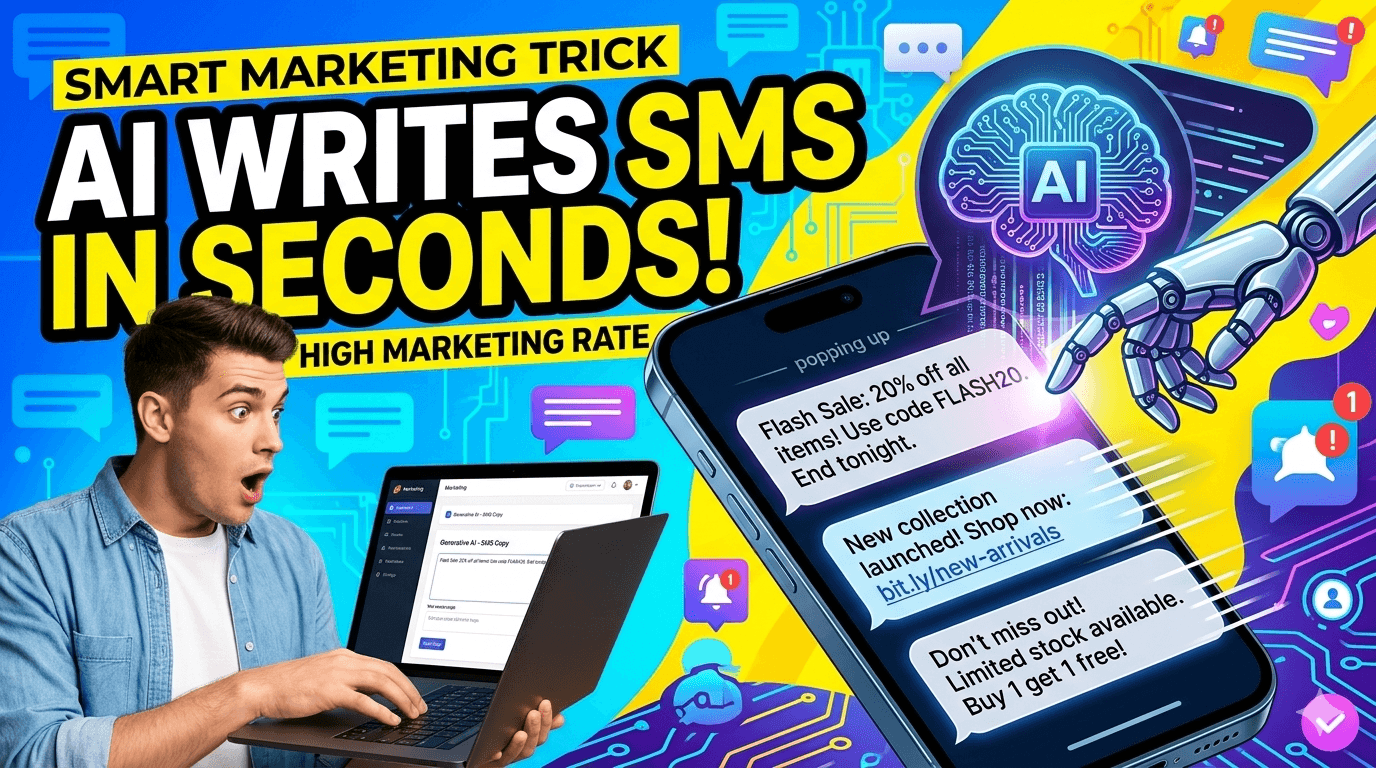
In today's fast-paced digital marketing landscape, speed and personalization are everything. SMS marketing boasts open rates of over 90%, making it one of the most powerful channels available to businesses. Yet crafting compelling, concise text messages that drive action — at scale — is a challenge many marketers face daily. That's where generative AI comes in.
Generative AI tools can now help marketers write high-quality SMS copy in seconds, not hours. Whether you're promoting a flash sale, sending appointment reminders, or re-engaging dormant customers, AI can generate, refine, and personalize messages with remarkable accuracy. In this guide, we'll walk you through everything you need to know — from the best AI tools available to practical prompting strategies and best practices for SMS marketing success.
Understanding Generative AI for SMS Marketing
Generative AI refers to artificial intelligence systems that can produce original content — text, images, code, and more — based on user inputs called prompts. For SMS marketing, these tools use large language models (LLMs) trained on massive datasets to understand context, tone, and intent, then generate relevant and engaging copy on demand.
Unlike traditional templates, generative AI doesn't just fill in blanks. It adapts to your brand voice, audience segment, campaign goal, and character limits — producing multiple variations you can test and deploy instantly. The result is smarter, faster, and more scalable SMS marketing.
5 Generative AI Tools for Writing SMS Copy
Not all AI tools are created equal. Here are five of the most popular options marketers are using today to generate SMS copy:
1. ChatGPT
Developed by OpenAI, ChatGPT is one of the most widely used AI writing tools. It excels at natural conversation and can generate creative, context-aware SMS messages quickly. Marketers can use it to brainstorm multiple message variations, adjust tone, and even simulate how different audience segments might respond to a campaign.
2. Writer
Writer is an enterprise-focused AI writing platform built for brand consistency. It allows teams to set custom style guides, vocabulary rules, and tone preferences — making it ideal for businesses that need SMS copy to stay strictly on-brand across large volumes of messages.
3. Jasper
Jasper is a marketing-specific AI tool that comes with templates designed for various campaign types, including SMS. Its built-in marketing intelligence helps users craft persuasive, conversion-optimized copy without needing deep copywriting expertise.
4. Claude
Claude, developed by Anthropic, is a highly capable AI assistant known for nuanced, thoughtful writing. It is particularly effective at following detailed instructions and producing SMS copy that feels human, contextual, and aligned with specific brand voices. Claude's ability to handle complex prompts makes it a strong choice for sophisticated marketers.
5. Perplexity
Perplexity combines AI generation with real-time web search, making it useful when you need SMS copy that references current events, trends, or promotions. It's a great option for time-sensitive campaigns where accuracy and relevance to today's context matter most.
Benefits of Using AI for SMS Marketing
1. Saves Time and Reduces Costs
Writing SMS copy manually for multiple campaigns, audience segments, and A/B test variations is time-consuming. Generative AI compresses that process from hours to minutes, freeing your team to focus on strategy and analysis. For small businesses and lean marketing teams especially, this efficiency translates directly into cost savings.
2. Sparks Creativity and Generates Multiple Variations
Even experienced copywriters hit creative blocks. AI tools can instantly generate dozens of message variations from a single prompt, giving you a wide pool of ideas to choose from. This is particularly valuable for A/B testing, where more variation options lead to better optimization outcomes.
3. Enables Personalization and Targeted Messaging
Modern consumers expect personalized experiences. AI tools can tailor SMS copy to different demographics, purchase histories, locations, and behavioral triggers — at scale. What once required a large content team can now be handled by a single marketer with the right AI tool and a well-structured prompt.
How to Create Effective Prompts for AI SMS Writing
The quality of your AI-generated SMS copy depends almost entirely on the quality of your prompt. Here's a step-by-step approach to writing prompts that produce great results:
1. Determine Your Use Case
Before writing a prompt, get clear on what you need. Are you announcing a sale? Sending a cart abandonment reminder? Promoting a loyalty reward? Defining your use case helps the AI understand what type of message to generate and what action you want the recipient to take.
2. Structure Your Prompt Clearly
A well-structured prompt includes: the objective (what the SMS should achieve), the audience (who will receive it), the tone (formal, casual, urgent, friendly), a character limit (typically 160 characters), and any key information such as discount percentages, deadlines, or product names. The more specific you are, the better the output.
3. Customize and Refine the Prompt
Once you have a base prompt, customize it for different segments or campaigns. For example, a prompt for VIP customers should differ from one targeting first-time buyers. Adding context about your brand, product, and audience nuances leads to significantly more relevant output.
4. Re-prompt to Improve the Output
AI rarely produces the perfect result on the first try — and that's okay. Use follow-up prompts to refine the output. Ask the AI to make the message more urgent, shorter, funnier, or more aligned with your brand voice. Iterating through two or three rounds typically yields copy that's ready to deploy.
Best Practices for AI-Generated SMS Marketing
1. Keep the Message Clear and Concise
SMS has strict character limits, and recipients typically scan messages in seconds. Even when AI generates longer copy, edit it down to ensure your core message and call-to-action are immediately clear. Every word should earn its place in a text message.
2. Use Personalization for Better Engagement
Instruct your AI tool to incorporate personalization tokens such as the recipient's first name, recent purchase, or location. Personalized messages consistently outperform generic ones in open rates and conversions. Most modern SMS platforms support dynamic fields that pair perfectly with AI-generated templates.
3. Test and Optimize AI-Generated SMS Copy
Never send just one version. Use AI to generate multiple message variations and run A/B tests to identify what resonates best with your audience. Track metrics like click-through rate, conversion rate, and opt-out rate to continually improve your AI prompting strategy and campaign performance.
Conclusion: Using Generative AI to Scale SMS Marketing
Generative AI has fundamentally changed what's possible in SMS marketing. What once required skilled copywriters, lengthy approval cycles, and hours of iteration can now be accomplished in seconds — with consistent quality and at any scale. Tools like ChatGPT, Claude, Jasper, Writer, and Perplexity each offer unique strengths, but all share the ability to dramatically accelerate your content workflow.
The key to success lies not just in choosing the right tool, but in mastering how to prompt it effectively. By clearly defining your use case, structuring detailed prompts, and iterating on the output, you'll quickly develop a repeatable process for producing high-performing SMS copy on demand.
As AI technology continues to evolve, the gap between brands that embrace these tools and those that don't will only widen. Start experimenting with generative AI for your SMS campaigns today — and discover how quickly great copy can become your competitive advantage.