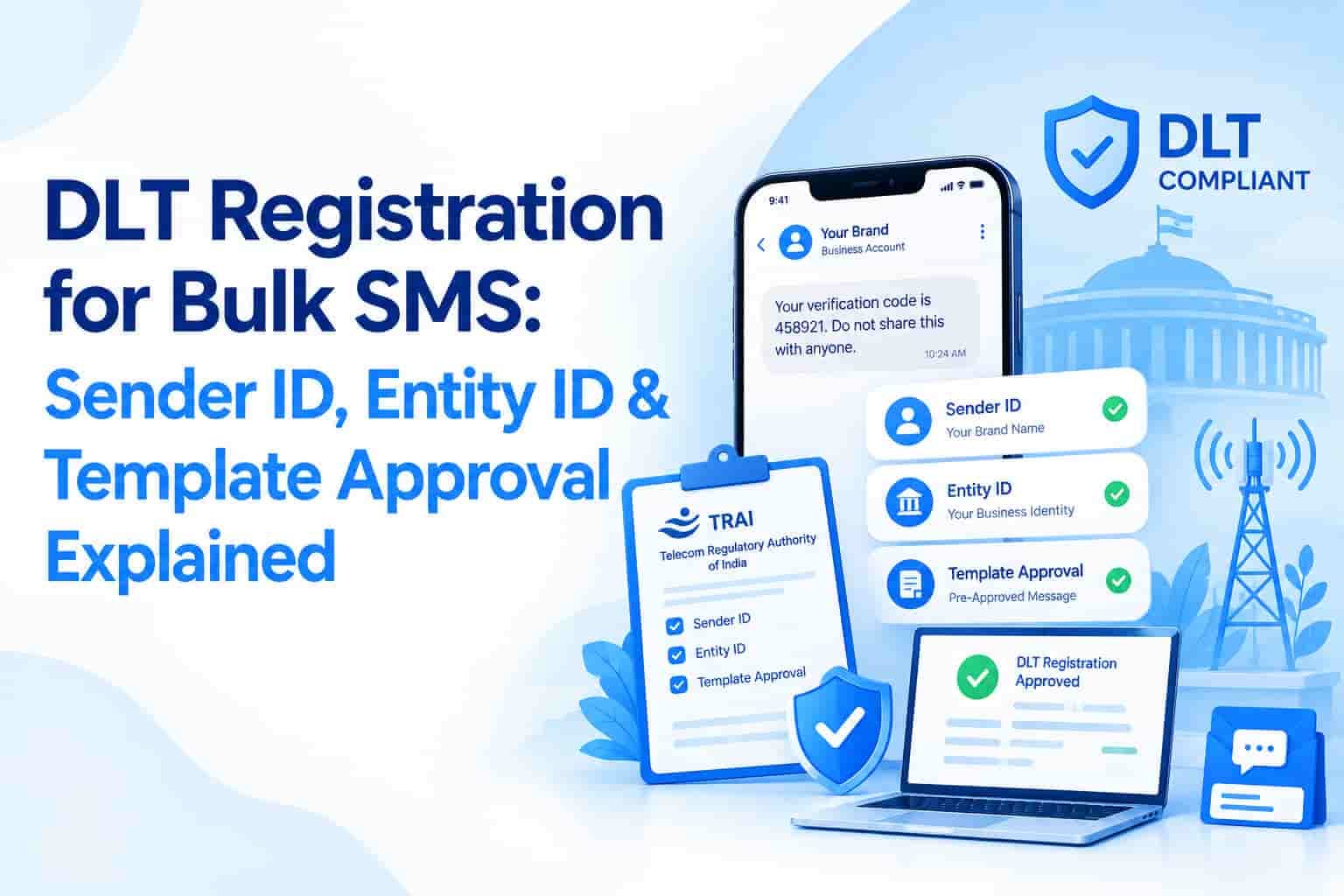
Any business planning to run a Bulk SMS program for the Indian market will run into one unavoidable requirement early on: DLT registration. Introduced by India's telecom regulator to curb spam and fraud, the Distributed Ledger Technology (DLT) framework requires every business, sender ID, and message template to be formally registered before a single message can legally be delivered. This guide walks through exactly what that process involves.
What Is DLT Registration and Why Does It Exist?
The Telecom Regulatory Authority of India (TRAI) mandates DLT registration to create a transparent, traceable record of who is sending commercial and transactional SMS, and to filter out unregistered spam before it ever reaches subscribers. Every business that wants to send Bulk SMS to Indian mobile numbers — whether transactional or promotional — must complete this registration through a telecom operator's DLT platform.
The Three-Part Registration Process
1. Entity Registration
The business itself must register as an "entity" on the DLT platform, providing company details, GST or business registration documents, and authorized signatory information. This step establishes a unique Entity ID that will be linked to every sender ID and template the business uses.
2. Sender ID (Header) Registration
Once the entity is approved, the business registers its Sender ID — the 6-character alphanumeric code (for example, OMTELS) that appears as the message sender. Each sender ID must be registered separately for transactional, promotional, and service-explicit categories, since each carries different sending rules.
3. Content Template Registration
Every message format a business intends to send must be pre-registered as a template, with dynamic fields marked as variables. Once approved, only the exact registered wording (with variable substitutions) can be sent — any deviation will cause the message to be blocked at the operator level.
Typical Timeline and Common Delays
Entity registration approval usually takes 3-7 business days depending on document accuracy.
Sender ID registration is typically faster, often 24-48 hours once the entity is approved.
Template approval delays are most often caused by mismatched variable counts, ambiguous wording, or promotional language mistakenly submitted under a transactional category.
Common Mistakes That Cause Rejections
Mismatched business documents: The company name on the DLT entity must exactly match official registration documents.
Vague template wording: Templates with unclear or overly generic placeholders are frequently sent back for revision.
Wrong category selection: Registering a promotional message under a transactional template category is one of the most common reasons for both rejection and later message blocking.
Missing variable brackets: Every dynamic value (OTP, name, order ID) must be explicitly marked as a variable during template submission.
Sample Template Submission Format
Template: Your order {#var#} has been shipped and will arrive by {#var#}. Track here: {#var#}
Approved and populated: Your order #4521 has been shipped and will arrive by Thursday. Track here: bit.ly/abcd123
Why This Matters for Bulk SMS Deliverability
Once DLT enforcement is active, any message sent from an unregistered sender ID or using an unapproved template is automatically blocked by the telecom operator before it ever reaches the subscriber — regardless of how well-configured your Bulk SMS platform otherwise is. Completing DLT registration correctly the first time is therefore not optional paperwork; it is a hard technical gate for delivery.
FAQs
Does DLT registration apply to OTP messages too?
Yes, though OTP (service-implicit) templates typically go through a slightly faster approval track than promotional templates, since they are considered essential transactional communication.
Can one sender ID be used for both promotional and transactional messages?
No. Sender IDs and their associated templates must be registered separately by category, and mixing categories under one header is a common cause of message blocking.
What happens if a message doesn't exactly match its registered template?
The message will typically be rejected at the operator level, since DLT filtering checks the sent content against the approved template pattern before allowing delivery.
Conclusion
DLT registration can feel like a bureaucratic hurdle, but it exists to protect the integrity of the entire Bulk SMS ecosystem by making every sender and every message traceable. Businesses that invest the time to get their entity, sender ID, and template registrations right from the start avoid the frustrating cycle of blocked messages and rejected campaigns later, and end up with a far more stable and predictable delivery pipeline.