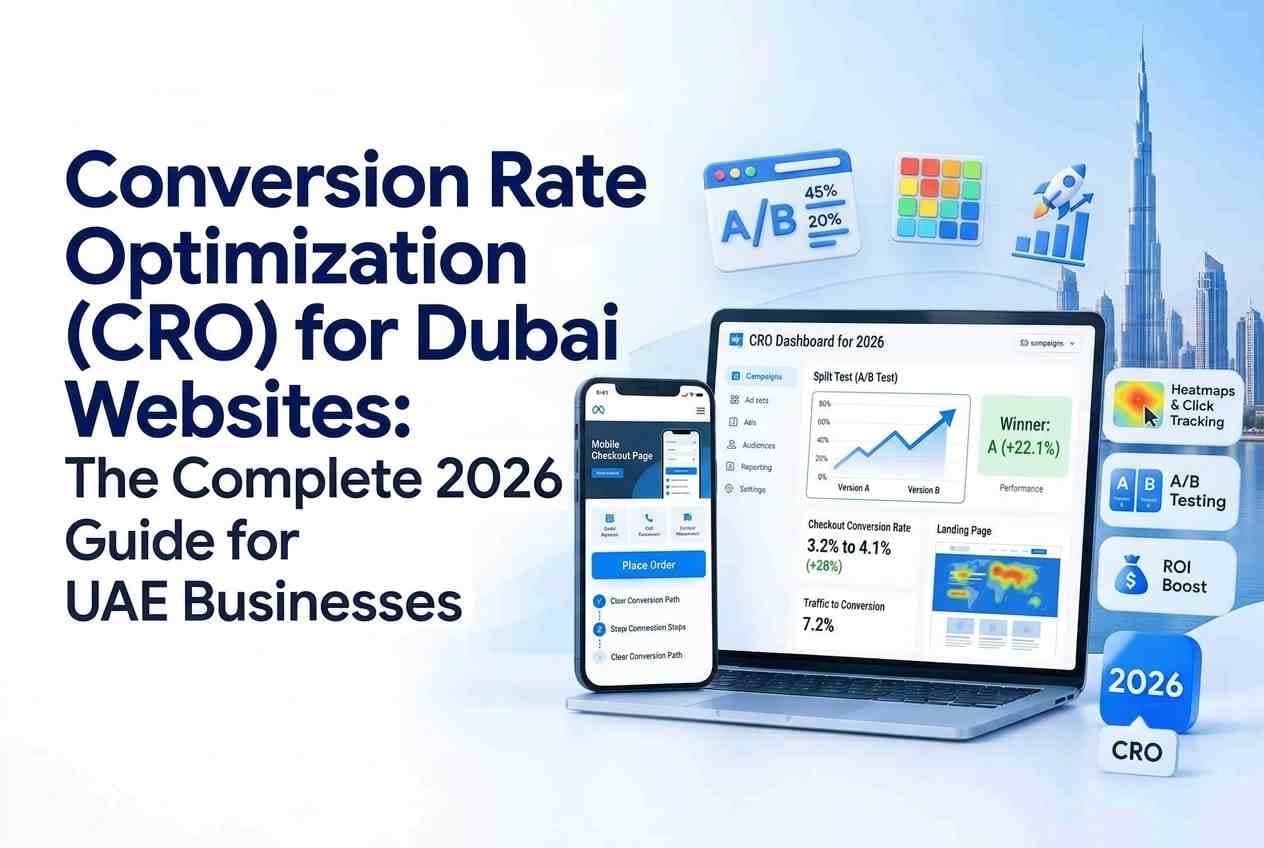
Most Dubai businesses solve a slow sales month the same way: spend more on ads. But if a website only converts 1–2% of its visitors, doubling the ad budget just means paying twice as much to convert the same tiny slice of traffic. Conversion Rate Optimization (CRO) — the discipline of turning more of your existing visitors into customers — is consistently the highest-ROI lever in UAE digital marketing, and one of the most under-used.
This guide covers what a realistic conversion rate looks like in 2026, the UAE-specific behaviours that quietly kill conversions on local websites, and a practical framework Dubai businesses can use to find and fix their biggest leaks.
Why CRO Matters More Than Traffic in Dubai's Market
The UAE is described by industry analysts as the most expensive digital ad market in the MENA region, with digital ad spend reaching an estimated USD 2.29 billion in 2025 and forecast to climb to USD 2.64 billion in 2026 — a 15.2% increase. In a market where every click costs more, a website that converts even one percentage point better effectively gives every dirham of ad spend a raise, without touching the media budget at all.
Dubai's e-commerce sector alone is projected to grow from AED 32.3 billion in 2024 to AED 50.6 billion by 2029 — meaning the businesses that fix their conversion funnel now compound that advantage over several years of category growth.
What Counts as a "Good" Conversion Rate in 2026?
Global benchmark data from mid-2026 puts the average e-commerce conversion rate at 2.03%, up from 1.85% a year earlier — but the number varies enormously by category:
Arts and crafts: 5.53%
Kitchen and home appliances: 2.84%
Pet care: 2.70%
Health and wellbeing: 2.58%
Fashion, clothing and accessories: 1.70%
Food and drink: 1.31%
Device performance matters too: mobile now drives roughly 63.5% of e-commerce sales globally but typically converts below desktop, which sits at around 35% of sales despite the smaller session share. Any Dubai brand benchmarking itself against a flat "2% conversion rate" target without adjusting for category and device is comparing against the wrong number.
The UAE-Specific Conversion Gap
Global benchmarks only tell half the story — UAE shopper behaviour has several distinct patterns that most website builds still ignore.
Mobile dominance is even more extreme locally. Smartphones processed an estimated 78.67% of all UAE e-commerce orders in 2025, well above the global mobile share, with mobile retail sales growing at roughly 15.6% annually.
Cash on delivery is still mainstream. Around 71.2% of UAE retailers still accept cash on delivery — a checkout option many international website templates omit entirely, quietly costing conversions from shoppers who don't want to pay online upfront.
Buy Now, Pay Later is a real conversion driver. Tabby and Tamara have become significant purchase drivers in the UAE; offering BNPL at checkout can influence conversion by an estimated 15–25%, particularly on higher-ticket items.
Page speed on mid-range Android over 4G is the real test. A meaningful share of UAE mobile shoppers are not testing your site on the latest iPhone over Wi-Fi — sites need to load in roughly 2 seconds on mid-range Android hardware over a 4G connection to stay competitive.
One documented case of mobile checkout optimization for a UAE retailer produced a 22% reduction in cart abandonment — a result achieved purely through fixing friction, without any change in traffic or ad spend.
The CRO Framework: Where to Find Your Biggest Wins
Effective CRO isn't a single fix — it's a repeatable process of measuring, testing, and validating changes across the whole funnel. A realistic timeline: early wins can appear within a few weeks of initial changes, but substantial, statistically validated uplift usually takes six to twelve weeks of coordinated testing.
Metrics to track, segmented by device, language, and emirate
Conversion rate (overall and by traffic source)
Average order value (AOV)
Revenue per visitor
Cart abandonment rate
Checkout completion rate
Time-to-purchase
Micro-conversions (email sign-ups, WhatsApp clicks, add-to-cart events)
Segmenting these by Arabic vs. English site version, mobile vs. desktop, and even by emirate can reveal gaps a blended, site-wide average completely hides — a common finding is that Arabic-language sessions convert differently from English ones simply because the Arabic version was translated as an afterthought rather than designed natively.
2026 CRO Trends: AI Personalization and Beyond
CRO in 2026 is increasingly shaped by AI tools that personalize the experience per visitor rather than testing one fixed version against another for everyone:
AI-driven personalization — dynamically adjusting product recommendations, offers, and even page layout based on a visitor's behaviour and likely intent, rather than showing every visitor the same homepage
Faster, AI-assisted A/B testing — tools that can identify a statistically significant result with less traffic than traditional split testing required, useful for UAE businesses that don't have the sheer visitor volume of global e-commerce brands
AI-generated UX audits — flagging friction points (confusing navigation, unclear CTAs, slow-loading elements) automatically rather than relying solely on manual heuristic review
None of these tools replace the fundamentals — they simply make it faster and cheaper for a mid-sized Dubai business to run a CRO program that previously required an enterprise budget.
Practical CRO Checklist for UAE Websites
Offer cash on delivery and at least one BNPL option (Tabby or Tamara) at checkout, not just card payment
Design and QA the Arabic version as its own site, not a machine-translated layer over the English one
Target sub-2-second load times on mid-range Android over 4G, not just on office Wi-Fi
Add a visible WhatsApp chat or click-to-WhatsApp CTA — UAE consumers frequently prefer messaging a business over filling out a contact form
Show trust signals prominently: UAE-specific delivery timelines, return policy, and any relevant Dubai Economy or free zone licensing details
Simplify checkout to the minimum number of steps and fields — every extra required field is a documented drop-off point
Test mobile checkout separately from desktop; don't assume a desktop-optimized flow works on a 6-inch screen
Common CRO Mistakes Dubai Businesses Make
Optimizing for global benchmarks, not UAE behaviour. A "best practice" checkout flow copied from a US case study may be missing cash-on-delivery or BNPL entirely.
Treating the Arabic site as secondary. Poor Arabic UX quietly caps conversion from a huge share of the addressable market.
Chasing traffic instead of fixing leaks. Increasing ad spend into a funnel that already loses most visitors at checkout compounds the waste rather than fixing it.
Running one big redesign instead of incremental tests. A full relaunch without testing individual changes makes it impossible to know which change actually helped — or hurt — conversion.
Frequently Asked Questions
What conversion rate should a Dubai e-commerce store aim for?
It depends heavily on category — fashion typically converts around 1.7%, while categories like health and wellbeing or home appliances can reach 2.5–2.9%. The more useful benchmark is your own site's trend over time, segmented by device and language, rather than a single industry-wide number.
Is cash on delivery still necessary for UAE e-commerce in 2026?
Yes. With an estimated 71.2% of UAE retailers still offering it, removing cash on delivery cuts off a checkout option a large share of local shoppers still expect, particularly for first-time purchases from a new brand.
How long does a CRO program take to show results?
Early wins can appear within a few weeks of initial fixes (like mobile checkout friction), but statistically reliable uplift from a structured testing program typically takes six to twelve weeks.
Does adding BNPL options really increase conversions?
Industry estimates suggest Buy Now, Pay Later availability can lift conversion by 15–25%, especially for higher-value purchases where splitting payments removes a real price objection.
Conclusion
Conversion rate optimization is the fastest way for a Dubai business to grow revenue without growing ad spend — but only when it accounts for how UAE shoppers actually behave: mobile-first, cash-on-delivery-friendly, increasingly BNPL-driven, and genuinely bilingual. A structured CRO program — tracking the right metrics, testing incrementally, and fixing the UAE-specific gaps most templates miss — consistently outperforms simply pouring more traffic into an unoptimized funnel. OMTEL helps UAE businesses audit their website and checkout experience and build a testing roadmap that turns existing traffic into more customers. Contact OMTEL to get a conversion audit of your website.