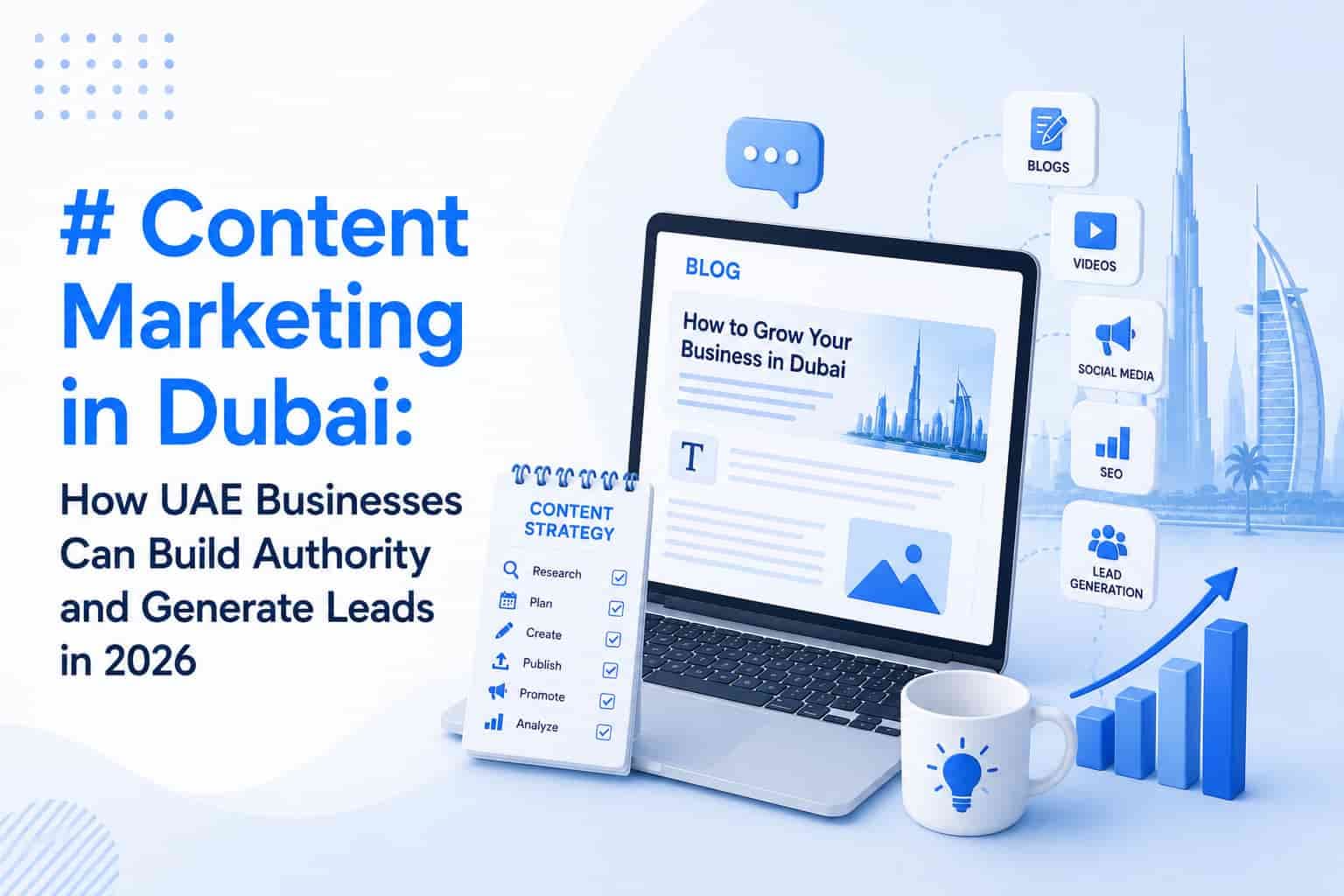
Dubai's digital economy runs on attention, and attention no longer goes to whoever shouts the loudest — it goes to whoever teaches, helps, or entertains best. That shift is exactly why content marketing in Dubai has moved from a "nice to have" to the backbone of every serious growth strategy heading into 2026. From real estate developers publishing neighbourhood guides to fintech startups explaining UAE compliance in plain English, the businesses winning search rankings and customer trust are the ones investing in useful, consistent content.
This guide breaks down why content marketing matters more than ever for UAE businesses, the biggest trends reshaping the industry in 2026, and a practical framework any Dubai brand can use to build authority, traffic, and qualified leads.
What Is Content Marketing, and Why Does It Matter in the UAE?
Content marketing is the practice of creating and distributing valuable content — blogs, videos, guides, social posts, newsletters — to attract, educate, and retain a clearly defined audience, rather than interrupting them with direct advertising. Done well, it builds trust before a prospect ever speaks to a salesperson.
For UAE businesses, this matters for a very specific reason: the market is saturated with paid advertising. Dubai's digital ad spend is growing at roughly 17.7% CAGR, which means CPCs and CPMs across Google and social platforms keep climbing every year. Content marketing offers a way to generate visibility and leads that doesn't get more expensive every time a competitor raises their ad budget.
Why Dubai and UAE Businesses Can't Ignore Content Marketing in 2026
The numbers make the case clearly. The UAE has around 11.2 million internet users, close to 99% of the population, and social media penetration exceeds 110% because most residents run multiple active accounts across platforms. That's an enormous, highly connected audience — but only for brands that show up with content worth their time.
On the return side, global data shows content marketing consistently outperforms paid channels on cost efficiency:
Content marketing generates roughly 3x more leads than outbound marketing, at about 62% lower cost per lead.
Average cost per lead from content sits around $92, compared to roughly $242 from paid search.
Businesses with a documented content strategy generate 3x more leads per dollar spent than those without one.
Content marketing can deliver an average ROI of 448% over 36 months as evergreen articles keep compounding in traffic and leads.
For Dubai SMEs and startups competing against well-funded regional players, that compounding effect is often the difference between a marketing budget that scales with growth and one that gets eaten alive by rising ad costs.
Key Content Marketing Trends Shaping the UAE in 2026
1. Generative Engine Optimization (GEO)
Search behaviour in the UAE is no longer limited to Google's blue links. Increasingly, customers ask ChatGPT, Google AI Overviews, and other AI assistants for recommendations before they ever open a search results page. Dubai businesses now need content structured to be understood and cited by AI systems — clear headings, direct answers near the top of the page, and well-organised facts — not just optimised for traditional keyword rankings.
2. Bilingual, Hyper-Local Content
Treating "the UAE" as one audience is a mistake. Dubai skews toward English-first messaging for a young, international population, while Abu Dhabi audiences respond better to Arabic-first content. Natively written Arabic content consistently outperforms direct translation, both in engagement and in search visibility, because it reflects real local phrasing and search intent rather than a literal conversion of English copy.
3. Short-Form Video as a Discovery Engine
Instagram Reels, TikTok, and YouTube Shorts have become primary product discovery tools for UAE consumers, not just entertainment. Video content now delivers the highest engagement of any format — data shows video achieves engagement rates around 72%, and marketers report roughly 87% positive ROI from video investment. Brands that pair short-form video with their written content see stronger reach across both search and social.
4. AI-Assisted, Human-Led Content
AI tools are now part of daily workflow for most content teams — around 67% of content marketers use AI tools every day, and hybrid AI-plus-human workflows can produce roughly 34% more content at equivalent quality. But there's a warning sign in the data too: purely AI-generated content, with no human editing, review, or local expertise added, tends to see ranking performance decline by around 23% within 12 months. For Dubai brands, the winning formula is AI-assisted drafting combined with a human editor who understands the UAE market, tone, and compliance requirements.
5. First-Party Data and Compliant Content
The UAE's Personal Data Protection Law (Federal Decree-Law No. 45 of 2021) is pushing businesses away from third-party data and toward owned audiences. Practically, this means content that captures genuine, consented engagement — newsletter sign-ups, WhatsApp opt-ins, gated guides — is becoming more valuable than ever, because it builds a direct, compliant channel to your audience that isn't dependent on any single platform's algorithm.
How to Build a Content Marketing Strategy for Your Dubai Business
Step 1: Define Your Audience and Goals Before You Write Anything
Every effective content plan starts with a clear picture of who you're writing for — a Dubai property investor, a UAE HR manager, a Sharjah-based online shopper — and what action you want them to take. Vague "content for everyone" strategies rarely rank or convert.
Step 2: Build Long-Form Pillar Content
In-depth blog posts still do the heaviest lifting for organic visibility. Long-form content (2,000+ words) earns roughly 77% more backlinks than shorter posts, and long-form articles overall generate about 56% more leads than short-form content. B2B content in particular tends to generate around 67% more leads per post than typical B2C content, since UAE buyers usually engage with several pieces of content — often 3 to 7 — before ever contacting a business.
Step 3: Repurpose Across Channels
A single well-researched article can become a LinkedIn carousel, an Instagram Reel script, a WhatsApp broadcast, and an email newsletter. Given WhatsApp penetration of roughly 85% in the UAE, pairing content marketing with WhatsApp distribution is one of the most effective ways to get UAE audiences to actually see and act on your content.
Step 4: Localise, Don't Just Translate
Write separate versions for Dubai's international audience and Abu Dhabi's Arabic-first market where it makes sense, rather than running one generic version across the whole UAE.
Step 5: Track Content ROI, Not Just Traffic
Only about 19% of content marketers currently track AI- and content-specific KPIs properly — and the ones who do see roughly 2.4x better content ROI than those who don't. Track leads, assisted conversions, and cost per lead by content piece, not just pageviews.
Common Content Marketing Mistakes UAE Businesses Should Avoid
Publishing without a strategy: random, inconsistent posting rarely builds the compounding traffic that makes content marketing cost-effective.
Ignoring Arabic-first audiences: a single English-only strategy leaves significant UAE market share untapped.
Publishing unedited AI content: content with no human review or local expertise tends to lose rankings within a year.
Not repurposing content: writing one blog and never turning it into video, social, or WhatsApp content wastes most of its potential reach.
Skipping measurement: without tracking which content actually drives leads, budgets get wasted on formats that don't perform.
The businesses that will lead Dubai's digital economy in 2026 aren't necessarily the ones spending the most on ads — they're the ones consistently publishing content that ranks, gets cited by AI tools, and earns trust before the first sales conversation even happens.
How OMTEL Helps Dubai Businesses Grow With Content
At OMTEL, we work with Dubai and wider UAE businesses to build content strategies that combine SEO-optimised blogs, WhatsApp and SMS distribution, social media content, and AI-assisted (human-reviewed) workflows — so content doesn't just get published, it actually drives leads. Whether you're starting from zero or need to fix a content plan that isn't converting, a structured, locally aware approach makes the difference between content that sits unread and content that compounds into real business growth.
Conclusion
Content marketing has become one of the most cost-effective, sustainable growth channels available to Dubai and UAE businesses in 2026. With rising ad costs, an increasingly AI-driven search landscape, and a highly connected but discerning local audience, brands that invest in well-researched, locally relevant, and properly measured content are positioned to build lasting authority rather than chasing short-term clicks.
Whether it's long-form SEO blogs, bilingual content for Dubai and Abu Dhabi audiences, or short-form video paired with WhatsApp distribution, the UAE businesses that treat content as a long-term asset — not a one-off campaign — will be the ones generating consistent, compounding leads well beyond 2026. If your business is ready to build a content strategy that actually drives results, now is the time to start.