Why the Provider You Choose Matters More Than It Seems
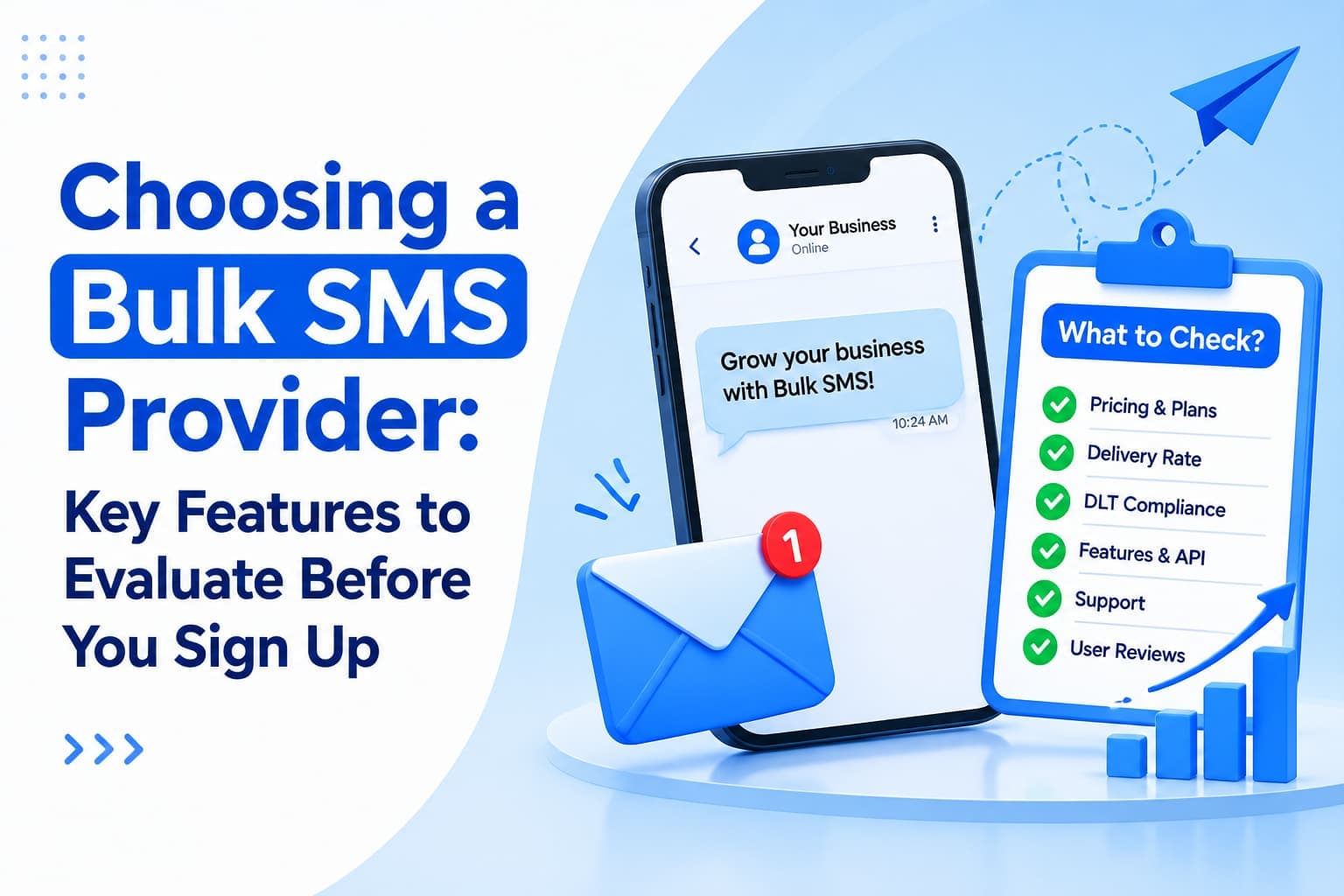
Picking a bulk SMS provider often gets treated as a simple pricing comparison, but the choice affects far more than cost per message. Delivery reliability, compliance support, API quality, and customer support responsiveness all shape whether your SMS program actually works at scale — or quietly underperforms in ways that are hard to diagnose until a critical campaign fails to deliver.
Delivery Rate and Route Quality
Not all SMS routes are equal. Some providers rely on cheaper, lower-priority routes that sacrifice delivery speed and reliability for lower per-message cost, which can mean promotional messages arrive hours late or transactional OTPs fail during peak traffic periods when speed matters most. Ask any prospective provider for real delivery rate data, ideally segmented by carrier and message type, rather than relying on a single blended average that can mask weak performance on specific routes.
Compliance and Registration Support
In India, DLT registration is mandatory, and the process can be genuinely confusing for businesses navigating it for the first time. A strong provider actively guides entity registration, sender ID approval, and template whitelisting rather than leaving the business to figure out TRAI's requirements independently. This support becomes even more valuable for businesses also sending to other countries, where compliance frameworks differ entirely from India's DLT system.
API Quality and Documentation
For businesses integrating SMS into their own applications or e-commerce platforms, API reliability and documentation quality directly affect development time and ongoing maintenance burden. Look for:
Clear, complete documentation with working code examples, not just endpoint lists
Webhook support for real-time delivery status updates
Reasonable rate limits that match your actual sending volume needs
Sandbox or testing environments to validate integration before going live
A provider with a thin or outdated API, even at an attractive price point, can cost far more in developer hours than a slightly more expensive option with genuinely well-built integration tools.
Scalability for Growing Volume
A provider that works well at 10,000 messages a month may struggle at 10 million. Ask specifically about throughput limits, how pricing scales at volume, and whether infrastructure genuinely supports sudden spikes — a flash sale or festive campaign that sends a huge batch in a short window shouldn't cause delivery delays or require advance notice to the provider every time volume increases.
Support Responsiveness When Things Go Wrong
Every SMS program eventually hits an issue — a blocked sender ID, a delivery failure, a compliance question. How quickly and competently a provider's support team resolves these moments matters enormously, particularly for transactional use cases like OTPs where a delivery outage directly affects customer-facing functionality like login or checkout. Testing support responsiveness before committing, rather than discovering it during an actual crisis, is worth the extra diligence upfront.
Evaluating Total Cost, Not Just Per-Message Price
The cheapest per-message rate rarely reflects the true cost of a provider relationship once delivery failures, compliance delays, and support friction are factored in. Comparing providers on delivery rate, compliance support, and API quality alongside price gives a far more accurate picture of total value than a simple per-message cost comparison alone.
Conclusion
Choosing a bulk SMS provider is a decision that affects delivery reliability, compliance risk, and development effort for as long as the relationship lasts — not just a line item on a pricing sheet. Evaluating delivery rate, DLT and regulatory support, API quality, scalability, and support responsiveness together, rather than defaulting to the lowest per-message price, leads to a far more dependable foundation for any serious bulk SMS program.