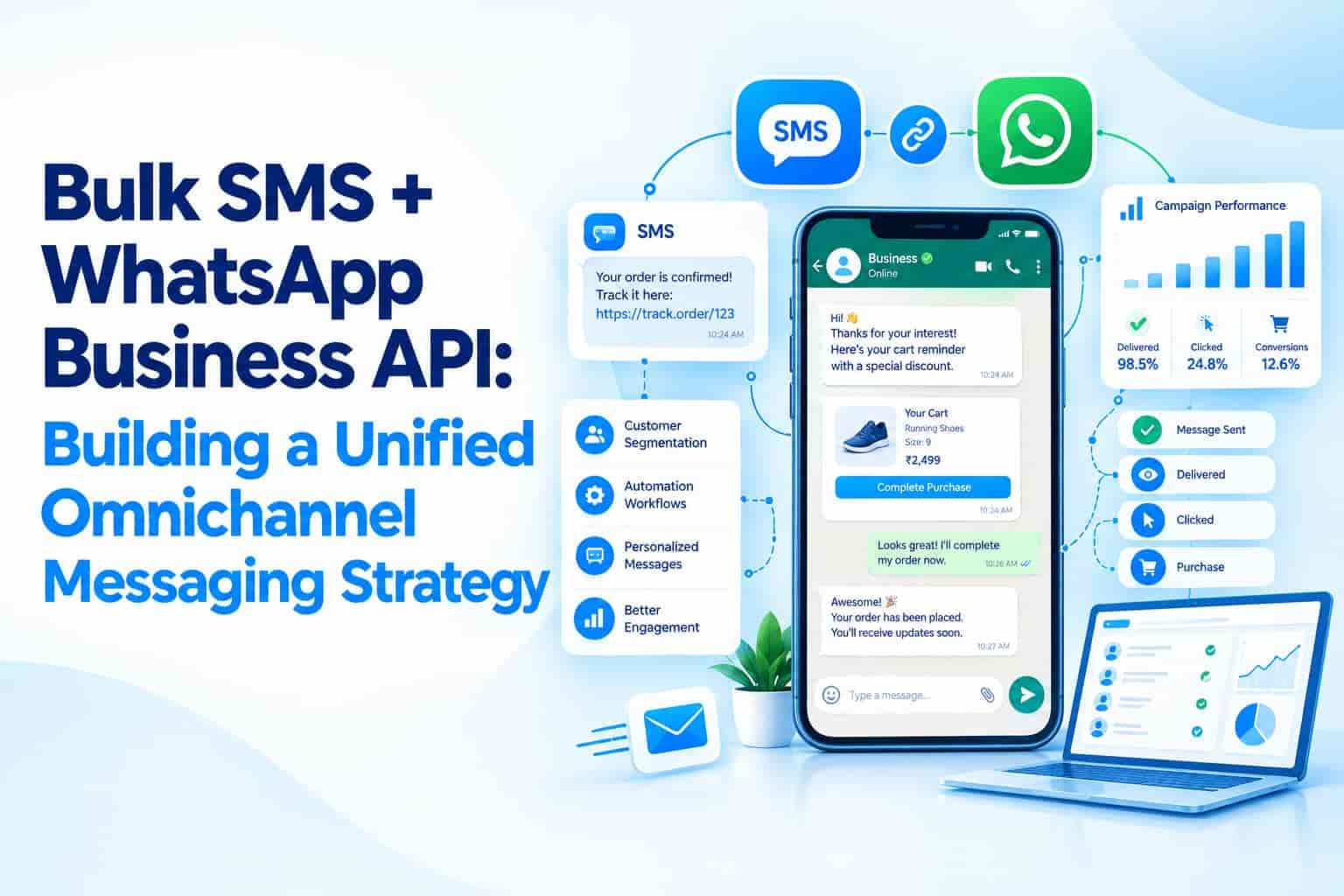
No single messaging channel reaches every customer every time. Some customers live inside WhatsApp and ignore texts; others never install messaging apps and rely entirely on their inbox. Businesses that combine Bulk SMS with the WhatsApp Business API build a messaging strategy that is resilient to both scenarios, rather than betting the entire customer journey on one channel.
Why Rely on One Channel When You Can Layer Two?
SMS and WhatsApp solve different problems. SMS works on every phone, requires no internet connection, and is universally trusted for time-sensitive alerts. WhatsApp, on the other hand, supports rich media, two-way conversation, and higher engagement for content that benefits from images, buttons, or catalogs. An omnichannel approach uses each channel for what it does best instead of forcing every message into a single format.
Designing an Omnichannel Messaging Flow
Step 1: Channel-first routing based on message type
Time-critical alerts — OTPs, delivery updates, payment failures — should default to Bulk SMS because it guarantees reach regardless of internet connectivity. Rich, conversational content — product catalogs, support conversations, personalized offers — performs better on WhatsApp.
Step 2: Fallback logic
A strong omnichannel system attempts WhatsApp first for cost efficiency and richer engagement, then automatically falls back to Bulk SMS if the WhatsApp message is not delivered or read within a defined time window (commonly 10-30 minutes).
Step 3: Consistent identity across channels
Use the same sender name, tone, and branding across both SMS and WhatsApp so customers recognize your business regardless of which channel a message arrives through.
Practical Use Cases for Combining Both Channels
Order journeys: Send the initial order confirmation on WhatsApp with a rich order summary card, then fall back to Bulk SMS for the final delivery OTP to ensure it's received even without data connectivity.
Appointment reminders: Send the first reminder on WhatsApp with rescheduling buttons, and a same-day SMS reminder as a guaranteed backup.
Payment recovery: Use WhatsApp for a friendly payment reminder with an embedded pay-now link, and Bulk SMS as the escalation channel closer to the due date.
Customer support: Handle detailed conversations on WhatsApp, but use SMS to notify customers when a support ticket has been resolved if they have gone inactive on WhatsApp.
Sample Messages Across Channels
WhatsApp (rich, first attempt)
Hi Aisha, your order #7734 is confirmed! 🛍️ Track your delivery and manage your order here: [link]
Bulk SMS (fallback, guaranteed reach)
Order #7734 confirmed. Delivery expected by Fri. Track: [link]
Measuring Omnichannel Performance
Track delivery and read rates separately for each channel to understand where your audience actually engages.
Monitor how often the fallback-to-SMS logic triggers — a consistently high fallback rate may indicate WhatsApp opt-in numbers need cleaning or re-verification.
Compare cost-per-conversion between channels, since WhatsApp session pricing and Bulk SMS per-message pricing behave very differently at scale.
FAQs
Is it more expensive to run both SMS and WhatsApp?
It can cost more per customer touchpoint, but the combined approach typically increases overall delivery and conversion rates enough to offset the added cost, since fewer customers are missed entirely.
How do you decide which channel to try first?
Most businesses default to WhatsApp for cost and richness when a customer has opted in and has an active WhatsApp number, reserving Bulk SMS as the universal-reach fallback and for anything strictly time-sensitive.
Do customers need to opt in separately for SMS and WhatsApp?
Yes. Consent for one channel does not automatically extend to the other, so businesses should capture and manage opt-in preferences independently for each channel.
Conclusion
An omnichannel strategy that pairs Bulk SMS with the WhatsApp Business API gives businesses the best of both worlds — the universal reliability of SMS and the rich engagement of WhatsApp. Rather than choosing one channel over the other, the smarter approach is designing a flow where each channel picks up exactly where the other falls short, so no customer ever falls through the cracks.