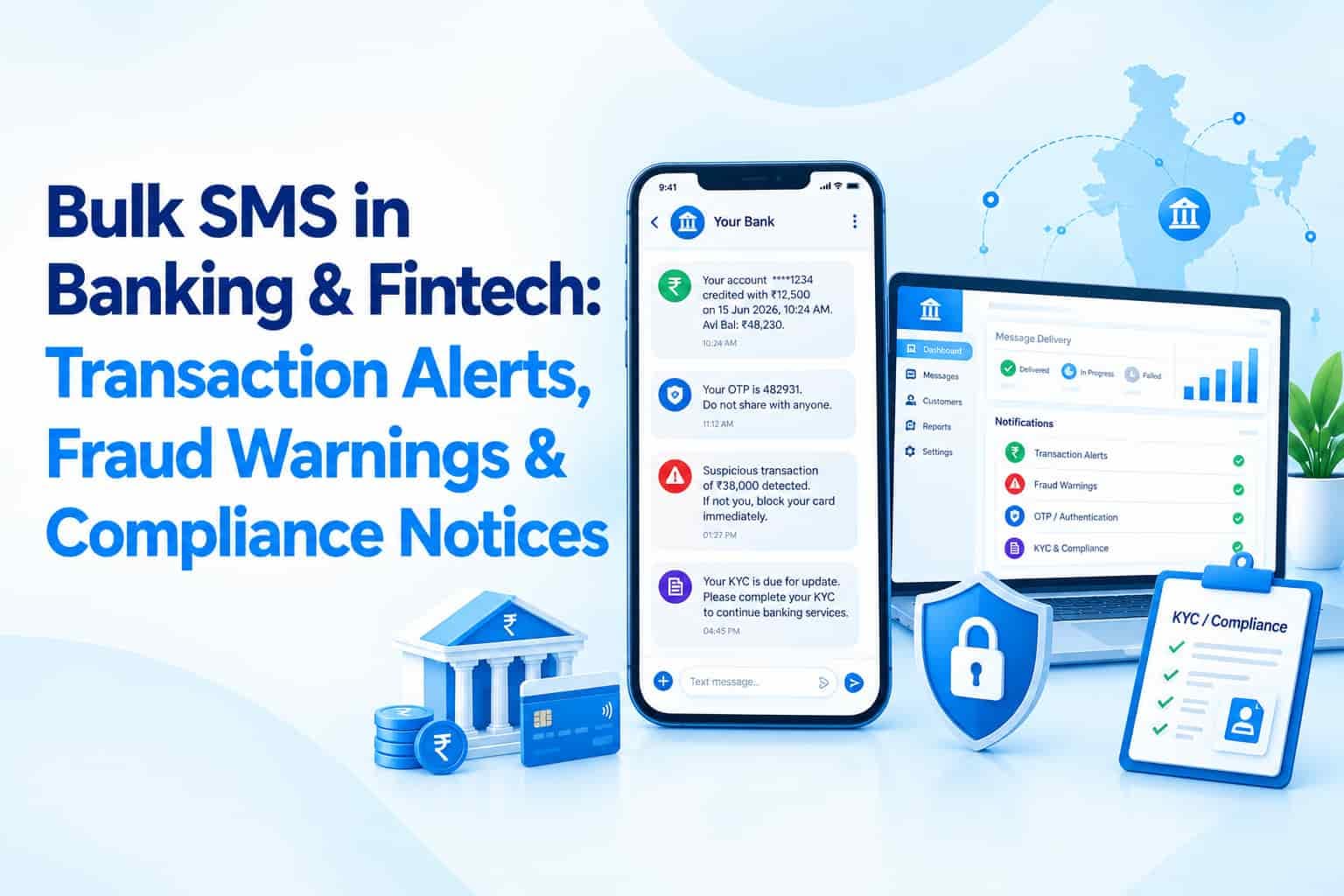
In banking and fintech, a delayed message is not a minor inconvenience — it can mean a missed fraud alert, a confused customer during a failed transaction, or a compliance gap. That is why financial institutions rely so heavily on Bulk SMS infrastructure built for speed, guaranteed delivery, and airtight audit trails.
Why Banking and Fintech Depend on Bulk SMS
Unlike app notifications or email, SMS reaches customers instantly regardless of whether they have a banking app open, a data connection, or even a smartphone. For time-sensitive financial events, this universal reach is not a convenience — it is often a regulatory expectation and a core part of fraud prevention infrastructure.
Core Categories of Financial SMS Alerts
Transaction alerts
Real-time notifications for debits, credits, ATM withdrawals, and card usage give customers immediate visibility into account activity, which is often the first line of defense against unauthorized transactions.
Fraud and security warnings
Unusual login attempts, card usage in a new location, or multiple failed PIN attempts should trigger an immediate Bulk SMS alert, giving customers a chance to act (such as freezing a card) before further damage occurs.
Regulatory and compliance notices
Statement availability, interest rate changes, KYC update requests, and mandatory disclosures are often required by regulation to be communicated promptly, and SMS provides a documented, timestamped delivery record.
Payment and billing reminders
Credit card due date reminders, EMI payment alerts, and low-balance warnings help customers avoid late fees while reducing delinquency for the institution.
What Makes Financial-Grade Bulk SMS Different
Guaranteed uptime and redundancy: Financial institutions typically require multi-route failover so that if one telecom route degrades, alerts automatically shift to a backup route without manual intervention.
Strict template accuracy: Financial SMS templates must be worded precisely, since ambiguous language around balances or transactions can create liability.
Auditable delivery logs: Every alert needs a timestamped delivery record that can be retrieved during a dispute or regulatory audit.
Data security in transit: Financial Bulk SMS platforms must ensure customer data and account details are handled securely from the point of message generation through delivery.
Sample Financial SMS Templates
₹15,000 debited from A/c XX4521 on 12-Sep at ATM. Available balance: ₹42,310. Not you? Call our helpline immediately.
Login attempt detected from a new device on 12-Sep, 10:42 PM. If this wasn't you, secure your account now: [link]
Your credit card payment of ₹8,200 is due on 18-Sep. Pay now to avoid late fees: [link]
Handling High-Stakes Fraud Alerts
Fraud-related Bulk SMS should be treated with the same urgency as OTP delivery — routed through the highest-priority gateway available, sent without delay, and ideally paired with a clear, immediate call to action such as a helpline number or an in-app link to freeze the account.
FAQs
Are financial SMS alerts legally required?
In many jurisdictions, certain transaction and security alerts are mandated by banking regulators as part of consumer protection requirements, though specific rules vary by market and institution type.
Can fraud alerts be delayed if SMS volume is high?
They shouldn't be — financial institutions typically route fraud and security alerts through dedicated high-priority channels precisely to avoid queuing delays during high-volume periods.
Why not rely solely on push notifications instead of SMS?
Push notifications require an active app installation, internet connectivity, and notification permissions — any one of which can fail, making SMS the more dependable channel for critical financial alerts.
Conclusion
For banks and fintech companies, Bulk SMS is not a marketing convenience — it is core infrastructure for trust, security, and regulatory compliance. Getting transaction alerts, fraud warnings, and compliance notices right requires prioritizing speed, accuracy, and auditability above all else, since the cost of a delayed or poorly worded financial SMS is measured in customer trust and potential liability, not just a missed engagement metric.