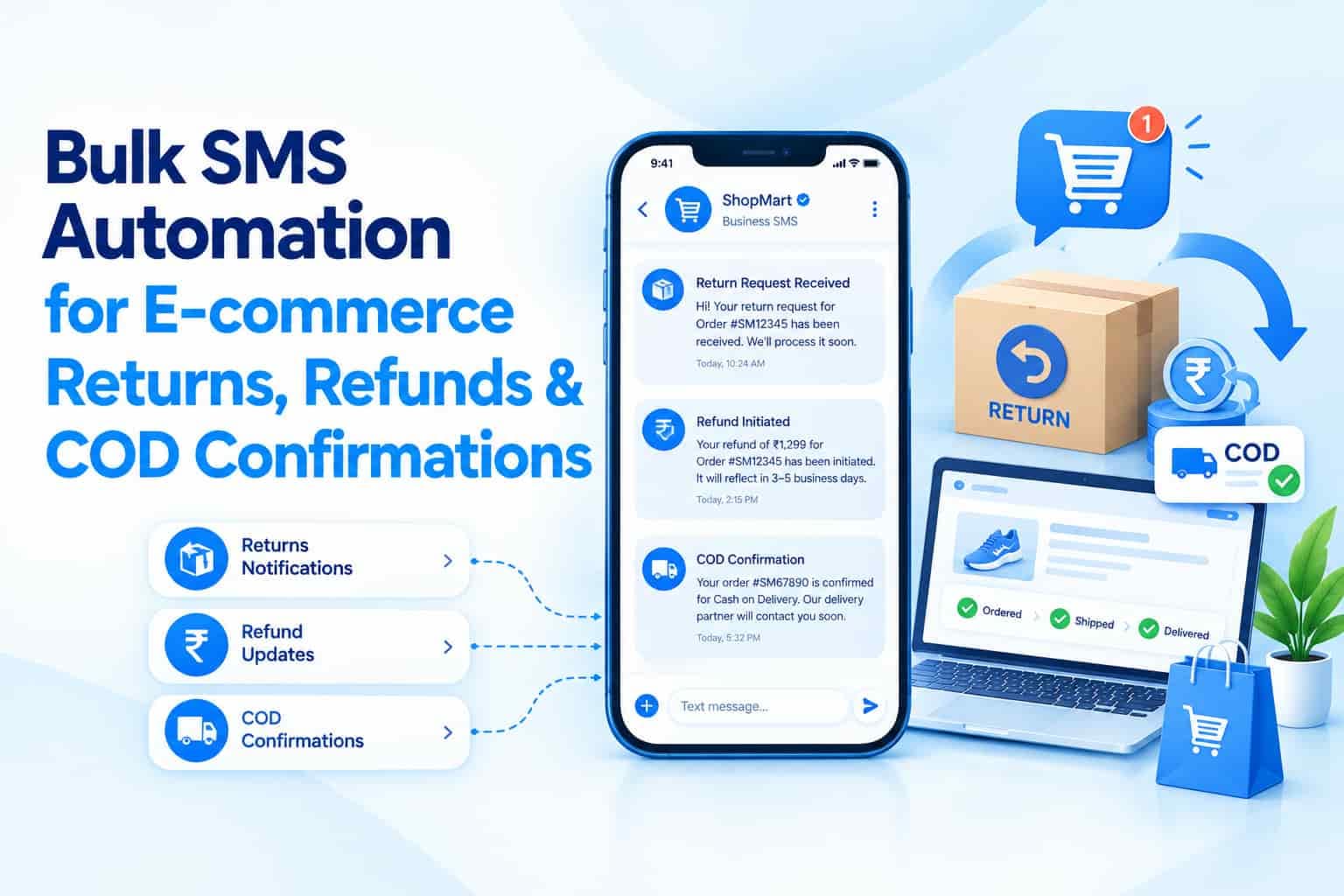
Order confirmations get all the attention, but the post-purchase moments that actually test customer trust are returns, refunds, and cash-on-delivery confirmations. A well-designed Bulk SMS workflow around these three moments can turn a potentially frustrating experience into one that feels transparent and well-managed.
Why Returns and Refunds Need Their Own SMS Workflow
Customers requesting a return are already in a slightly negative mindset, and uncertainty about status makes it worse. Automated Bulk SMS updates at each stage of the return and refund process reduce support ticket volume and reassure customers that their request is actually being processed, rather than leaving them to guess.
Mapping the Returns & Refunds SMS Journey
1. Return request acknowledgement
Sent immediately when a customer initiates a return, confirming the request has been received and outlining next steps (pickup scheduling, drop-off location, or self-ship instructions).
2. Pickup or drop-off confirmation
Sent once a pickup is scheduled or a returned item is received at the warehouse, giving the customer a concrete checkpoint.
3. Quality check and approval
Sent after the returned item passes inspection, confirming the refund process has officially started.
4. Refund initiated and completed
Two separate messages — one confirming the refund has been initiated to the original payment method, and a second once the amount actually reflects, since these can be several days apart and customers often assume the process has stalled without a clear update.
Cash-on-Delivery (COD) Confirmation Workflow
COD orders carry higher fraud and return risk than prepaid orders, which is why many e-commerce businesses use Bulk SMS to confirm the order before it ships.
Pre-shipment COD confirmation
A quick SMS asking the customer to confirm the order (often with a simple reply keyword) significantly reduces COD return-to-origin rates, since it filters out impulse or accidental orders before dispatch resources are spent.
Payment collection confirmation
Once the delivery agent collects payment, a confirmation SMS with the amount collected protects both the business and customer by creating a clear record of the transaction.
Sample Message Templates
Return request for order #8821 received. We'll pick up your item within 2-3 business days. Details: [link]
Good news! Your return for order #8821 has been approved. Refund of ₹1,499 has been initiated to your original payment method.
Please confirm your COD order #9034 worth ₹2,199 by replying YES. Orders not confirmed within 24 hrs may be cancelled.
Payment of ₹2,199 collected for order #9034. Thank you for shopping with us!
Why This Reduces Support Load
Customers who receive proactive Bulk SMS updates are significantly less likely to contact support asking "where is my refund," since the status is already visible in their messages.
COD pre-confirmation messages reduce failed delivery attempts, saving logistics costs on undeliverable or refused orders.
A documented SMS trail for refunds and COD collections gives customer service teams a fast reference point when disputes do arise.
FAQs
How many SMS updates should a return/refund journey include?
Most businesses find 3-4 touchpoints (acknowledgement, pickup/receipt, approval, refund completion) strikes the right balance between transparency and message fatigue.
Does COD confirmation SMS actually reduce return rates?
Yes — many e-commerce operators report a meaningful drop in COD return-to-origin incidents after introducing a simple reply-to-confirm step before dispatch.
Should refund SMS include the exact amount?
Yes, including the exact refund amount reduces ambiguity and pre-empts a common category of customer support questions about partial or delayed refunds.
Conclusion
Returns, refunds, and COD confirmations are often the least glamorous part of e-commerce operations, but they are exactly where customers form lasting impressions of a brand's reliability. A thoughtfully sequenced Bulk SMS workflow across these moments reduces support burden, builds trust during an already uncertain process, and gives both the business and the customer a clear, timestamped record of what happened at every step.