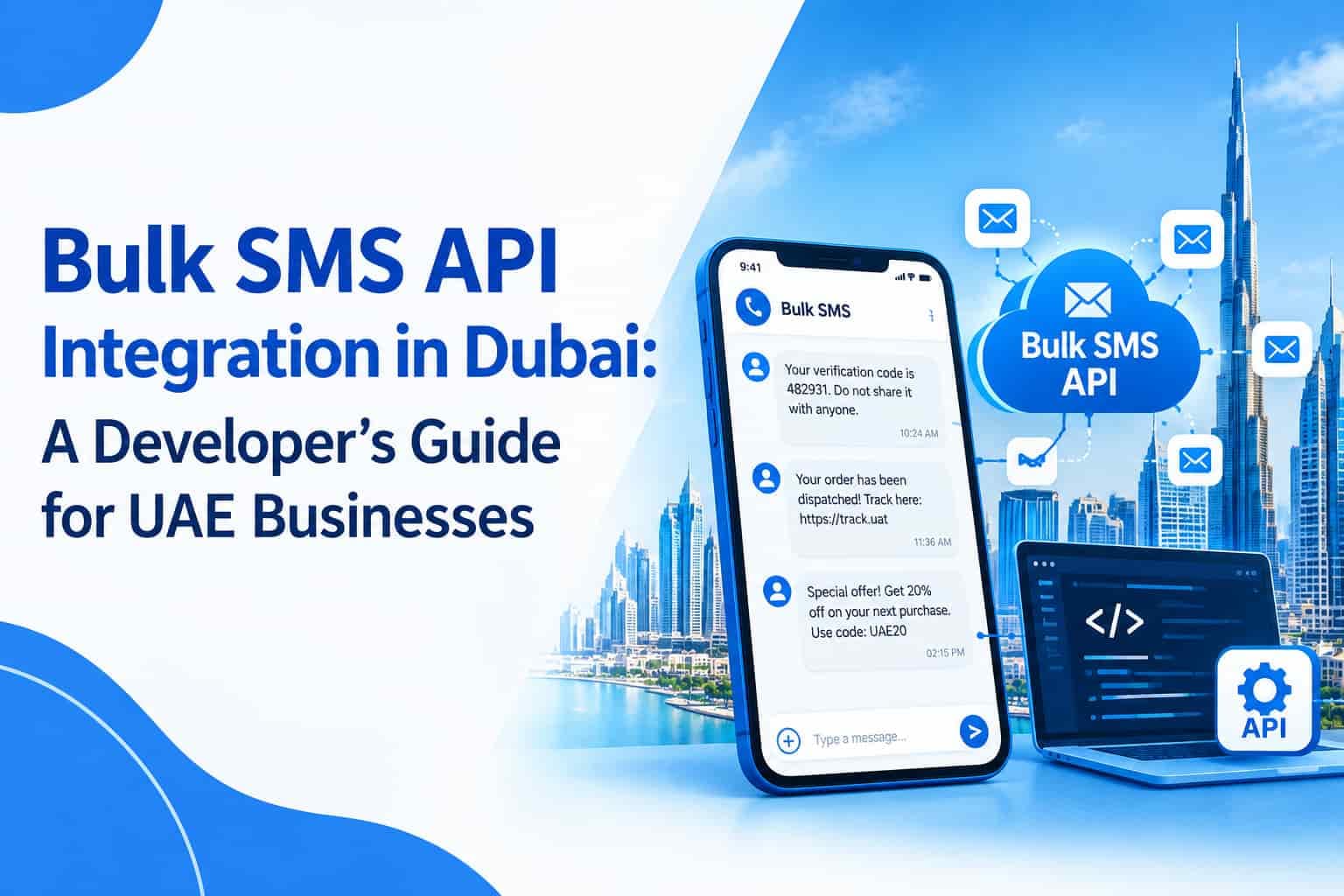
Most conversations about bulk SMS focus on the marketing dashboard — uploading a list, writing a promo, hitting send. But a growing share of UAE businesses never touch that dashboard at all. Their SMS runs entirely through code: an OTP fired the instant a user signs up, a delivery alert triggered the moment an order status changes, a booking confirmation sent automatically from a reservation system. That's bulk SMS API integration, and in 2026 it's become the backbone of how UAE platforms — fintech apps, e-commerce sites, delivery services, healthcare portals — communicate with customers in real time.
This guide is written for the people who'll actually do the integration: developers, technical founders, and product teams evaluating an SMS API for a UAE-based platform. It covers how SMS APIs work, what to check before choosing one, the technical and compliance details specific to the UAE, and common integration mistakes worth avoiding.
What Is a Bulk SMS API, and How Is It Different From the Dashboard?
A bulk SMS API is a programmatic interface — usually REST-based — that lets an application send text messages directly from its own codebase, without a human opening a web dashboard. Instead of uploading a spreadsheet of numbers, your application makes an HTTP request with the recipient number, message body, and sender ID, and the SMS gateway handles routing the message to the right carrier.
The dashboard and the API usually sit on top of the same underlying gateway and sender ID registrations — the difference is who (or what) is triggering the send. Marketing teams use the dashboard for planned campaigns; engineering teams use the API for anything that needs to fire automatically based on an event in the product.
Common Integration Use Cases in the UAE
OTP and authentication: login verification, password resets, two-factor authentication for banking and fintech apps
Transactional alerts: order confirmations, payment receipts, delivery status changes, appointment confirmations
Workflow triggers: a booking system texting a customer the moment a slot is confirmed or cancelled
Alerting and monitoring: internal ops teams getting an SMS when a system threshold is breached or a shipment is delayed
CRM and marketing automation: a CRM platform (like Salesforce or HubSpot) triggering a follow-up SMS based on a lead's behavior
How the Integration Actually Works
1. Authentication
Most SMS APIs authenticate requests using an API key or token tied to your account, sent as a header on every request. Keep this key server-side only — never embed it in a mobile app or front-end JavaScript, where it can be extracted and abused.
2. Sending a Message
A typical send request includes the destination number (in international format, e.g. +9715XXXXXXXX), the message text, and your registered sender ID. The API responds with a message ID you can use to track delivery status.
3. Delivery Reports (DLRs)
Delivery Receipts confirm whether a message actually reached the handset, was queued, or failed. Most providers offer this via a webhook — your server registers a callback URL, and the gateway posts a status update to it as the message moves through the carrier network. This is essential for anything transactional, like OTPs, where you need to know a code actually arrived.
4. Two-Way SMS (Inbound Messages)
Some use cases — customer support, STOP/opt-out handling, simple keyword-based workflows — require receiving replies, not just sending. This works the same way as DLRs: an inbound message triggers a webhook to your server, which your application then processes.
Sender ID Registration: The UAE-Specific Step
Unlike some markets where any sender name can be used freely, the UAE requires alphanumeric sender IDs to be registered and approved before use, in line with TDRA regulations. This is a one-time setup step per sender ID, not something handled per API call — but it needs to happen before a single message goes out under your brand name, so factor the approval timeline into your project schedule rather than assuming it's instant.
What to Evaluate When Choosing an SMS API Provider
Documentation quality. Clear, up-to-date API docs with code samples save real engineering time — vague or outdated docs are a strong signal of what support will be like post-launch.
Delivery reporting reliability. If DLR webhooks are inconsistent or delayed, OTP flows and transactional alerts become unreliable, which directly affects user trust in your product.
Local carrier routes. Direct connections to Etisalat (e&) and du typically mean faster, more reliable delivery than providers routing through international aggregators.
Rate limits and throughput. Check how many messages per second the API supports — this matters if your platform sends OTPs at high volume during peak sign-up periods.
SDKs and libraries. Official SDKs for your stack (Node.js, PHP, Python, Java) reduce integration time versus building raw HTTP requests from scratch.
Uptime and redundancy. For OTP and transactional flows, downtime isn't a minor inconvenience — it can block users from logging in or completing a purchase entirely.
Support responsiveness. When a delivery issue happens in production, how quickly can you reach a human who understands the UAE carrier landscape?
Common Integration Mistakes to Avoid
Skipping delivery status handling. Firing a send request and assuming success without checking the DLR leaves you blind when messages silently fail.
Hardcoding sender IDs without fallback logic. If a sender ID isn't approved for a particular route, having a fallback (or at least clear error handling) prevents silent failures.
Not rate-limiting OTP requests. Without throttling, an SMS OTP endpoint can be abused to run up costs or spam a number — always pair OTP sending with request rate limits per phone number.
Storing API keys client-side. This is a security basics issue, but it still happens — SMS sending must be triggered from your backend, never directly from a mobile or web client.
Ignoring number formatting. Inconsistent phone number formats (missing country codes, local formats mixed with international ones) are one of the most common causes of failed deliveries during initial integration.
Compliance Considerations for API-Triggered Messages
Even when SMS is sent automatically rather than manually, TDRA's rules around consent and identification still apply. Transactional messages like OTPs are generally treated differently from promotional ones, but if your platform also uses the same API for marketing sends — cart abandonment reminders, promotional nudges — those messages still require proper consent and opt-out handling, just like a manual campaign would.
Frequently Asked Questions
How long does sender ID approval take in the UAE?
Timelines vary by provider and how complete the submitted business documentation is, so it's worth confirming an estimated turnaround with your provider before locking in a launch date.
Can I use the same API for OTPs and marketing messages?
Yes, most SMS APIs handle both, but it's good practice to use separate sender IDs or message categories for transactional versus promotional sends, both for compliance clarity and for keeping delivery priority high on time-sensitive OTPs.
What happens if an SMS fails to deliver?
A properly configured DLR webhook will report the failure, typically with a reason code. Applications handling OTPs should have a retry or fallback flow (such as a voice call OTP) for cases where SMS delivery fails.
Do I need a UAE-based server to integrate with a UAE SMS API?
No — most SMS APIs are accessed over standard HTTPS from anywhere, so your backend can be hosted in the UAE or elsewhere, as long as it can reach the API endpoint and receive webhook callbacks.
Conclusion
Bulk SMS API integration turns SMS from a manual marketing tool into an automated, event-driven part of a product — powering OTPs, order updates, and alerts that fire the instant something happens, with no human in the loop. Getting it right in the UAE means paying attention to a few local specifics: registered sender IDs, reliable delivery reporting, and TDRA-aligned consent handling for anything promotional. OMTEL provides a documented SMS API with local carrier routes across the UAE, built for developers integrating OTP, transactional, and marketing SMS into their platforms — reach out to see how the integration fits your stack.