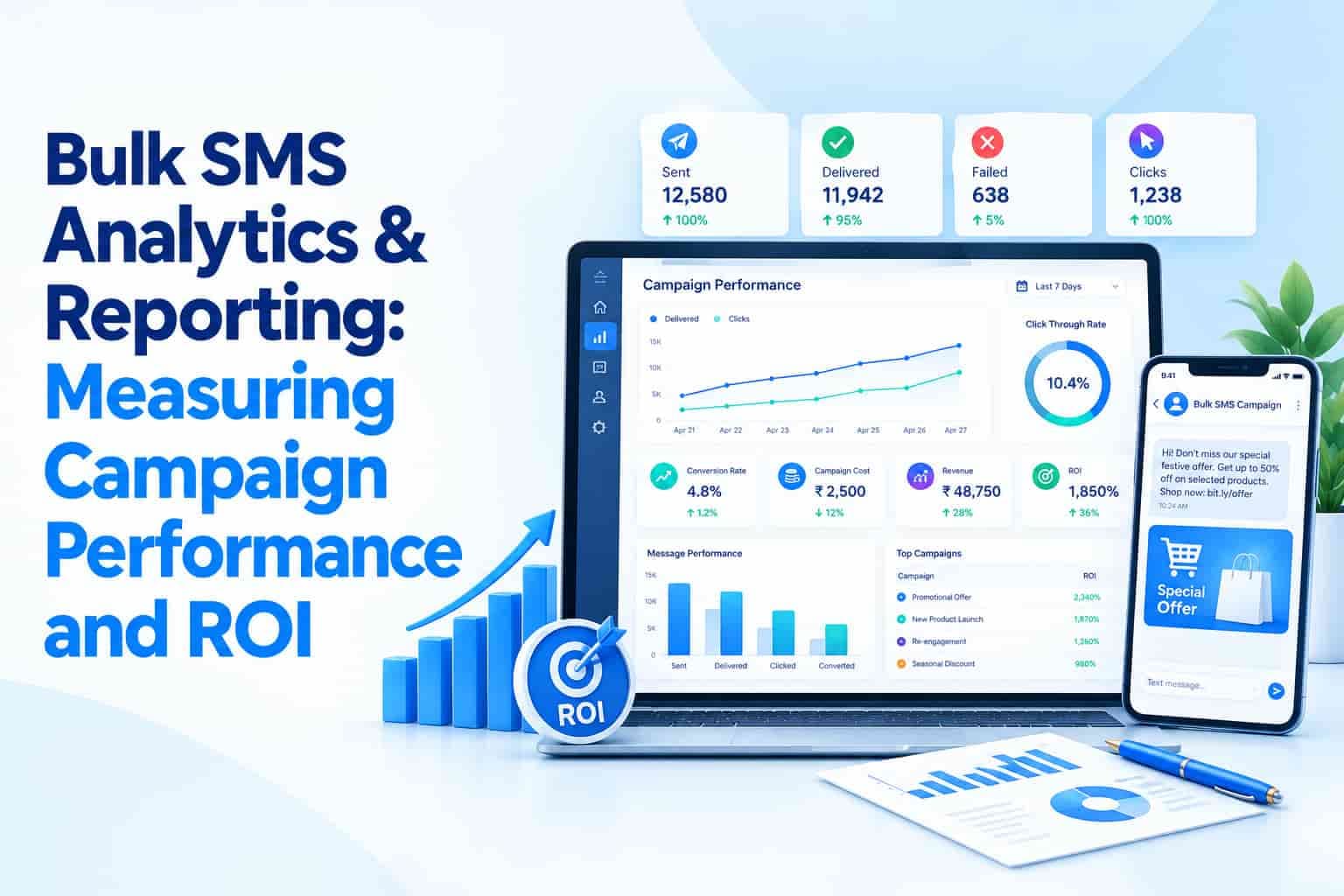
Sending a Bulk SMS campaign is the easy part. Knowing whether it actually worked — and why — is where most businesses fall short. Without the right analytics in place, it's impossible to tell if a campaign underperformed because of poor timing, weak copy, bad targeting, or simply a technical delivery issue.
Why Bulk SMS Analytics Matter
Unlike email, SMS has no open-tracking pixel, which means measuring engagement requires a slightly different toolkit built around delivery reports, link clicks, and reply tracking rather than traditional open rates.
Core Metrics Every Campaign Should Track
Delivery rate
The percentage of sent messages that were confirmed delivered to the handset. This is the foundational metric — if delivery rate is low, every metric downstream of it becomes meaningless.
Click-through rate (CTR)
For campaigns including a shortened link, CTR reveals how many recipients engaged with the message content, using a trackable short URL rather than the raw destination link.
Reply rate
For two-way campaigns (reply YES to confirm, reply STOP to opt out), reply rate shows how many recipients actively interacted rather than passively receiving the message.
Conversion rate
The percentage of recipients who completed the intended action — a purchase, a booking, a form submission — attributable back to the specific Bulk SMS campaign, usually tracked via UTM parameters or unique promo codes.
Opt-out rate
A rising opt-out rate is an early warning signal that message frequency, relevance, or timing needs adjustment before it damages sender reputation further.
Building a Reporting Framework
Step 1: Tag every campaign with a unique identifier
Use a consistent campaign ID or UTM tag across every message batch so performance can be filtered and compared across time periods and audience segments.
Step 2: Combine delivery data with business outcome data
Connect your Bulk SMS provider's delivery and click reports with your own sales or booking data to calculate true conversion rate and revenue attribution, not just engagement proxies.
Step 3: Segment performance by audience group
Compare delivery and conversion rates across customer segments (new vs. returning, high-value vs. low-value) to identify which groups respond best to SMS outreach.
Step 4: Review trends over time, not single campaigns
A single campaign's numbers can be misleading; tracking delivery rate, CTR, and conversion trends over multiple campaigns reveals whether performance is genuinely improving or declining.
Calculating Bulk SMS ROI
ROI = (Revenue attributed to campaign - Total campaign cost) / Total campaign cost × 100
Total campaign cost should include the per-message sending cost plus any platform fees, while attributed revenue should only count conversions that can reasonably be traced back to that specific campaign via tracking links or promo codes.
Common Reporting Mistakes to Avoid
Judging success by delivery rate alone: High delivery with low CTR or conversion still signals a messaging or offer problem.
Ignoring opt-out trends: A campaign with strong short-term conversion but rising opt-outs is trading long-term reach for short-term gain.
Not segmenting data: Aggregate numbers can mask the fact that one segment is driving all the results while another is actively disengaging.
FAQs
How is Bulk SMS click-through rate tracked without app installs?
By including a trackable shortened URL in the message, which routes through a link-tracking service before redirecting to the final destination, recording each click along the way.
What's a healthy CTR for a Bulk SMS campaign?
CTR varies significantly by industry and offer relevance, which is why comparing your own campaigns over time is generally more useful than benchmarking against a generic industry average.
Should reply rate be tracked for every campaign?
Only for campaigns that explicitly invite a reply (confirmations, opt-in/opt-out, simple surveys) — one-way informational messages won't generate meaningful reply data.
Conclusion
Treating Bulk SMS as a measurable channel — not just a broadcast tool — is what separates businesses that steadily improve their messaging performance from those that keep guessing. By tracking delivery rate, CTR, reply rate, conversion, and opt-outs together, and reviewing trends over time rather than isolated campaigns, businesses can make confident, data-backed decisions about what to send, to whom, and when.