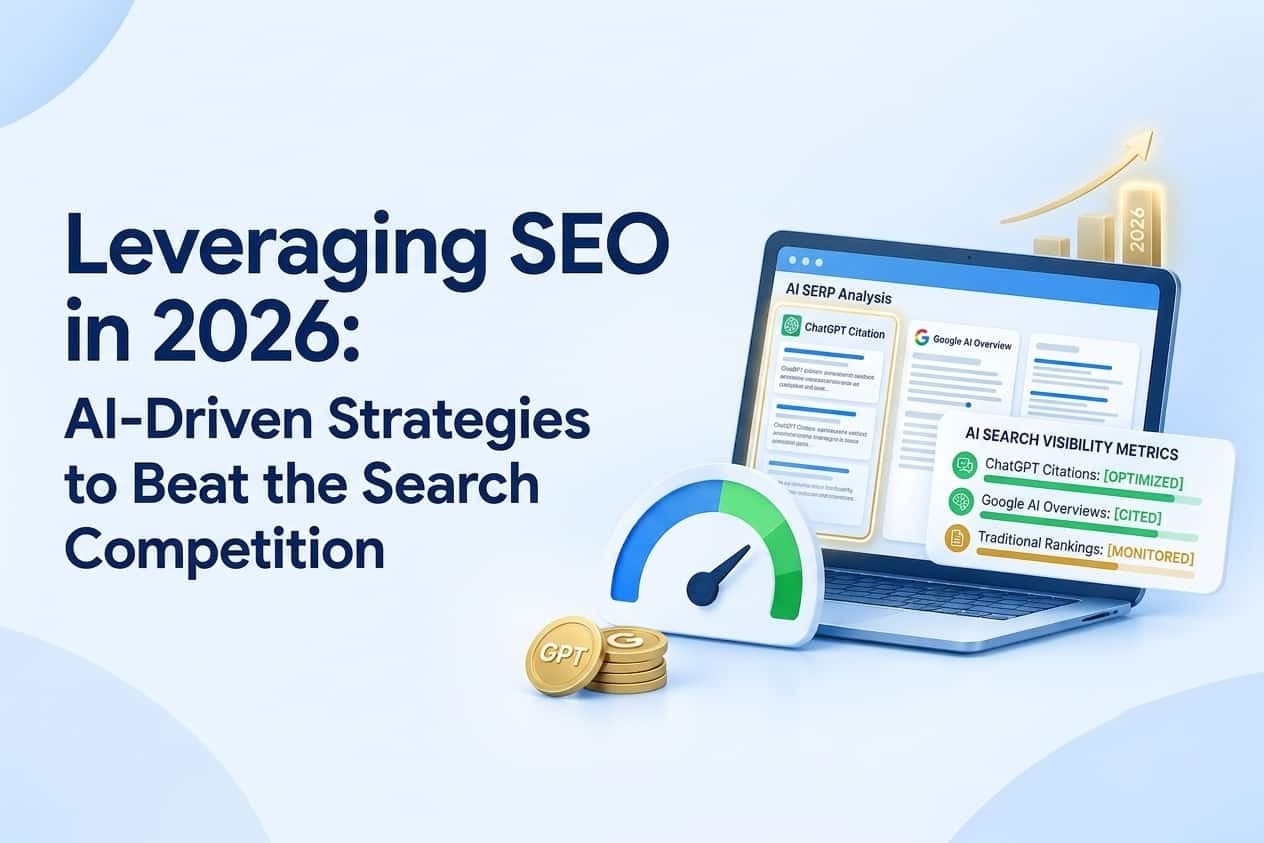
Search behavior in Dubai is changing faster than most marketing teams have adjusted for. Customers who used to type a query into Google and click through to a website are now getting their answer directly inside an AI-generated summary — or asking ChatGPT, Perplexity, or Google's AI Mode the question instead of opening a search engine at all. For UAE businesses, this shift raises an uncomfortable question: what happens to your visibility when the "search result" is a paragraph written by an AI, with no guarantee your business is even mentioned in it?
This is the problem Generative Engine Optimization (GEO), sometimes called Answer Engine Optimization (AEO), exists to solve. It is not a replacement for SEO — it is what happens after your SEO gets you noticed by machines that summarize rather than list. This guide breaks down what GEO actually means, why it matters for Dubai and UAE businesses specifically, and the concrete steps you can take in 2026 to get cited instead of skipped.
What Is GEO (Generative Engine Optimization) and Why It Matters Now
Traditional SEO is a ranking competition: you optimize a page so it appears higher than competitors' pages on a results list, and the user decides which blue link to click. GEO is a different game entirely. AI systems like ChatGPT, Google's AI Overviews, and Perplexity don't return ten links — they generate a single synthesized answer, and they either cite your business as a source within that answer or they don't. There is no "page two." You are either part of the answer, or you are invisible.
This distinction matters because the traffic pattern behind it has already shifted. According to SparkToro's 2026 analysis of Similarweb data, 68.01% of Google searches in early 2026 ended without any click — up from 60.45% just two years earlier. Google's AI Overviews now appear on more than 20% of searches, and when they do, click-through rates to the underlying websites drop by nearly 60%. Google has also reported that its AI Mode has surpassed 1 billion monthly users, with query volume doubling every quarter. On the AI chatbot side, ChatGPT alone reported over 900 million weekly active users worldwide as of February 2026, tripling from roughly 300 million in December 2024.
For a Dubai business, this means a growing share of the customers researching "best digital marketing agency in Dubai" or "SEO cost UAE" may never see a traditional search results page. They will see — or hear — whatever ChatGPT or Google's AI decides to summarize. If your business isn't structured to be part of that summary, you don't just rank lower. You disappear from the conversation entirely.
How AI Search Is Different From Ranking on Google
It helps to think of GEO as solving a citation problem rather than a ranking problem. When an AI system answers a question, it pulls from content it considers factual, well-structured, and trustworthy enough to reference by name. Vague marketing language — "we are a leading digital marketing agency" — gives an AI model nothing concrete to cite. Specific, verifiable claims do.
This is also why GEO isn't a shortcut around SEO. Businesses that get cited consistently in AI answers are, in almost every case, businesses that already rank well organically and have a clean, credible presence across the web. GEO amplifies strong fundamentals; it doesn't replace them.
The 5 GEO Ranking Factors That Get UAE Businesses Cited
1. Factual Density and Specificity
AI systems reward content with concrete, checkable details over generic claims. Instead of "we help businesses grow online," a Dubai agency page that states "Google Partner and Meta Business Partner headquartered in Dubai Internet City, serving 120+ UAE clients since 2019" gives an AI model something specific enough to quote. Every service page, about page, and case study should replace vague adjectives with verifiable numbers, certifications, and locations.
2. Entity Consistency Across the Web
AI models cross-reference multiple sources before deciding whether to trust a business. If your company name, address, phone number, and description differ across your website, Google Business Profile, LinkedIn page, and industry directories, that inconsistency reduces confidence and citation likelihood. Dubai businesses should audit their name, trade license details, and address so they match exactly across every platform, in both English and Arabic where relevant.
3. Structured Data (Schema Markup)
Schema markup — Organization, LocalBusiness, FAQPage, and Product schema — turns your content into a format machines can parse directly rather than infer. A Dubai retail or service business that marks up its opening hours, service areas, pricing, and FAQs in schema gives AI crawlers a clean, structured dataset to pull from, rather than forcing them to interpret prose.
4. E-E-A-T Signals (Experience, Expertise, Authority, Trust)
The same signals Google has used for years to judge content quality carry directly into AI citation decisions: named authors with real credentials, case studies with outcomes, third-party mentions, and backlinks from authoritative regional sources such as Gulf News, Khaleej Times, or established UAE industry publications. A single credible mention from a recognized outlet can do more for AI visibility than dozens of low-quality directory listings.
5. Question-and-Answer Content Architecture
AI systems are, at their core, answering questions. Content structured explicitly around the questions your customers actually ask — as FAQ sections, "how to" guides, and direct-answer paragraphs near the top of a page — aligns naturally with how these models generate responses. A page that opens with a direct, quotable answer to "How much does SEO cost in Dubai?" is far more likely to be pulled into an AI summary than one that buries the answer three paragraphs down.
A Step-by-Step GEO Action Plan for Dubai Businesses
Audit entity consistency across your website, Google Business Profile, social platforms, and any UAE business directories your company is listed on.
Add schema markup to your homepage, service pages, and FAQ sections — Organization and LocalBusiness schema first, FAQPage schema next.
Rewrite vague claims into specific, checkable statements with real numbers, certifications, and dates wherever possible.
Build or expand a genuine FAQ section on key pages, answering the exact questions your sales team hears most often from UAE customers.
Pursue mentions from credible regional sources rather than volume-based link building — one Gulf News or Khaleej Times feature outweighs dozens of low-authority backlinks.
Claim and complete your Google Business Profile and Knowledge Panel with accurate categories, services, and UAE-specific details.
Monitor whether AI tools are citing you by regularly asking ChatGPT, Perplexity, and Google's AI Mode the questions your customers would ask, and tracking whether your business appears.
GEO vs Traditional SEO: Do You Need Both?
Factor | Traditional SEO | GEO / AEO |
|---|---|---|
Goal | Rank higher on a results page | Get cited inside a generated answer |
Competition model | Compete against other pages | Compete to be a trusted source |
Key inputs | Keywords, backlinks, page speed | Factual specificity, entity consistency, schema, E-E-A-T |
Output the user sees | A list of links | One synthesized answer, possibly with citations |
The two are not competing strategies — GEO builds directly on strong SEO, and businesses that neglect one will struggle at the other.
Common GEO Mistakes Dubai Businesses Make
The most frequent mistake is treating GEO as a one-time technical fix rather than an ongoing content discipline. Businesses add schema markup once and assume the job is done, while their entity information quietly drifts out of sync across new directory listings or a rebranded social profile. Another common error is writing FAQ content that is too promotional to be useful — an AI model will not cite a paragraph that reads like an advertisement. Finally, many businesses focus entirely on Google while ignoring that ChatGPT and Perplexity pull from a different, often narrower set of sources, meaning a business invisible to Google's AI Overviews could still be missing from ChatGPT's answers even after fixing on-page SEO.
How to Measure GEO Success
Because AI answers rarely generate a clickable referral the way search results do, measurement requires a slightly different approach. Track branded search volume growth (are more people searching your company name after encountering it in an AI answer?), monitor referral traffic from domains like chatgpt.com and perplexity.ai in your analytics, and periodically run manual checks — asking AI tools the exact questions a prospective UAE customer would ask and recording whether, and how accurately, your business is mentioned.
Frequently Asked Questions
Is GEO replacing SEO in the UAE?
No. GEO builds on the same foundation as SEO — credible content, technical health, and authority signals. Businesses that already rank well organically have a significant head start on being cited by AI systems.
How long does it take to see GEO results?
Because AI models refresh their training and retrieval sources on different timelines than Google's index, GEO improvements can take anywhere from a few weeks to a few months to show up in AI answers, depending on the platform and how frequently it crawls fresh content.
Do I need schema markup even if my website is small?
Yes. Schema markup is one of the lowest-cost, highest-impact GEO investments available, and it benefits businesses of any size by making existing content machine-readable rather than requiring new content to be written.
Which AI platforms matter most for a Dubai business?
Google's AI Overviews and AI Mode matter most simply because of Google's search volume in the UAE, but ChatGPT and Perplexity are increasingly used for research-heavy, high-intent queries such as choosing a service provider — exactly the kind of query that matters most commercially.
Conclusion
AI search is no longer an emerging trend for Dubai businesses to watch from a distance — it is already reshaping how a meaningful share of UAE customers find and choose the companies they work with. The businesses that adapt now, by making their content factually specific, structurally consistent, and genuinely useful to a question-answering system, will be the ones AI tools trust enough to cite. The ones that don't will keep showing up in Google's index while becoming steadily less visible in the conversations that actually influence buying decisions.
OMTEL helps Dubai and UAE businesses build search strategies that work across both traditional rankings and AI-generated answers — from technical SEO and schema implementation to content built around the real questions your customers are asking. If you want to know whether AI tools are currently citing your business at all, that's a conversation worth having before a competitor gets there first.