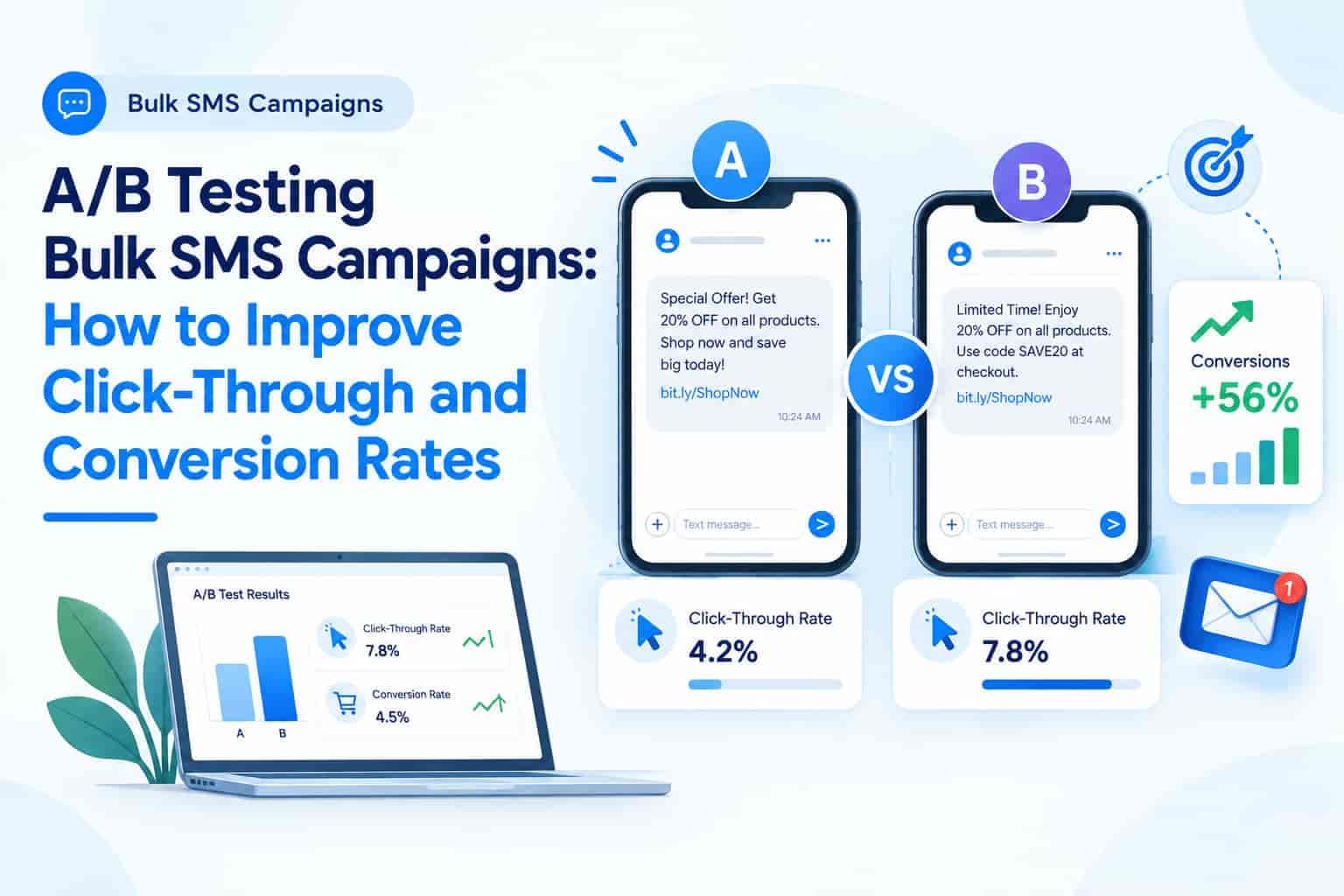
Why Guesswork Doesn't Scale in SMS Marketing
With only 160 characters to work with, every word in a bulk SMS matters more than it would in a longer format like email. Small changes in wording, offer framing, or call-to-action placement can meaningfully shift results. A/B testing removes the guesswork, letting data — not instinct — decide what your audience actually responds to, rather than relying on assumptions about what "should" work based on other channels.
What to Test in a Bulk SMS Campaign
Effective SMS testing focuses on a small number of high-impact variables at a time:
Message opening line: a question vs. a direct offer statement
Call-to-action wording: "Shop Now" vs. "Claim Your Discount"
Offer framing: percentage off vs. flat rupee discount
Send time: morning vs. evening delivery windows
Personalization: using the customer's name vs. a generic greeting
Urgency language: a hard deadline vs. an open-ended offer
Testing one variable at a time keeps results clean — changing the offer, the wording, and the send time simultaneously makes it impossible to know which change actually drove the difference in performance.
Running the Test and Reading the Results
Split your contact list randomly into two equal, statistically meaningful groups, send each version simultaneously to control for timing bias, and measure click-through rate and conversion rate rather than open rate alone — since SMS open rates are consistently high across almost every message and rarely reveal meaningful differences between variants.
Give the test enough volume to be statistically reliable; testing on a list of only 50 contacts per variant rarely produces a trustworthy signal, and any apparent "winner" from such a small sample may simply be noise. Once a clear winner emerges from a properly sized test, roll that version out to your full remaining list for that campaign to capture the performance lift at scale.
Common Mistakes That Undermine Test Results
A few pitfalls consistently distort A/B test results in SMS marketing. Sending the two variants at different times introduces timing as an uncontrolled variable, making it unclear whether the winning message actually won on content or simply landed at a better moment. Similarly, testing against audiences with meaningfully different characteristics — say, new versus loyal customers — can produce misleading results that don't generalize to your full list.
Running a test for too short a window is another common issue, particularly for offers with longer consideration periods; a variant that looks like it's losing after two hours may catch up by the end of the day once the full response window plays out.
Turning Test Results Into a Playbook
The real value of A/B testing comes from compounding what you learn across campaigns. Keep a simple log of what you tested and what won — over several campaigns, clear patterns emerge about what tone, offer structure, and timing consistently perform best for your specific audience, rather than needing to re-test the same basic questions every time you launch something new.
This accumulated knowledge eventually lets you skip testing on lower-stakes decisions and focus your testing budget on genuinely novel questions, like a new offer format or an unfamiliar audience segment.
Conclusion
A/B testing turns bulk SMS marketing from a guessing game into a repeatable, improving system. By testing one variable at a time, measuring click-through and conversion rather than just opens, avoiding common pitfalls like timing bias, and logging results across campaigns, businesses can steadily raise their SMS performance without needing a larger budget or bigger contact list. Over time, these small, data-backed improvements compound into significantly better campaign ROI.